
At the start of the new month we revisit that favourite topic of ours at the moment - how high can the pound’s recovery against the Greenback extend?
Sterling and the dollar are currently being pulled in opposite directions allowing the UK currency to record gains against the greenback for a third week in a row.
In fact the pound rose by an impressive 1.56% against the US dollar in April.
A similar strong performance against the euro was noted but regular readers will be aware that we have been warning the the British pound’s good run could well be about to reach a limit.
We still believe that those who are issuing warnings on sterling’s limits should be listened to. In fact, the pound to euro exchange rate has been in decline for a few days now.
Is the GBP/EUR turning south again or are we witnessing a ‘timeout’ as suggested by strategists at both ING and Societe Generale?
While the pound-euro is hard to call, against the US dollar we are more confident in agreeing with those analysts who suggest the GBP/USD exchange rate still has further to climb.
“The chart shows that this positive price action has lifted it through February’s intermediate peak, at 1.46 or so, and to its highest closing level since January – and there is still little in the way of compelling technical evidence to suggest that this push to the upside is about to come to an end,” says technical strategist Bill McNamara at brokers Charles Stanley in London.
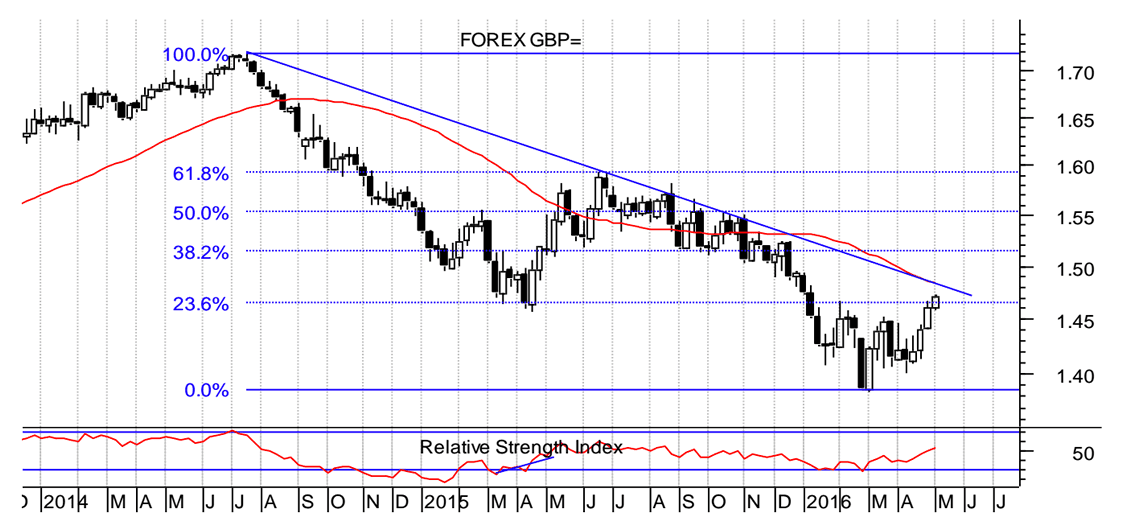
That said, McNamara is conscious that downtrend resistance is possible at 1.48 or so, and it is worth noting that the 40-week moving average is also at that level.
Pound’s Climb Defies the Data, US Dollar Worse Off Though
The move higher in the British pound exchange rate complex comes in spite of some worrying data points being released that suggest the UK economy is seeing its previously GBP-supportive growth stall.
Of particular concern is the manufacturing sector - on Tuesday Markit and the CIPS reported their Manufacturing PMI series read at below 50 for the first time since 2013.
A reading below 50 suggests the sector is shrinking.
Despite the news the pound managed to advance further against the US dollar confirming markets remain more concerned by the slowing rate of economic expansion in the United States.
“Cable extended gains above the 1.47 mark for the first time in a month as traders continue unwinding their Brexit-short positions. Despite the knee-jerk sell-off on soft PMI read, the broad-based weakness in the USD keeps the door open for a further appreciation toward the 1.50 mark,” says Ipek Ozkardeskaya at London Capital Group.
Latest Pound / US Dollar Exchange Rates
  | Live: 1.335▲ + 0.35%12 Month Best:1.3867 |
*Your Bank's Retail Rate
| 1.2896 - 1.295 |
**Independent Specialist | 1.3163 - 1.3217 Find out why this is a better rate |
* Bank rates according to latest IMTI data.
** RationalFX dealing desk quotation.
It would appear that, from a fundamental perspective, the dominant driver in sterling-dollar at present is a lack of confidence in the dollar.
“The combination of weak economic data and a dovish Fed is taking its toll on the dollar,” says McNamara, and price action in the US dollar index (a basket of USD pairs that measures overall strength) of the last few sessions has taken the index back to the bottom of its recent range.
In fact, the dollar is seen trading around its lowest closing level in almost sixteen months.
The US Federal Open Market Committee made only minor changes to its policy statement last week, leaving its forward guidance on rates unchanged.
The statement signalled a reduction in concerns over the external environment but acknowledged that, overall, activity and household spending appear to have moderated.
“In our view, the Fed’s steady policy, even as the risk environment and inflation expectations improve, leaves the USD vulnerable versus the funding currencies,” says Charlotta Pühringer at BNP Paribas in London.
The pound sterling is not considered a funding currency to the extent that the euro is, owing to the UK’s higher interest rates, however strength in EUR/USD could well play positively on GBP/USD.
Indeed, BNP Paribas confirm they remain long EURUSD targeting a move to 1.16.
This could well aid GBP/USD to test the magical 1.50 mark.
“Even if immediate Sterling strength ultimately proves corrective further gains appear likely in coming sessions. Some resistance will probably emerge around 1.4750 but looking ahead an extension nearer to 1.5000 is achievable before strong resistance is encountered again,” says Lucy Lillicrap, a risk manager at Associated Foreign Exchange.
Dips beforehand have support at 1.4400 initially and Lillicrap believes only a sell-off back through secondary demand at 1.4150 as well would trigger another direct attack on 1.3850.
That said, prices would need to hurdle 1.5925 to fully negate the long term bearish argument here warns the AFEX analyst.
Remain in the Lead, But is it Brexit Fear Really Over?
The other significant driver behind the GBP to USD conversion’s strength is the growing consensus that the UK will vote to remain in Europe on the 23rd of January.
Polling results vary considerably but the latest polls suggest an average lead of around 3 percentage points for those who want to remain in the EU.
“This is enough for bookmakers to estimate the probability of Brexit at only 30%, which is roughly where we would put it,” says Dr. Ralph Solveen at Commerzbank, “however, the referendum outcome is by no means a foregone conclusion.”
Solveen notes the gap with EU ‘outers’ is significantly smaller than the percentage of those who are undecided, and the polls failed to predict the result of the last general election with much accuracy.
Commerzbank have reminded clients at the start of the new month that Brexit would not only put further pressure on sterling, which would suffer from uncertainty about Britain’s future access to the single market, and also from concerns about the long-term financing of Britain's high current account deficit (which last year stood at 5.2% of GDP).
However, the euro would probably also fall against many other currencies. Since Brexit would further intensify and highlight the problems facing the single currency, it would hardly be a safe haven for many investors.
In particular the Swiss franc, as the safe haven 'par excellence', would appreciate considerably against the euro.