Signs that the GBP to NZD conversion is settling down after weeks of hefty losses confirm our predictions that the worst has come to pass for the pair.
The New Zealand Dollar was one of the best performing currencies in the G10 complex on Tuesday after the Reserve Bank of New Zealand's governor Wheeler suggested he was in no hurry to cut interest rates.
New Zealand commands the highest basic interest rates in the G10, therefore it is a target for investors desperate for yield. This has in turn ensured the NZD has remained uncomfortably strong.
Therefore, it came as a surprise to some that Wheeler did not try to talk the currency down by threatening further rate cuts.
"We do not believe that the outlook and balance of risks warrants a position of no policy change, nor a position of rapid easings,” Wheeler wrote in a speech delivered to the Otago Chamer of Commerce by Assistant Governor John McDermott.
“Rapid ongoing decreases in interest rates would likely result in an unsustainable surge in growth, capacity bottlenecks, and further inflame an already seriously overheating property market,” noted Wheeler.
Further NZ rate cuts in 2016 now look unlikely.
“This should put thoughts of 50 basis point cuts to bed, and at the margin, suggests the hurdle to a September cut is high,” says a note from ANZ in response.
The New Zealand Dollar was higher across the board.
Yet, Sterling is seen trading at 1.7970 against the New Zealand Dollar at the time of writing - the pair has actually traded a remarkably tight range since the 10th of August with a floor at 1.77 at the bottom and a ceiling emerging at 1.81.
Nevertheless, GBP/NZD remains about 12% lower than where it traded on the eve of Brexit.
The forming of a tight range with a floor at 1.77 is therefore good news for those who are looking to buy NZD with their GBP over coming days as it suggests a more robust Pound.
We have noted that in general the UK currency is correcting higher from undervalued levels and there are growing signs the down-trend may be finding a short-term bottom.
However, we have not seen enough strength to call a reversal and recovery yet.
The move down from the May highs in GBP/NZD contains some of the hallmarks of a complete Elliot Wave sequence after unfolding five component waves, a further sign the pair may be basing and ready for correction:
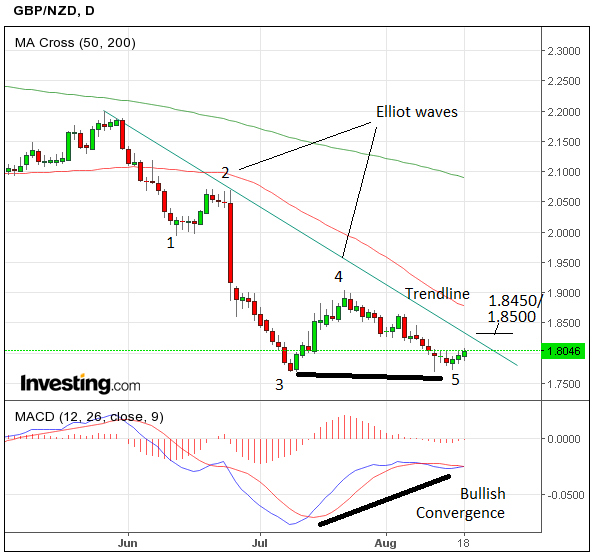
There is a wide bullish convergence between MACD and price at the July and August lows.
There have been three up days in a row since the August 11 lows, another indicator of reversal.
The surest sign a reversal was occurring would be to see the exchange rate break above the trend-line for the move down (turquoise line).
A further break above the monthly pivot at the 1.8371 level, confirmed by a move above 1.8450, would probably lead to a continuation higher to the next target at 1.8600.
Until the exchange rate has moved above the trend-line, however, the down-trend is still dominant and could press lower.
As such a break below the S1 monthly pivot - a level watched by traders as a place where the exchange rate can bounce or stall – which would be confirmed by a move below 1.7640, would probably activate the next target down at 1.7500.
Latest Pound / New Zealand Dollar Exchange Rates
  | Live: 2.3468▼ -0.47%12 Month Best:2.4815 |
*Your Bank's Retail Rate
| 2.267 - 2.2763 |
**Independent Specialist | 2.3139 - 2.3233 Find out why this is a better rate |
* Bank rates according to latest IMTI data.
** RationalFX dealing desk quotation.
New Zealand Dollar Weakness to be Limited by Interest Rate Advantage
Given the still relatively high interest rates in New Zealand of 2.0% compared to the rest of the G10 the New Zealand Dollar should continue to enjoy strong carry trade flows from investors attracted to its high yielding bonds.
Meanwhile, in the UK the Bank of England is on an easing path which has put even more pressure on interest rates and this is likely to exacerbate the difference between New Zealand and UK yield resulting a net flow of capital from the UK into NZ.
Ultimately this is one factor which will place the GBP/NZD pair under continued pressure for the foreseeable future.
In a recent research note Morgan Stanley expected an even greater increase in flows to higher yielding currencies, as a result of the Federal Reserve to remaining on the side-lines in the near term.
“However, our base scenario suggests the FED staying on the side line. The minutes underlining the importance of the inflation outlook provides some assurance suggesting US real rates staying low lending support for the global carry trade. High yielding FX should stay in demand.”
Janet Yellen’s Jackson Hole speech on Friday, may be constructive on this issue, and impact on the kiwi.
Head of research and Morgan Stanley, Hans Redeker said of the New Zealand dollar:
“We believe further rate cuts are likely and the the Reserve Bank of New Zealand will eventually act more forcefully against NZD. But with the next monetary policy meeting not until November, it will take time for this narrative to play out.”
Data for the New Zealand Dollar in the Week Ahead
The main data release for the kiwi is the Trade Balance on Tuesday, which has been positive for most of the year.
Economists are forecasting the monthly trade balance to read at -350M and the annual figure to read at -2980M.
UK Data
For the pound, the week kicks off with the Consortium of British Industry (CBI) Order Book Balance in August (also on Tuesday).
This will be the first data for August, so may gain extra attention due its significance in assessing the impact of Brexit.
The July result was -4, which was better than the -6 expected, and was at about the level of the long-run average.
Wednesday sees the release of British Banking Association (BBA) Mortgage Approvals data, which is of limited import to sterling.
There is more significant data out on Friday, however, including Q2 Business Investment (qoq), and then the final estimate of Q2 (qoq) GDP growth data.
The preliminary figure was 0.6% and the consensus estimate for the revised figure is expected to remain at 0.6% qoq (2.2% yoy).
The data, however, does not reflect the impact of Brexit which occurred right at the end pf the period.