Although the Pound to New Zealand Dollar exchange rate weakened after the Bank of England’s stimulus announcement our studies show the pair's outlook to be evenly balanced.

GBP/NZD came under heavy selling pressure following the Bank of England's (BoE) decision to cut interest rates and introduce 70bn more of quantitative easing.
Market analysts were surprised by just how assertive the Bank proved to be and believe that Mark Carney and his team have proven they are not willing to stand aside while UK economic growth slows.
Indeed, the Bank believes their measures will stave off recession with the worst projections anticipating growth of 0.8% in 2017 ahead of a stronger recovery.
The move by the Bank, "adds to the global super low interest rate complex and should continue to support demand for higher yielding assets. That implies ongoing GBP underperformance against the AUD, NZD and Asian currencies," says Brian Martin, a technical strategist with ANZ Bank.
In the lead up to the Thursday 4th event, it was the New Zealand Dollar which was struggling.
Look at the weekly chart of GBP/NZD below, for example, it is showing a down-trend was punctuated by a clear two bar reversal in July, which was followed by some upside activity as Sterling strengthened:
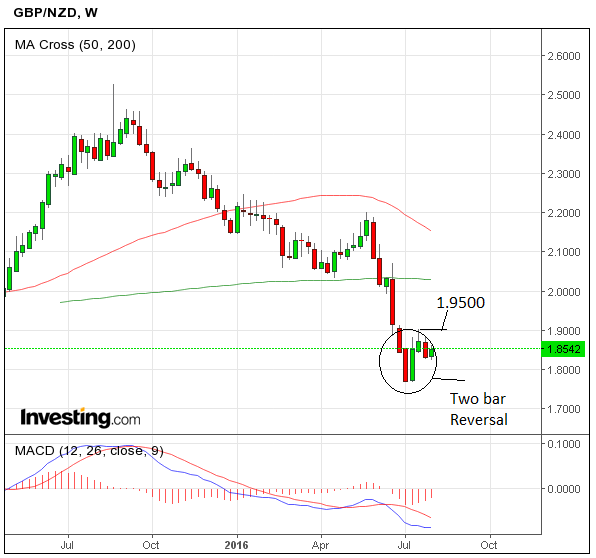
Two-bar reversals are relatively reliable signs that a new trend is beginning - which in this case was up for sterling and down for the kiwi.
The forecast based on this chart is for an extension of this embryonic up-trend at the break of the 1.9000 highs, with 1.9500 as an initial target:
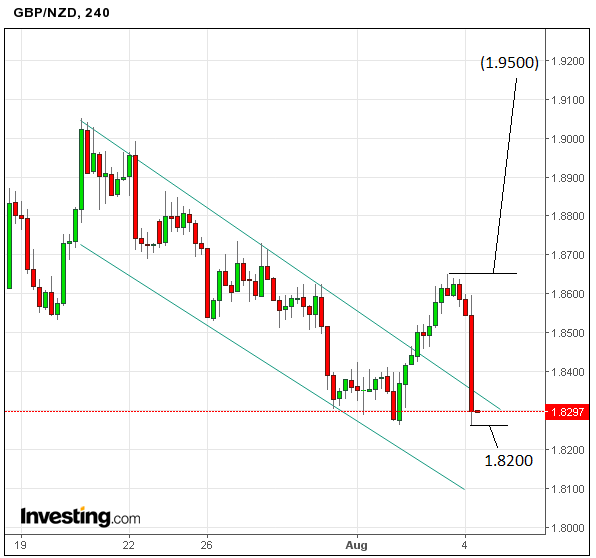
On the four-hour chart the pair has retraced almost all the recent gains, and a break below the 1.8250 level would probably lead to a move down to 1.8200, however the chart is so chaotic, the very short-term trend is not at all clear.
From a fundamental perspective, the main event on the horizon is the Reserve Bank of New Zealand (RBNZ) August 8 meeting, which analysts currently expect to be the moment for the central bank to cut interest rates again (the last time was in March).
Whilst much of the expectation has already been baked into the price, and reflects the bottom reversal pattern on the weekly chart, the actual event is also still nevertheless expected to lead to a further sell-off in the kiwi as well (and therefore upside for the GBP/NZD).
The RBNZ recently ordered an ‘unscheduled economic assessment’, which was seen as paving the way for an interest rate cut, as the bank would not have requested one had economic conditions been evolving as expected.
New macro-prudential rules, increasing the minimum deposit required for purchasing a property for investment purposes, was also seen as a move to cool the overheating housing market, preparing the way for an interest rate cut and the inevitable knock-on effect of such a move of stimulating mortgage lending yet more.
Latest Pound / New Zealand Dollar Exchange Rates
  | Live: 2.3474▲ + 0.03%12 Month Best:2.4815 |
*Your Bank's Retail Rate
| 2.2676 - 2.277 |
**Independent Specialist | 2.3145 - 2.3239 Find out why this is a better rate |
* Bank rates according to latest IMTI data.
** RationalFX dealing desk quotation.
Credit Suisse’s head of research Shahib Jalinoos, for example, points out that - even more so than Australia New Zealand’s rising house prices are a major factor in preventing the RBNZ from cutting interest rates, as the housing boom has been meteoric.
CICB market’s Jeremy Stretch, sees the 0.25% cut (from 2.25% to 2.00%) as now fully priced in to the kiwi, however, he thinks the potential for volatility now comes from expectations of whether the RBNZ will cut again in November or not, currently a 50/50 possibility.
“While a rate move from the RBNZ next week is now fully priced it’s the prospects for additional stimulus in November that matters, at this juncture the market continues to price in a near 50:50 chance of another cut prior to year end. We would expect that investors will increasingly look for additional stimulus as recent NZD gains are set to constrain inflationary pressures. Look for the RBNZ to maintain dovish tendencies, opening up a test of recent double-bottom lows at around 0.6950/60 in upcoming sessions.”