The GBP/NZD is at a critical technical turning point, with a break below 1.8100 resuming the down-trend, but a break above the current highs continuing the up-trend

The pound to New Zealand Dollar exchange rate has now breached our intial target at the 1.8200 highs, surpassing them and rising up to new highs at 1.8373.
It has also completed an ABC correction (see chart below), which indicates the possibility that the down-trend could resume - and a break below 1.8100 - or the printing of three down-bars in a row - that would be the case, and we would probably see a continuation of the trend down to 1.8000, initially.
Likewise, given a break above the C wave highs at 1.8373 highs, would assert a new up-trend, with a fresh upside target at 1.8500.
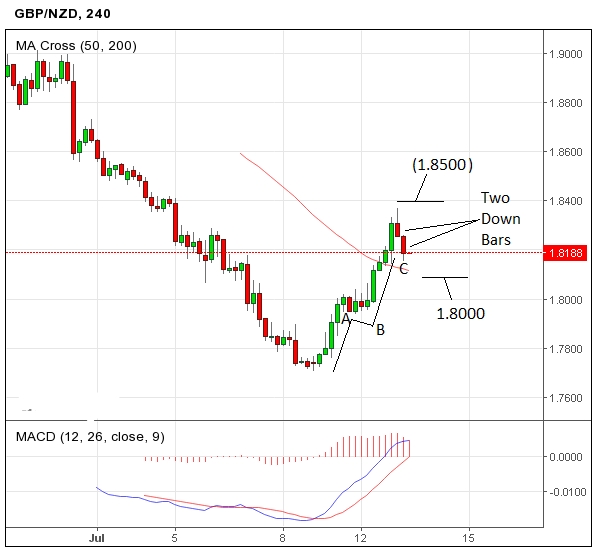
Longer-term the dominant down-trend remains intact and a break below the 1.7700 strata will lead to a continuation down to the 1.7000 round number eventually.
Such a move might gain confirmation from a break below 1.7500.
Latest Pound / New Zealand Dollar Exchange Rates
  | Live: 2.3468▼ -0.47%12 Month Best:2.4815 |
*Your Bank's Retail Rate
| 2.267 - 2.2763 |
**Independent Specialist | 2.3139 - 2.3233 Find out why this is a better rate |
* Bank rates according to latest IMTI data.
** RationalFX dealing desk quotation.
Will they, Won't They? The Big Debate on New Zealand's Interest Rate Path
Of more interest to traders will be a speech by Reserve Bank of New Zealand’s (RBNZ) Assistant Governor Dr. John McDermott to the Manawatu Chamber of Commerce.
McDermott will discuss how the Bank makes an OCR decision, and the constantly evolving process of forecasting.
The outlook for the New Zealand interest rate is a big deal; with a basic rate of 2.25% foreign money is rushing into New Zealand as yield-starved investors seek out better returns. This is in turn keeping the NZD at elevated levels; something the RBNZ believes is not helpful to the economy.
Should we receive notice that another rate cut is coming we could see the NZD take a dip.
With risk appetite returning to global financial markets now that the dust has settled following Brexit, there is a possibility that Mr McDermott may take a more optimistic line, revealing a reduction in the possibility of the RBNZ cutting interest rates.
This would lead to a rise in the kiwi against the pound all other things being equal, and a continuation of the current entrenched down-trend.
CIBC Global Market’s FX Analyst Jeremy Stretch said on the matter of RBNZ interest rate expectations that:
“Ahead of the Spencer speech the market was pricing in a near 65% probability of an August cut, but after the latest RBNZ rhetoric assumptions these have been pared to just 39%. Should McDermott extend rate re-pricing, it would point towards continued near term NZD outperformance, in particular versus the AUD."
New Zealand’s base interest rate is set by the RBNZ is currently at 2.25%. This is substantially higher than other G10 countries and therefore New Zealand attracts a lot of foreign investor capital, increasing demand for the currency, and therefore its value too.
The speech by RBNZ Deputy Governor Spencer last week, led to a rise in the kiwi after he said that macro-prudential measures to stem mortgage lending and limit house price inflation would not be implemented until the end of the year.
Macro-Prudential measures are those which place a limit on a specific area of the economy, which in the case is the housing boom in Auckland and now the rest of New Zealand. This has led to excessive valuations for houses and arguably a market 'bubble'.
The delay in introducing these measures assumed in Spencer's rhetoric, was interpreted by the market as reducing the likelihood of the RBNZ cutting interest rates, since house price inflation has been a major factor in preventing the RBNZ from cutting interest rates any lower, since such a move would exacerbate the bubble.
Bank of England Dominates GBP Outlook
The main event for sterling in the week ahead is the Bank of England (BOE) rate meeting on Thursday July 14.
Analysts are divided as to whether the BOE will decide to cut interest rates to help stimulate the economy following Brexit.
ING Bank’s Viraj Patel recently commented that according to market-based methods of estimating the likelihood, the probabilities are estimated at 64% that the BOE will cut interest rates by 25 basis points.
However, Patel also acknowledged that, ING’s economists were not in agreement with him and his team as they did not think there would be a cut, due to a lack of available econometric evidence since Brexit which only occurred at the end of June.
ING's economists expect the BOE to first see what the scale of the slow-down looks like before making a decision on interest rates.
This too seems a cogent argument for expecting the BOE to take a ‘wait-and-see’ approach.
CIBC’s Jeremy Stretch, however, thinks the BOE will cut rates by 0.25% based on Mark Carney’s speech on June 30 in which he emphatically suggested that the BOE would take action to stabilise markets:
“Ahead of Carney’s June 30 speech we assumed that the BoE would wait until their August meeting, in conjunction with updated macro-economic forecasts, prior to acting. However, with Carney keen to see the BoE step into the ongoing political vacuum, (note the UK Chancellor is now on a two week world tour to remind markets that the UK remains open for business) it seems more than likely that the BoE will sanction a 25bp cut this week, underlining Brexit related headwinds.”
The sieze up in three major 'open end' property funds, which normally allow invetsors to take out their money at will, but have since locked in funds, is an overall negative sign in the short-term.
Stretch also mentioned Carney’s testimony to the Treasury Select Committee on Tuesday July 12, to discuss the Financial Stability Report, as a key event to watch for insights into BOE thinking.
Sterling stronger after May wins leadership contest
The pound rallied after the immediate news that Theresa May will be next leader of the Conservative party, and therefore the next prime minister of the United Kingdom, as it reduces one of myriad sources of uncertainty.
The news came about after it was announced on Monday morning that her last remaining rival, Andrea Leadsom, was standing down.
Leadsom said she was standing down due to May's overwhelming support and because it was in the national interest to foster stability in the country.
The pound may also have gained a boost as it is not expected that May will take a hard line in any divorce negotiations with the EU, as she voted 'Remain' in the campaign, albeit only offering mild support.
This may also curry favour with EU diplomats as they will not see her as party to Brexit, and help Britain get a better deal, and could therefore be seen, on balance as improving the outlook for the economy.
May is also an experienced politician and seen as a capable 'pair of hands' by many.