The move lower in GBP/NZD could be about to accelerate should a key confirmation level be touched over coming days.

The British Pound found relief against the New Zealand dollar in mid-week trade having met a major technical support level which may deter sellers from pushing the rate even lower.
The consolidation at the 2.1900 area comes after days of declines with the rapid fall on Monday proving the rate is now also being subject to selling centred on the EU referendum due to be held in June.
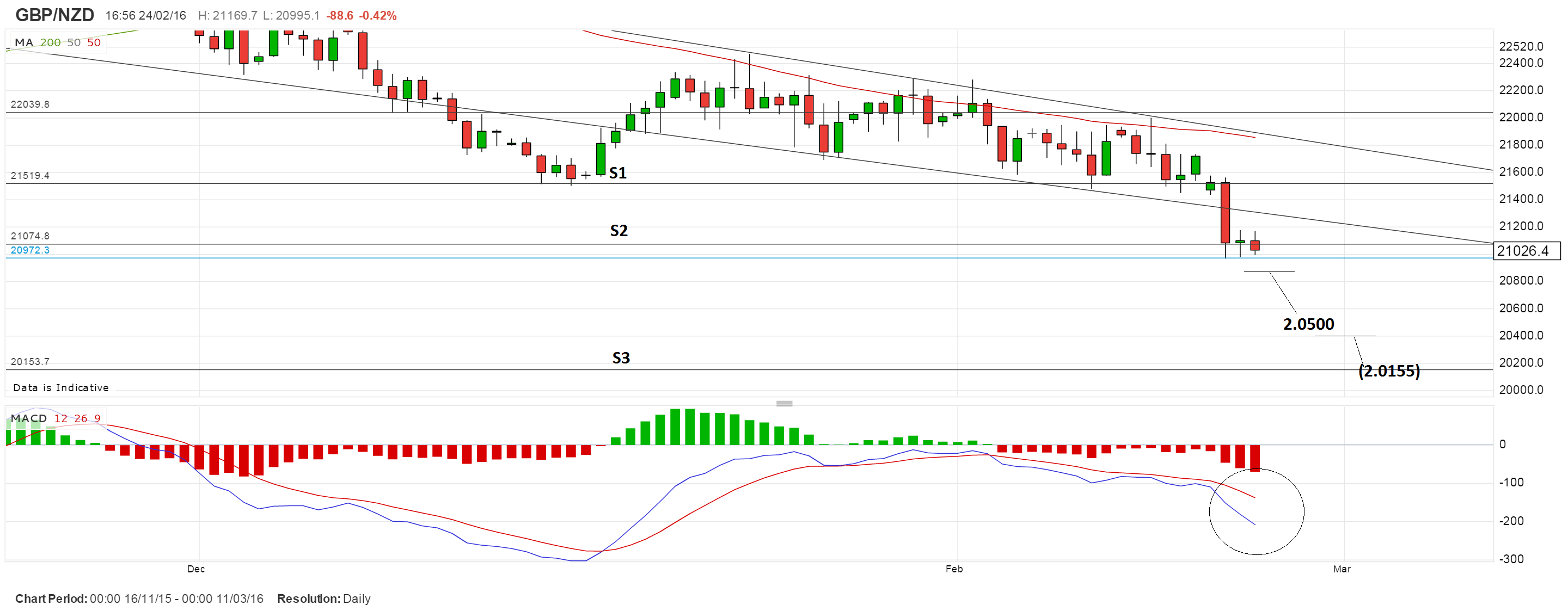
The support zone is composed of a historic support and resistance line (blue) at 2.0073 formed from the September 2014 and February 2015 highs, as well as the S2 Monthly Pivot at 2.1075.
These levels tend to halt moves in the market because they are favourite haunts for market speculators to place their buy and sell orders. Speculators know where other speculators are likely to congregate and this gives them the confidence to place their own exit and entry levels in a similar area.
The impact of this can be quite predictable - support areas hold the declines and resistance areas thwart further moves higher. When these areas fail a break-out occurs as failed bets accelerate the move.
The current down-move made lows at the blue S&R line and 2.0968 and Monday’s close was marginally above the level of the S2 Monthly Pivot at 2.1080, since then it has been going sideways.
Latest Pound / New Zealand Dollar Exchange Rates
  | Live: 2.3468▼ -0.47%12 Month Best:2.4815 |
*Your Bank's Retail Rate
| 2.267 - 2.2763 |
**Independent Specialist | 2.3139 - 2.3233 Find out why this is a better rate |
* Bank rates according to latest IMTI data.
** RationalFX dealing desk quotation.
More Declines Likely
Overall, the picture is very bearish, with the breakout from the descending channel marking a sudden acceleration in previously gentle sell-off.
If the pair manages to pierce below the S&R level at 2.0968, with a break below 2.0800 providing confirmation, I suspect the down-trend will gain new impetus and it will confidently move down to an initial target at 2.0500, followed perhaps by 2.0155 eventually.
With the UK referendum supplying most of the volatility for the pair, a break lower would require a material change in the probabilities of a Brexit in June, which could come from a change in the close run polls and a shearing away of the ‘out’ vote ahead; or potentially from the actual referendum result on June 23 - if it is for a Brexit.
It could be argued a substantial amount of the risk of a Brexit has been priced in; the fall on Monday was as a result of Boris Johnson joining the Eurosceptic camp and thus providing it with its most charismatic member so far.
Nevertheless, some analysts have been arguing that investors are underestimating the impact of Brexit on the U.K economy and sterling, and that there remains a substantial amount of risk still on the table:
“The economic and political costs of a Brexit are likely to dawn on investors as we approach the June vote, and that this could lead to a risk of sudden volatility," says a recent research note from ING Bank,
"As such, the pricing in of any Brexit risk premium could manifest itself swiftly and aggressively (while only fully showing up in the weeks or months leading up the vote).”
Rate Cut on the Cards
New Zealand fundamentals remain mixed, with continued pressures on Dairy prices and other commodities keeping a cap on inflation, but other areas of the economy such as employment showing signs of improvement.
Nevertheless, a rate cut from the Reserve Bank of New Zealand is considered highly likely, both to weaken the kiwi and to buffer disinflationary pressures:
“It’s a simple story really,” said one bank analyst who sees a cut as highly likely in coming months, “strong NZD keeping monetary conditions tight amidst falling NZ commodity prices and inflation expectations, and a lack of conviction that inflation will recover as the RBNZ expects.”
Such a move by the RBNZ might well signal a recovery in the pound, all other things remaining the same, and a possible bounce in the pair before the June referendum.