The strong arm of large speculators betting on interest rate differentials appears to be behind the recent surge in the NZ dollar following the ECB's January rate meeting.

Traders looking for "Carry" flocked to the kiwi on Thursday, pushing the currency higher as the outlook for global monetary conditions softened, following the ECB’s decision to earmark its March meeting to “reconsider and review” its monetary policy stance, with a view to possibly increasing stimulus.
What is the carry trade? This is an important concept for anyone seeking to understand how global currencies work. Essentially, money chases yield across the globe - yield is higher where interest rates are higher. Higher NZ interest rates have long attracted currency inflows, and likewise, when the RBNZ cuts interest rates that attraction declined.
With the Bank of England (BoE) not looking to increase UK interest rates until 2017 the relative benefit of borrowing in sterling and parking it in NZ assets has become more attractive once again, something that exerts downward pressure on the GBP to NZD rate.
This week BoE Governor Carney demolished hopes of an early rate hike during a speech at the start of the week and investors down-graded their expectations of how many rate hikes the Fed would undertake from four in 2016 to only two.
The New-Zealand dollar rose on the back of this change in global monetary policy outlook because it has relatively higher interest rates of 2.5% compared to the BOE (0.5%), ECB(0.05%) and Fed (0.25-5%).
Latest Pound / New Zealand Dollar Exchange Rates
  | Live: 2.3468▼ -0.47%12 Month Best:2.4815 |
*Your Bank's Retail Rate
| 2.267 - 2.2763 |
**Independent Specialist | 2.3139 - 2.3233 Find out why this is a better rate |
* Bank rates according to latest IMTI data.
** RationalFX dealing desk quotation.
When FX trader’s hold a position overnight they get paid or have to pay the difference between the interest rate of the currency they are buying and that of the one they have sold.
If they bought the Kiwi, for example, and sold the pound, they would gain the difference (2.5% – 0.5% ) or 2.0% (divided by 365) rollover rate on their position overnight.
This is how a popular form of trading called the carry-trade works, and it appears this was at the bottom of the surge in the kiwi on Thursday, especially because recent NZ data has been so poor, it cannot have been as a result of fundamentals.
CPI and Dairy Prices fall
At the beginning of the week the kiwi came under pressure after fundamental data showed inflation rapidly falling in New Zealand to its lowest rate since 1999 and then the global milk auction saw prices fall, once again by 1.4%, to an average price of $2,405.
Dairy products are New Zealand’s largest commodity export so any fall in the price is damaging to the economy and likely to weigh on the kiwi.
According to Farmers’ Weekly, recent research has shown that world milk output is running well above recent averages and is expected to rise a further 1.0% in 2016.
This could well indicate further pressure to come on Dairy prices in the future.
The technical outlook for the US to New Zealand dollar seems to indicate a lessening of downside overall for the kiwi, although it is too early to suggest its down-trend has reversed, so overall the probabilities still favour more weakness.
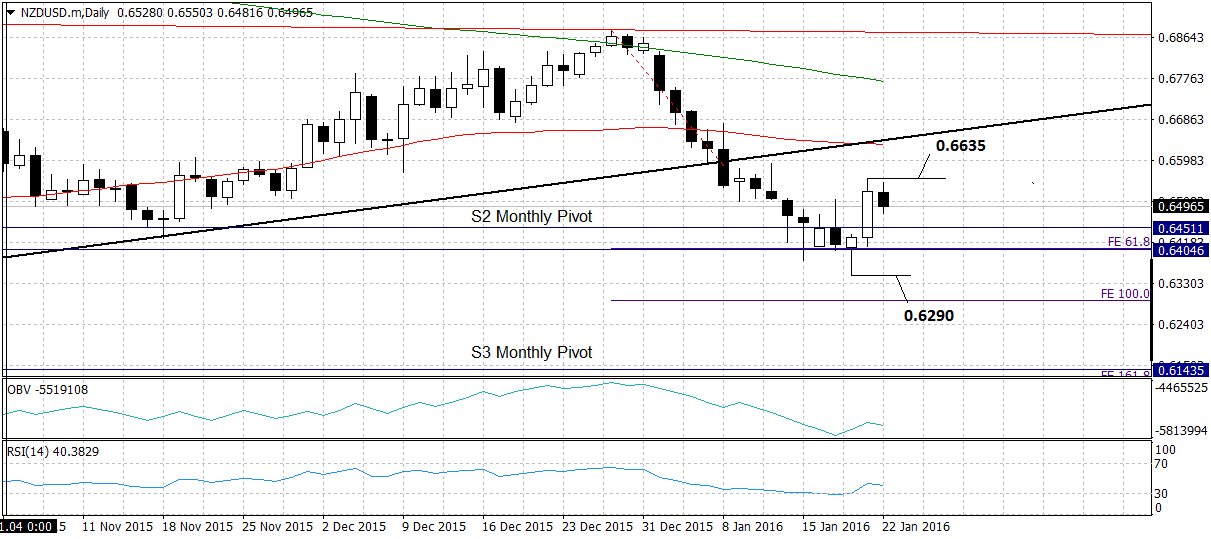
The pair has since risen up to 0.6558, and if it breaks above these temporary highs again, there is a possibility the very short-term trend will have changed to 'up' and there will be a move higher to the 50-day MA at 0.6633.
Nevertheless, the longer-term down-trend remains dominant and could well resume, with a break below 0.6347 possibly confirming such a continuation towards a target at the 0.6292 and the 100% extension of the wave before the break below the trend-line at 0.6595.
Pound to New Zealand Dollar Outlook
The pound to New-Zealand dollar exchange rate had weakened to below key support at 2.2000, and it was looking possible that this might be signalling a resumption of the dominant longer-term down-trend, however, the strengthening of the kiwi has seen the exchange rate move higher again, back up 2.2000.
The little boost higher is not enough to forecast a resumption of the up-trend yet, so the bias remains to the down-side.
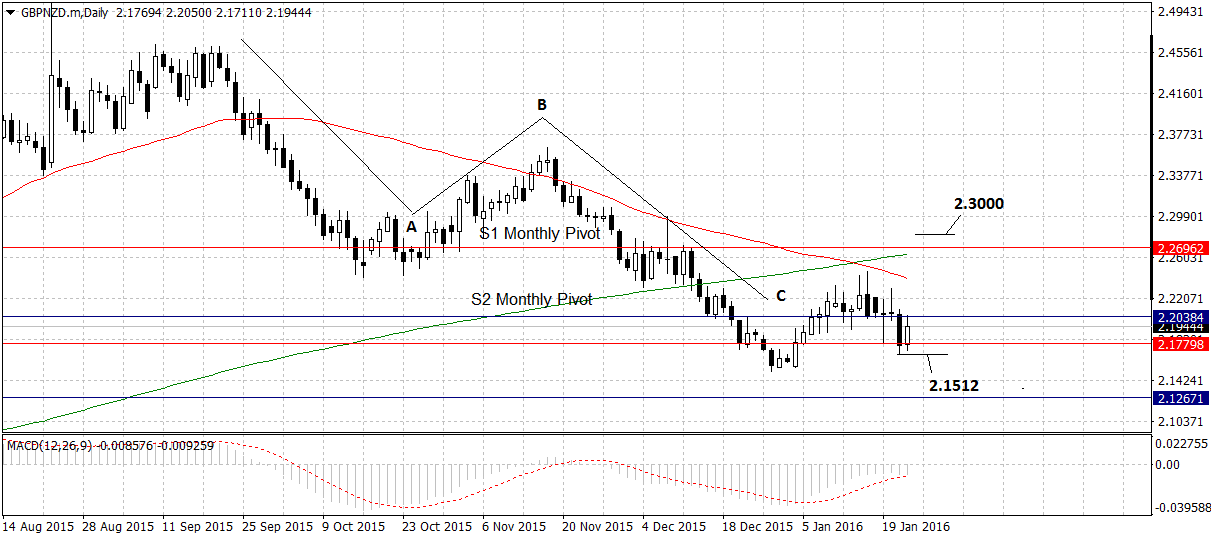
As such a break below the new 2.1989 lows would renew the down-trend bias and expect to see the pair fall to a target at the 2.1512 lows.
Alternatively, if the correction does go higher, it will encounter tough resistance in the form of the 50-day MA, 200-week MA and S1 Monthly Pivot at 2.2696, and, therefore, I would ideally want to see these levels breach before expecting a longer-term recovery to take place, which would be confirmed by a break above the 2.2800 handle, with an initial target at 2.3000.