Despite Governor Carney's comments reigniting sterling bears the currency has found brief respite from strong employment data for December.

The data showed a fall in the Unemployment Rate to 5.1% when it had been expected to remain unchanged at 5.2% and a decline in the number of people claiming unemployment benefits.
The pound, which had been under relentless selling pressure against the euro and US dollar of late with multi-week lows being recorded against both, rallied at the news, although analysts are sceptical about how long it will last.
On Tuesday the 19th of January the selling pressure moved into 5th gear with the GBP to EUR conversion breaking below 1.30 and the GBP to USD breaking below 1.42.
Mark Carney Stamps on the Pound
The reason for the declines lies with the all-important expectations on interest rates at the Bank of England.
Markets have long been buying the pound in anticipation of an impending interest rate rise - higher interest rates = higher yield = more money flowing into the country to take advantage on the return that those yields offer.
Markets had expected a rate rise in early 2016 - this was then moved back to late 2016 and the pound suffered as a result.
Governor of the Bank of England Mark Carney has just stepped up and kicked it into 2017. The pound is on sale as a result.
Delivering the Peston Lecture at the Queen Mary University of London Carney dealt specifically with the question of why the Bank of England has not followed the US Federal Reserve in raising interest rates, "after all, the Federal Reserve raised rates in December.
Might the ‘special relationship’ extend to monetary matters?" said Carney, toying with those who had clearly wrong-footed themselves by assuming Carney was a sheep to US policy-makers.
This question prompted some rather strong comparisons between the US and the UK and why we should not expect an interest rate rise any time soon:
First, cost pressures are stronger in the US. American unit costs have increased by 3% in the past year and are growing above historical averages, while unit costs in the UK are currently rising by around half that rate or at a speed notably below that consistent with the inflation target.
Latest Pound/Euro Exchange Rates
  | Live: 1.1888▲ + 0.19%12 Month Best:1.1913 |
*Your Bank's Retail Rate
| 1.1484 - 1.1531 |
**Independent Specialist | 1.1722 - 1.1769 Find out why this is a better rate |
* Bank rates according to latest IMTI data.
** RationalFX dealing desk quotation.
Second, the UK economy is twice as open as the US and is therefore more exposed to global weakness, dragging on exports.
Third, this also means that pass-through of weak global inflation, compounded by exchange rate appreciation, is likely to exert a greater and more persistent drag on UK inflation. Partly as a result, after adjusting for one-off factors, core inflation is firmer in the US than the UK.
Fourth, the stance of fiscal policy differs markedly. The UK is undergoing the largest fiscal consolidation in the OECD, with the structural deficit projected to decline by around 1 percentage point a year on average over the next four years, having fallen only 1/3 percentage point on average over the past three. In contrast, US fiscal policy is expected to loosen notably over next three years.
Finally, the Bank of England’s control over macroprudential policy (i.e capping buy-to-rent mortgages, ensuring only those who can afford mortgages get a mortgage) reduces the need to use monetary policy to address financial stability considerations
And then the coup de grâce:
"In my view, the decision proved straightforward: now is not yet the time to raise interest rates. This wasn’t a surprise to market participants or the wider public.
"They observed the renewed collapse in oil prices, the volatility in China, and the moderation in growth and wages here at home since the summer and rightly concluded that not enough cumulative progress had been made to warrant tightening monetary policy."
So let's not expect interest rates to rise until well into 2017.
Inflation Data Offers False Hope for Sterling
Relief for sterling had come earlier in the day in the form of the release of December’s inflation numbers by the official statistics body, the ONS.
"Sterling rose by one cent against the Dollar and around 1% against the Euro on Tuesday, following the release of higher than expected UK inflation data. With the Pound having fallen fairly consistently over the past six weeks due to the Bank of England signalling low inflation would mean rates staying on hold for longer; the news of a pickup in consumer prices gave a reason for the market to buy Sterling," says Andy Scott at HiFX.
The ONS reports that headline annual inflation read at 0.2% in December, marginally above deflationary levels. But - it did beat analyst expectations for a reading of 0.1%, and in the world of currency it is how expectations are met that counts.
Monthly inflation read at 0.1% while house prices surged higher by 7.7%.
Why is inflation seen as positive for the pound? Because rising inflation = more of a chance the Bank of England will have to raise interest rates which in turn drives buying interest in the pound.
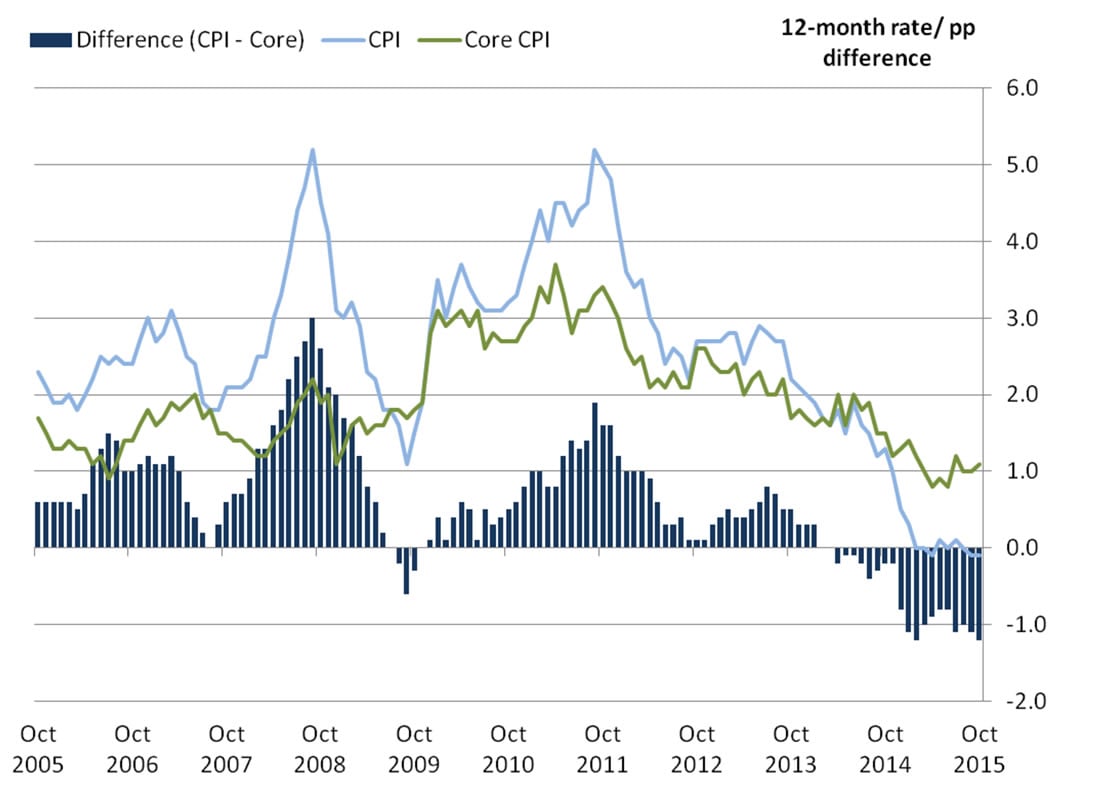
“Leading survey data hints downward price pressures may have waned, opening the door for an upside surprise. Such an outcome may breathe a big of life into rate hike speculation, offering a lift to the British Pound,” says Ilya Spivak, Currency Strategist, at DailyFX.
"This could be indicating that the continued UK economic growth is giving companies the confidence to raise prices, despite CPI having been around zero for the majority of 2015," says Scott at HiFX.
UniCredit: Inflation to Hit 1% in November
But, when we delve into the figures there is not too much to get excited about, for instance, air fares are the main driver of prices it seems:
“The only substantial upward push on inflation between November and December 2015 came from price movements for transport costs, particularly air fares and to a lesser extent motor fuels,” say the ONS.
Air fares rising when oil prices are at record lows? What is going on here? It seems the airline industry are quite happy to absorb the lower costs of fuel into their profit margins.
The question is, will a benign Bank of England change direction on today’s rise in core inflation?
No they won't says UniCredit's Lead UK Economist Daniel Vernazza:
"Inflationary pressure remains subdued, largely owing to the further fall in the price of oil. The rise in air fares could prove temporary as pipeline cost pressures, in particular the price of jet fuel, remains subdued.
"Absent further downward shocks to the price of oil, in around a year’s time the fall in the oil price will start to drop-out of the year-on-year comparison and headline inflation should move materially higher.
"Until then, we expect headline inflation to rise only gradually and to not reach 1% until November this year. That should be enough for the MPC to increase interest rates in November."
Sadly, Vernazza made this comment before Carney's speech.