After a multi-month decline the pound to New Zealand dollar exchange rate looks ready to deliver further advances.

At the start of the final trading day of the first week of 2016 the New Zealand dollar is looking to recover the ground it has lost against the pound sterling over recent days.
The GBPNZD exchange rate is up but has by no means retraced the losses suffered during the global stock market sell-off that was sparked by China.
Indeed, buying interest in the New Zealand dollar will likely be muted across the board as there are no signs the Chinese situation has resolved itself.
When China sells off so do the commodity currencies, a club to which the NZ dollar enjoys membership.
Advances in the GBP to NZD conversion could have been greater, however the UK currency is also apparently not enjoying the risk-off environment.
Nevertheless, technically speaking, the 2016 recovery in GBPNZD is being baked into the charts and our studies advocate for further gains.
Latest Pound / New Zealand Dollar Exchange Rates
  | Live: 2.3468▼ -0.47%12 Month Best:2.4815 |
*Your Bank's Retail Rate
| 2.267 - 2.2763 |
**Independent Specialist | 2.3139 - 2.3233 Find out why this is a better rate |
* Bank rates according to latest IMTI data.
** RationalFX dealing desk quotation.
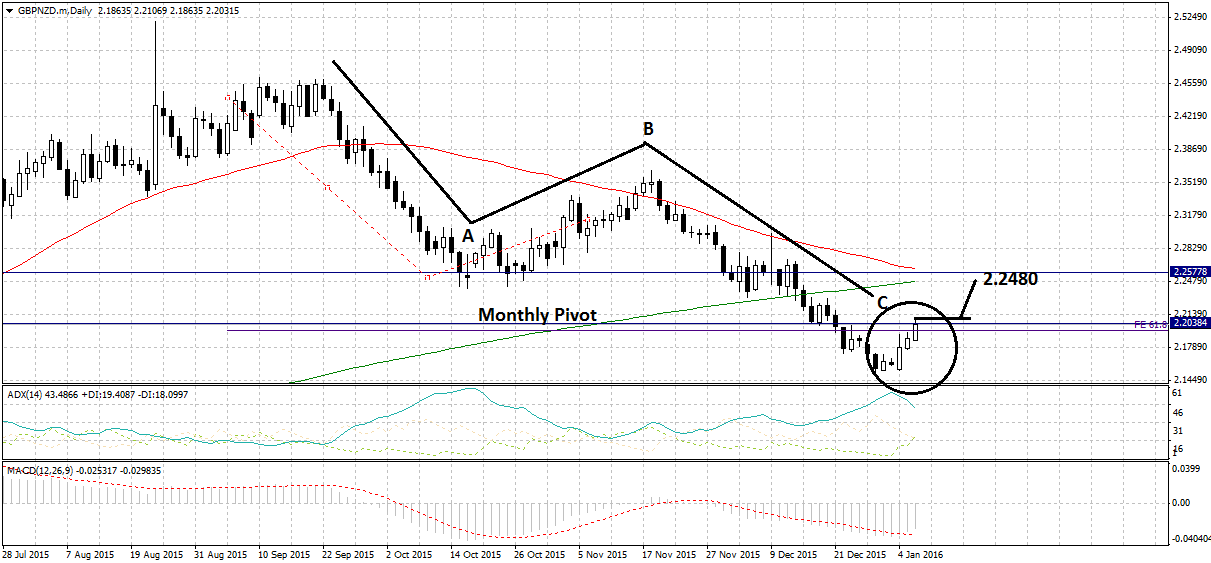
A 3-white-soldier’s reversal candle-stick pattern, which although on its own is not a strong bullish sign, combined with the fact that the pair has probably finished forming a 3-wave a-b-c correction, heightens the likelihood of a reversal.
The pound has also shrugged off poor Services PMI data, which fell to 55.5 when it had been expected to fall to 55.6, and although Services account for over 70% of U.K GDP, the currency remained unaffected – a sign off underlying resilience.
Kiwi Outlook Worsening on China
The New-Zealand dollar, however, has come under pressure after Dairy prices fell 1.4% at the first Dairy Auction of 2016 on the first trading day of the new year.
In addition, recent soft data from China has weighed disproportionately on the kiwi, as exports to China account for 12.8% of total New Zealand trade (only 5.1% in the U.K) and therefore the kiwi is more likely to be affected by China.
Both the recent devaluation of the Chinese currency to a 5-year low, by the People’s Bank, and the unexpected fall in the Caixan Services indices were bad omens for the kiwi, which tends to underperform in a risk off environment.
In addition, the weakening of the yuan will make New Zealand exports more expensive to Chinese customers and therefore less appealing, whilst increasing the appeal of cheap Chinese imports.
The fall in the Caixan weighs because it signals China is cooling and therefore demand for New Zealand commodities, including lamb and dairy products may fall as Chinese consumer’s tighten their belts.
Targetting 2.24
The chart below shows the 3-white soldier candlestick formation at the bottom of a 3-wave measured move.
The third candle is yet to finish, however, assuming it remains in the positive the pair will have had three up-days in a row, which is a fairly high probability sign of short-term trend-reversal.
The monthly pivot is capping gains, however, at the current day’s highs, and I would want to see a re-break above them at 2.2107 for confirmation of more upside, with a target at the 200-day MA at 2.2480, potentially.