The GBP to EUR conversion has slumped by a massive full percentage point on Thursday as global markets descend into panic mode.

The British pound has now fallen below the crucial 1.35 floor against the euro - something we had not anticipated earlier in the week.
Why has the pound fallen so sharply? The reason lies with global markets which have taken a massive tumble on Thursday.
In fact the FTSE 100 is over 2% lower than where it closed last night - such falls are rare and signify investors are really worried. The key concern is China whose economic growth profile continues to slow down.
“Stock markets across the globe are moving deeper in negative territory and we have the feeling it is now legitimate to wonder whether this is just a panic reaction or the beginning of a crisis,” says Arnaud Masset, a market strategist with Swissquote Bank in Switzerland.
In conditions like these the safest of currencies benefit while the riskier ones suffer. So at the top of the pile we have the likes of the swiss franc and the Japanese Yen while at the bottom sits the South African Rand.
In this ladder we have found the euro to be sitting higher than the British pound. This could be because the euro is a much larger and more liquid currency.
The pound to euro exchange rate is a percent lower on a day-to-day comparison having reached 1.3434. Banks are now offering payments on your behalf just above 1.3050 while independent providers are still holding onto the 1.32’s. Expect spreads to widen as markets become more volatile though!
"Global equity markets are in freefall as yet another Chinese shutdown caused mass panic across European futures markets. For many in the City, there was a feeling that the show was over before it begun, with the FTSE 100 already down almost 2% by 7am. Despite gradually gaining access to the IMF’s SDR basket, it is clear that Chinese markets are in no state to be called developed, with inexperienced regulatory bodies overseeing unsophisticated investors who seem to be in panic mode," says Joshua Mahony at IG.
Why China Could Undermine the Euro Longer-Term
While these declines are notable, the longer-term picture means losses should ultimately be contained.
In fact, the Chinese issue could work against the euro.
Euro-zone exports to China account for 14.0% of total exports, where as in the U.K the figure is only 5.1%, therefore any weakness in Chinese buying-power is likely to concern Euro-zone export businesses and Euro-area policy-makers more than their British counterparts.
With this in mind the People’s Bank of China’s (PBOC) decision to devalue its currency to a five-year low today is more likely to impact on the euro than the pound.
ING Bank’s Christopher Turner alludes to this, when accessing the implications for the Euro of Pboc’s recent moves:
“We would also add that CNY has a greater weight in the EUR than USD trade weighted index.
That means the ECB rather than the Fed will have a greater interest in a weaker currency should China devalue further.”
The recent lower-than-expected euro-zone inflation figures for December brought back the spectre of deflation to the euro-area and led to fears the ECB might turn to more easing, however, going forward events in China may also come to dominate ECB decision making.
Latest Pound/Euro Exchange Rates
  | Live: 1.1887▲ + 0.18%12 Month Best:1.1913 |
*Your Bank's Retail Rate
| 1.1483 - 1.153 |
**Independent Specialist | 1.1721 - 1.1768 Find out why this is a better rate |
* Bank rates according to latest IMTI data.
** RationalFX dealing desk quotation.
A Picture's Worth..
Looking now at a chart of sterling-euro, the pair had been falling on pound weakness but Monday’s euro-zone inflation data combined with a rebound in U.K construction PMI helped support a bounce.
The pair put in a very convincing bullish reversal, signified by a very long-wick, hammer candlestick at the lows and since then has been steadily going higher.
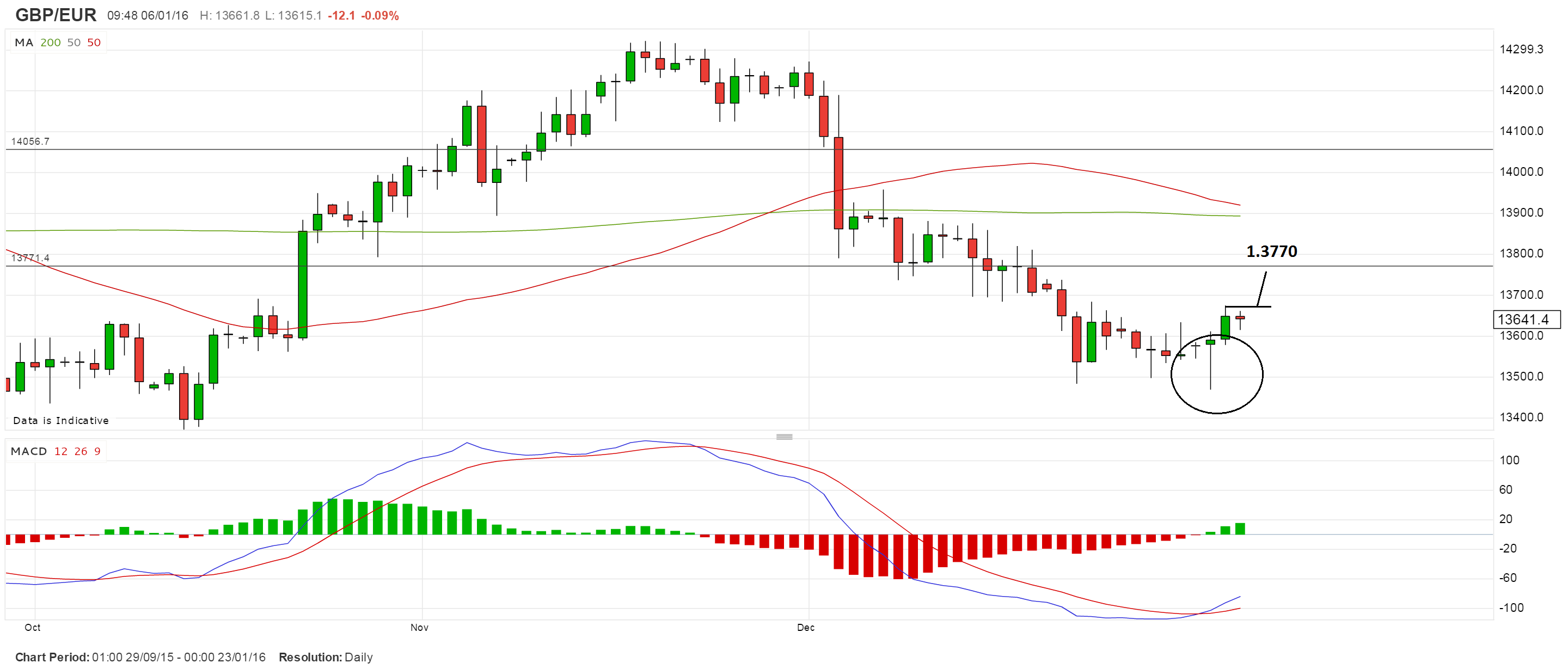
The MACD is providing further confirmation after crossing above the signal line.
However, it’s the hammer, which is the most bullish sign, which could be indicating a reversal and if the exchange rate moves above Tuesday’s 1.3675 highs, it would confirm the start of a change of trend, with a target at 1.3770, where the monthly pivot is situated.
In summary, given the changing sentiment around the euro, the balance of probabilities may be favouring a cautious upside bias for the pair.