
Image © Adobe Images
The pound rises against the New Zealand dollar amidst improving technical foundations and a setback to global investor sentiment.
Global investors are incredibly bullish right now, what with the U.S.S&P 500 and NASDAQ printing a steady stream of record highs courtesy of the dispersion of the AI trade.
That's good for risk sentiment and good for risk-adjacent currencies, like the New Zealand Dollar.
But even the bulls must take a break every now and again, and a pullback in stocks over the midweek period has weighed on the NZ dollar, allowing the pound-to-New Zealand dollar exchange rate the chance to recover.
"NZD has been dragged lower by increased risk aversion," says a note from ASB in Auckland.
There are a couple of factors behind the downshift in confidence:
"President Trump replays the US tariff card, proposing fresh US tariffs of 10-12.5%, likely from July. Those hoping for de-escalation in the US-Iran conflict would have been disappointed with a stepping up in tensions putting the US-Iran ceasefire under severe strain. Oil prices and global yields have pushed higher, while equities ease," explains the ASB note.
Should the paring of recent equity market gains persist, GBP/NZD would be expected to advance further, underscoring an increasingly constructive technical setup.
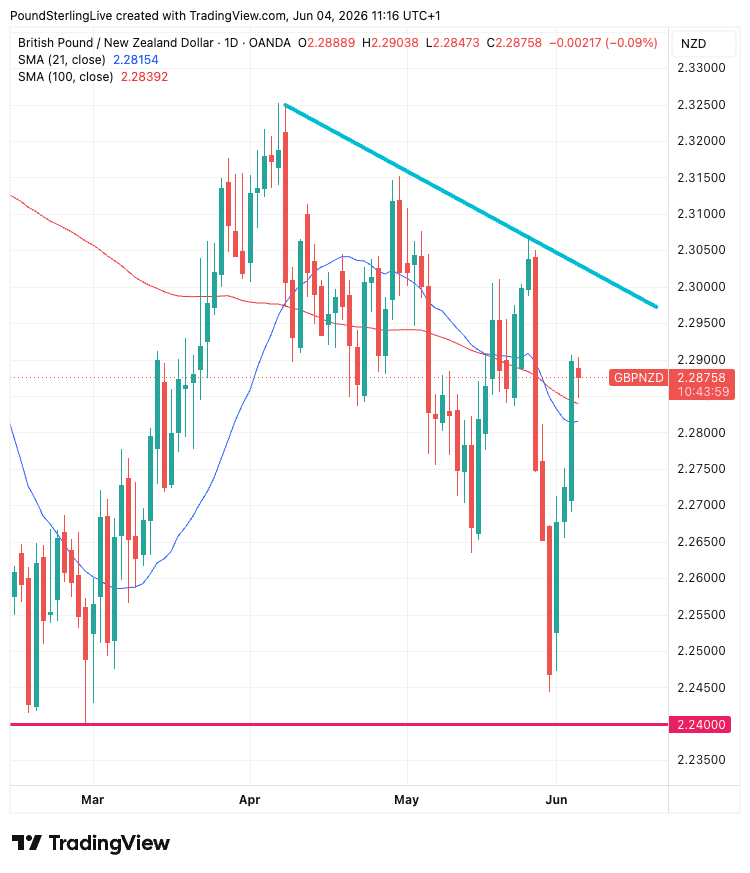
Studies of the daily chart show GBP/NZD has shifted from defensive to constructive after successfully rejecting the 2.2400 support area and reclaiming its short-term moving averages.
The balance of probabilities now favours a test of the descending trendline near 2.30, where the next important technical battle is likely to take place.
The 100-day moving average sits just beneath the trendline, creating a significant resistance cluster.
However, the distance between spot and that resistance is now relatively small compared with the distance to major support, which improves the risk-reward profile for sterling bulls.
A break above that resistance cluster would mark a significant improvement in the outlook and suggest the corrective phase from April is ending.