- Pound to Euro exchange rate latest quote (8-12-16): 1.1738
- Pound to Dollar exchange rate: 1.2664
- Pound to Australian Dollar exchange rate: 1.6897
Pound Sterling has come under pressure amidst a shift in global financial market trends in which stock markets and bond prices have risen.
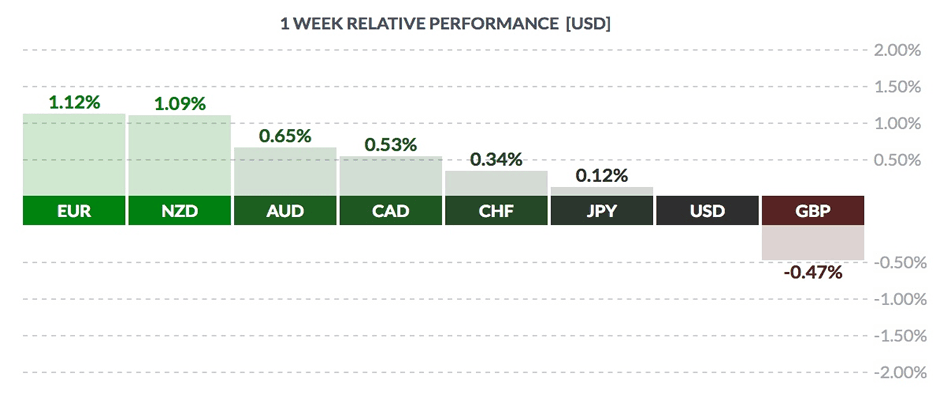
The British Pound is the worst performing currency amongst its group-of-ten peers this week, the US Dollar is just ahead of Sterling in second-last place.
Leading the pack is the Euro and New Zealand Dollar - the two currencies which have struggled in prior weeks.
So there is certainly a sense of adjustment taking place as the best-performer board has seen a complete flip in fortunes.
The catalyst for the turnaround appears to be the strong performance in European and global stock markets at present which have reacted to news that a potential rescue package for the Italian banking sector is on the cards.
The flow of currency into stocks appears to be severely hampering Sterling.
Importantly, UK bond prices have rallied alongside. And when bond prices rally, bond yields fall.
Recall that over recent weeks it has been the massive post-Trump spike in UK and US bond yields that has fed the Pound's rally.
This trade could finally be ending.
"The potential for a Monte dei Paschi package from the Italian government is lifting the European markets this Wednesday," says Connor Campbell at Spreadex in London. "There have been multiple different reports about what could happen."
Mid-week Reuters claimed that the Italian government could take another €2 billion stake in Italy’s oldest bank, while this morning La Stampa (an Italian newspaper) stated that the country could ask for a €15 billion European Stability Mechanism loan, which would be used to aid not only Monte dei Paschi but a few of Italy’s other ailing banks.
Such loans have been used in other peripheral nations such as Greece and Spain over recent years.
"Of course nothing has been confirmed, and the precarious political situation in Italy is going to make doing anything a lot more difficult," says Campbell.
Also keep an eye on technicals. Analyst Kathleen Brooks at City Index says "this failed to boost the pound on Wednesday morning, and GBPUSD continues to slip back below 1.27. We think that this is a technical move."
The GBP/USD hit 100-day sma resistance at 1.2790 and reversed as a result of failure; this could be weighing across the board.
Latest Pound/Euro Exchange Rates
  | Live: 1.1661▲ + 0.17%12 Month Best:1.1828 |
*Your Bank's Retail Rate
| 1.1265 - 1.1311 |
**Independent Specialist | 1.1498 - 1.1544 Find out why this is a better rate |
* Bank rates according to latest IMTI data.
** RationalFX dealing desk quotation.
For Sterling, Politics Might not Matter so Much at the Moment
The background mood-music for Sterling remains positive and we would view the weakness to be limited over the short-term.
Importantly, Brexit-related headlines remain a positive underpinning with news the UK Government will present their Brexit negotiation plans to Parliament before triggering Article 50 of the Lisbon Treaty in 2017.
The move represents a concession by Prime Minister May to the opposition Labour party and some members of her own Conservative party.
The markets will welcome the added scrutiny provided by Parliament as they believe it will likely lead us to a closer integration with Europe's single market and further away from a hard-Brexit which could entail harsher trade barriers being erected between the UK and the continent.
Furthermore, Chancellor Philip Hammond and Secretary for State for Leaving the EU, David Davis, have promised financial services firms a “smooth and orderly transition” when Britain leaves the EU, as pressure mounts for an interim deal to smooth the exit.
We saw the British Pound leap in early December when Davis and Hammond both suggested that the UK would be willing to pay for access to the single market.
It looks therefore that this theme is one that is starting to gauge traction, and markets like that development.
Davis and Hammond met 10 leading financial bosses in talks lasting 90 minutes.
Up for discussion were topics that included a post-Brexit deal to allow current trading rules to continue for a limited period.
Davis, who has previously expressed scepticism about such a deal, was said by one participant to be “not dismissive” of the idea.
It was the first time the Davis and Hammond had jointly attended talks with financial services bosses.
“A transitional deal would be in the interests of Britain and the EU and necessary for the financial stability of both,” one participant at the meeting told the Financial Times. “It’s just that nobody is prepared to say that publicly at the moment.”
For businesses and markets what is needed is some clarity on the Government’s negotiating position.
The more pro-single market the hints we are given, the more likely Sterling will be supported going forward.
"With the Eurozone taking a turn on the political hot seat, it helped to divert attention away from pound-negative Brexit uncertainty. It’s also helped that economic life after the June Brexit vote has shown remarkable resilience. It’s also helped sentiment that the U.K. government seems more open than first thought to retaining access to Europe’s single market," says Joe Manimbo at Western Union.
But, analyst Bhaveen Shah at Credit Suisse reckons Sterling is in fact no longer taking guidance from politics.
In a foreign exchange briefing to clients this week Shah writes, "we still struggle to attribute the full extent of GBP appreciation since the start of November to political developments – especially since the overall picture remains highly uncertain."
"The wavering and occasionally contradicting nature of comments made by EU and UK officials has made trading GBP based on political developments alone a much less intuitive – and profitable – endeavor," says Shah.
If Shah is correct then we may have to wait for the truly notable 'big' announcements on Brexit for further FX guidance.
The most obvious being the Supreme Court ruling on Article 50 due in January. However, it would appear that the Government has already conceded this battle and there is therefore little more movement to be had on this front.
EU Sets Out an United Front
On the other side of the equation we got a brief glimpse of how the EU are preparing for negotiations.
Michel Barnier, the lead EU negotiator on Brexit, says the "time will be short" within which negotiations are able to arrive at a deal.
Barnier’s first official appearance before the media in his capacity as the EU’s lead Brexit negotiator saw him confirm the four central negotiating points that the EU will be working from:
1) "determination for unity" - The EU are showing a united front going into the negotiations and will likely remain so.
2) Negotiations will not start before triggering of Article 50
3) “Being a member of EU comes with rights and benefits. Third countries (non members as the UK will be after Brexit) can never have the same rights and benefits since they are not subject to the same obligations.”
4) "The single market and its four freedoms (which includes freedom of movement) are indivisible. Cherry picking is not an option."
As mentioned, one growing theme is that the UK could seek to pay for single market access, which would allow the country to control its borders.
How this fits into the cast-iron stance on free movement of people therefore looks tricky.
However, the EU is going to have a massive income fall when the UK leaves, perhaps this will help their hand.