HSBC tell us why Pound Sterling is still pointed lower against both the US Dollar and Euro.
- British Pound to Euro exchange rate today: 1.1107
- Pound to Dollar exchange rate today: 1.2350
- Euro to Pound Sterling exchange rate today: 0.9031
Pound Sterling has really outdone itself in terms of delivering an anticipated Brexit-related slump.
The currency was easily the worst-performing unit it the G10 complex having fallen steadily through the opening week of October on the realisation that the UK government is seeking out a 'hard Brexit' during negotiations that will start in 2017.
Sterling has fast exceeded consensus forecasts with a second post-referendum leg lower being turbo-charged by the massive slump of confidence triggered by the flash crash suffered in early Asian trade on Friday the 7th October.
Sterling plummeted in thin market conditions with many analysts blaming algorithmic trades for the slump.
Whatever the case, the pace of decline has really shaken up currency markets, particularly the institutional research segment.
The problem for analysts is that Sterling has fallen towards consensus forecasts some three months ahead of schedule.
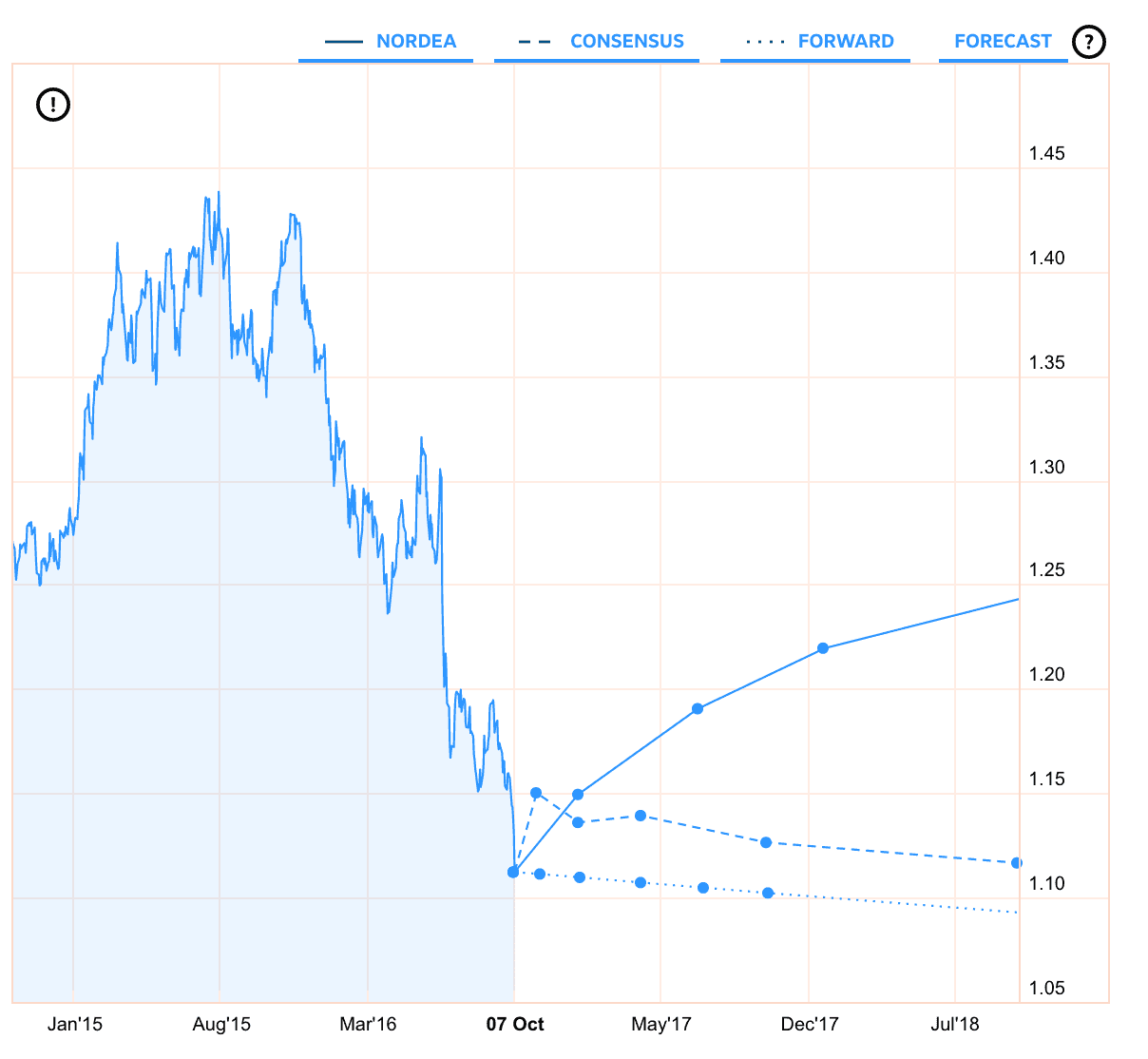
For instance, by January consensus forecasts for the GBP to EUR exchange rate are for a reading of 1.1360:
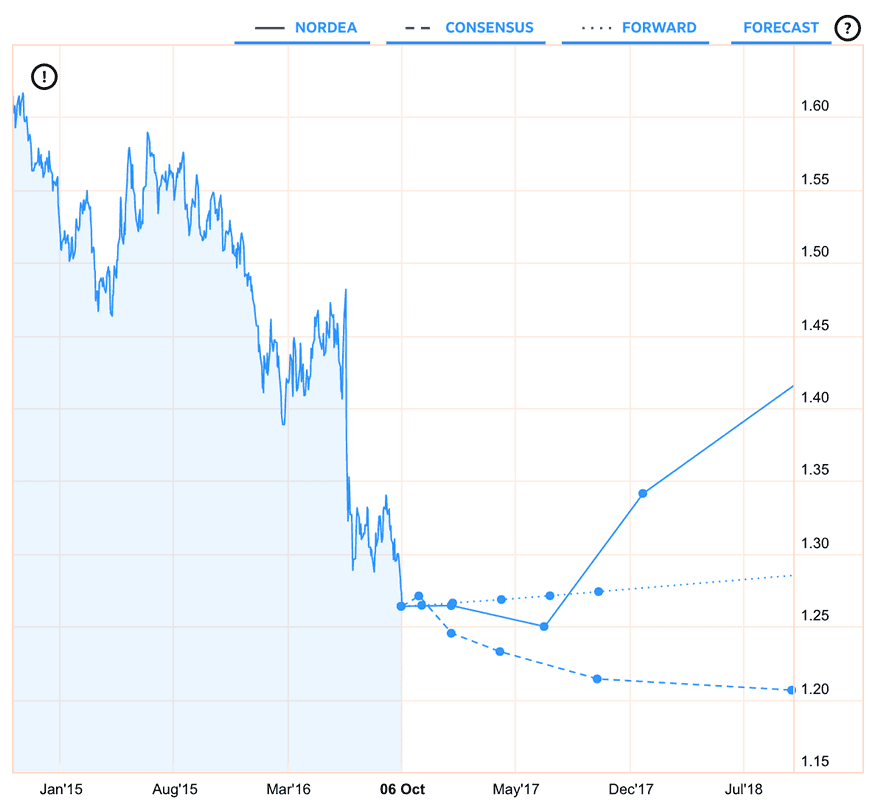
And the consensus forecast for GBP to USD is at 1.2454:
“To adjust for the recent move in the GBP and uncertainty unleashed by this flash crash, we adjust the GBP forecasts lower,” says Aurelija Augulyte at Nordea Markets who appears to have been quick off the mark in adjusting expectations for Sterling.
Some forecasters are looking pretty smug at this juncture.
We always viewed UBS as outliers for their parity forecast on EUR/GBP; however even UBS could be wondering if they were overly optimistic as the call for parity stood for late 2017.
HSBC Stick to Forecast for Parity in EUR/GBP
Analysts at HSBC join peers at UBS in forecasting the Pound to par the Euro over coming months.
For HSBC's Strategist David Bloom further declines in the currency are certainly warranted as the UK unit shifts from a cyclical currency to a political currency that must express the risks placed on the economy by political developments.
In the past bond markets would have taken the role of absorbing political risk sentiment, but in the age of quantitative easing that role falls almost solely on the currency.
"We used to have the bond vigilantes. These were the collective that punished western governments via higher bond yields when they vehemently disagreed with policy. This helped keep government fiscal ambitions in check. With QE this mechanism is dead," says Bloom.
The question asked of investors, poses the analyst, is do you want to buy a currency that has massive twin deficits with an unknown political direction and for that risk you can get zero rates?
"In other words we should have some kind of risk premium which through QE is not showing up in bond markets. It’s the currency that needs to offer this risk premium," says Bloom.
Bloom argues GBP has gone from a cyclical to a political and structural currency.
"The structure and politics are conducive to a currency that needs to fall to a level that causes balance. That balancing act is and has been in our eyes is still a lot lower than where it is today," says Bloom.
HSBC continue to look for GBP-USD at 1.20 by year end and 1.10 by end 2017, taking EUR/GBP to parity
Could the GBP actually be worth less than a EUR this time next year?
Yes, remember once spreads are subtracted the retail rate being offered will fall well below a spot rate at 1:1.
Latest Pound/Euro Exchange Rates
  | Live: 1.18▲ 0%12 Month Best:1.1838 |
*Your Bank's Retail Rate
| 1.1399 - 1.1446 |
**Independent Specialist | 1.1635 - 1.1682 Find out why this is a better rate |
* Bank rates according to latest IMTI data.
** RationalFX dealing desk quotation.
Not everyone thinks so, as there is an air of disbelief and a sense that sanity must soon be restored.
“The net-short speculative positions in sterling on the futures market are massive. At some point in time these investors will take profit on their sterling shorts, probably at a time when sterling fails to weaken further. If we take purchasing power parity into account, sterling is substantially undervalued,” says Georgette Boele at ABN Amro in a client note.
Whatever the case, it would take a very brave speculator to buy Sterling in anticipation of a bounce.
Catching a falling knife springs to mind.
Fawad Razaqzada, Market Analyst at Forex.com reminds those watching the market that certain technical hurdles must be crossed before a falling asset can be considered a buying opportunity:
“As things stand however, the technical bias remains bearish as none of the major resistance levels have been reclaimed yet, which is a prerequisite before sentiment potentially turns bullish on the GBP/USD.
“The point of origin of the overnight breakdown was at 1.2600, while the prior swing low was 200 pips higher at 1.2800. Until and unless the cable moves above these levels, bullish speculators should treat any bounces with extreme caution.”
Razaqzada says those bears who have missed the overnight drop may still find opportunities here and there but probably not to that extent and in that manner.
Developments in UK Politics: Hammond to Provide 'Stimulus-Lite'
With Sterling becoming a 'political currency' it goes without saying that we should keep an eye on political developments this weekend in case we are stung by another big move on Monday.
With the currency looking severly oversold on multiple timeframes there could actually be growing upside risks over coming days.
Speaking in Washington, we have heard over Chancellor Philip Hammond rule out a spending splurge to support the economy over coming months.
However, there are signs that some kind of expansionary monetary policy will be delivered.
Hammond said:
“Now is a good time to invest in genuinely productivity-enhancing infrastructure, and to take advantage of low borrowing costs and our ability to borrow.
“But this is not about a fiscal splurge. It is about supporting the economy in a measured and balanced way.”
Hammond said it was quite often the “modest” public infrastructure projects that had the best returns, because they could to be started quickly"
“They give a short-term boost to the economy but also provide longer-term benefits.”
“It will not be spending in the way previous chancellors have used the word investment. It will be investment in the way a businessman would understand the word investment.”