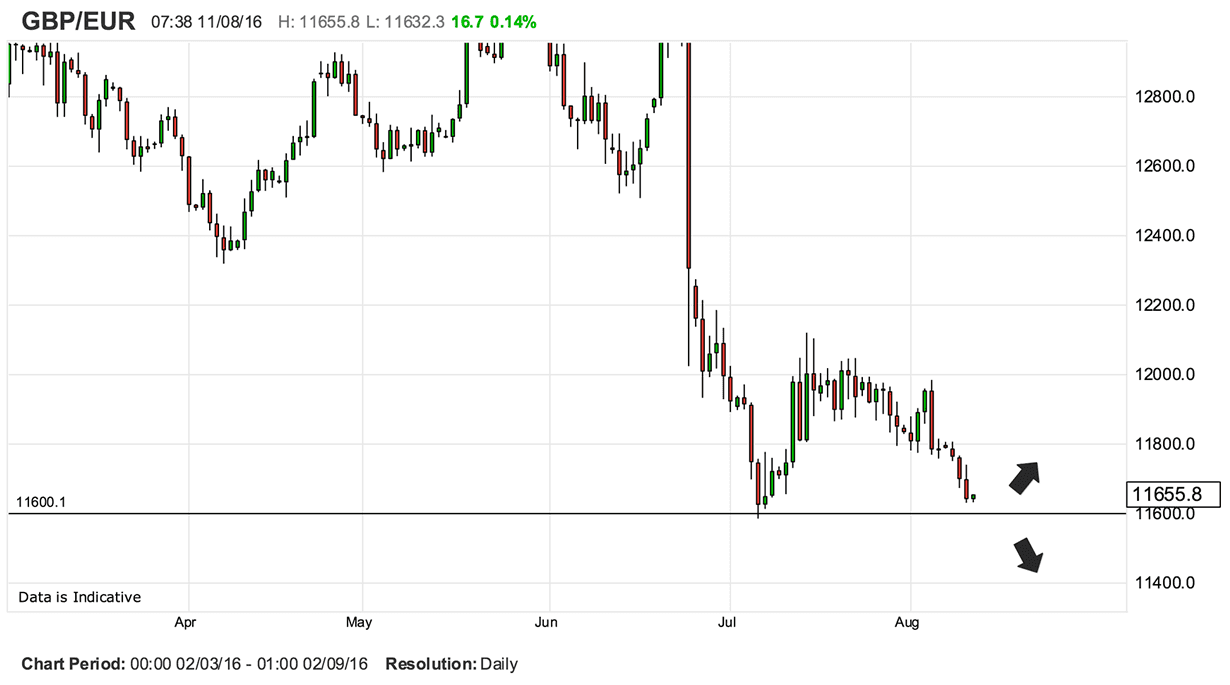
GBP has fallen back to its 2016 lows against the EUR and sets up a test of the support zone at 1.1580-1.16.
Recent weakness in the British Pound, triggered by the commencement of the Bank of England's quantitative easing programme, has allowed the GBP/EUR to fall back to its 2016 lows.
These levels were last seen following the hefty sell-off that was triggered by the decision to leave Europe in the June 23rd referendum.
The falls took the exchange rate down to a 2016 low of 1.1594 on the mid-market.
It was here that we saw relief-buying trigger a rally back towards the early 1.20's, providing welcome respite for those with outstanding Euro payments to make the best of a bad situation.
However, the subsequent decline back to 2016 lows means we are faced with either 1) Another bounce, which suggests a bottom may be forming in the pair, or 2) a decisive break through this support.
If the latter were to occur then we could well see a race down to those big targets set by the various investment banks we follow.
Where are we leaning concerning the outlook?
For us, technical support lines are likely to prove ineffective in dictating market moves when faced with the Bank of England's bond-buying juggernaut
The Bank managed to buy £1.17BN worth of Gilts at Wednesday’s reverse auction - the full amount it intended to acquire.
This was only the third auction of many and saw UK yields fall, in turn forcing the Pound to Euro exchange rate (GBP/EUR) lower:
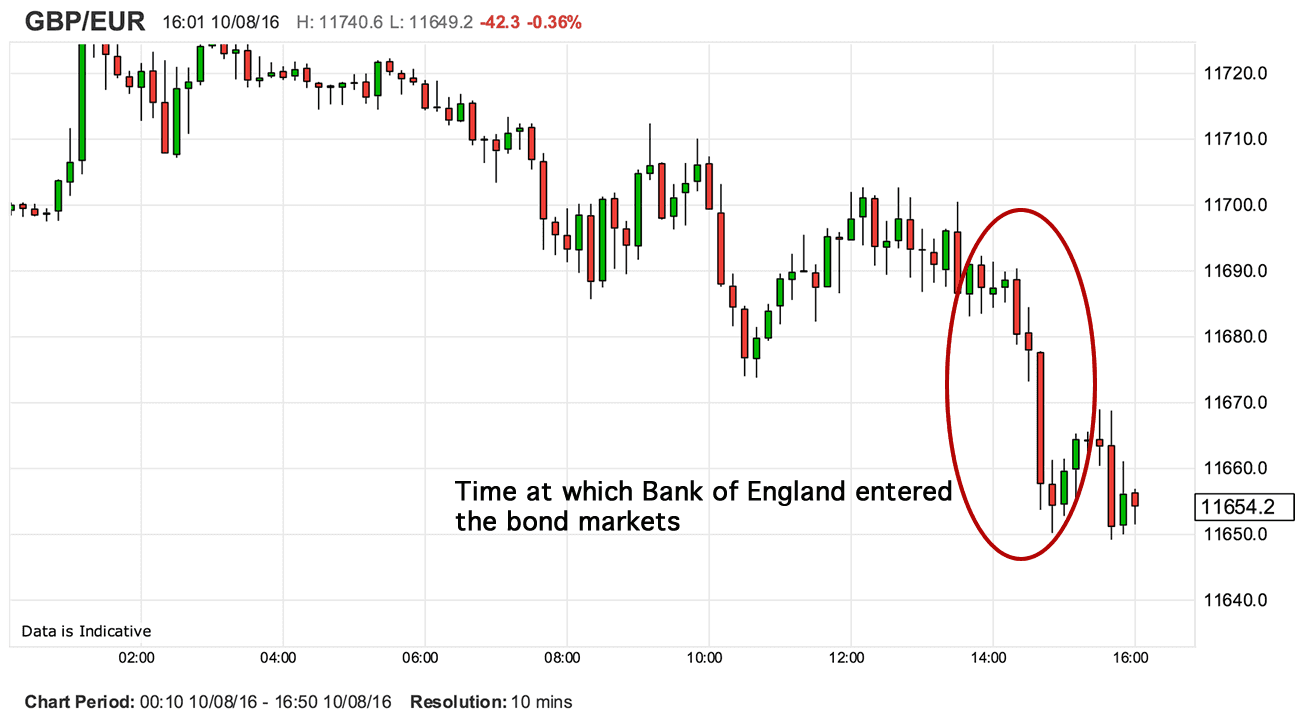
"We think that GBP weakness will largely be driven by the lowering of bond yields but then also by the balance sheet expansion of the Bank of England. UK bond yields being higher than those in the Eurozone, means that UK bond yields have further to fall, supporting our long EUR/GBP trade," says a note from Morgan Stanley on the soft outlook facing Sterling.
The Bank bought £1.17bn of UK Gilts in the reverse auction with maturities between 2023 and 2030.
£5.5bn worth of Gilts were offered to the BoE leaving the reverse-auction 4.7 times over-subscribed.
The successfuly mid-week reverse-auction was a far cry from the previous day's efforts which saw the Pound rally against the Euro on news that the previous day’s auction had run into trouble.
The Tuesday 9th August auction failed to find the requisite amount of sellers from which the Bank could hoover up debt using money it has effectively printed.
This allowed a reversal in fortunes for surpressed UK yields, which in turn saw Sterling bounce.
Latest Pound/Euro Exchange Rates
  | Live: 1.179▼ -0.08%12 Month Best:1.1838 |
*Your Bank's Retail Rate
| 1.1389 - 1.1436 |
**Independent Specialist | 1.1625 - 1.1672 Find out why this is a better rate |
* Bank rates according to latest IMTI data.
** RationalFX dealing desk quotation.
The Bank is in the process of purchasing up to £60BN in government debt in reverse-auctions in an attempt to suppress yields, and thus borrowing costs.
A side-effect of the action is a weaker Pound Sterling and markets will continue to buy and sell Pounds based on whether the current programme is successful enough to warrant an extension at a future date.
Should such an extension not be forthcoming, either as a result of an inability to find sellers, or should a pick-up in economic growth materialise, then the Pound will likely recover.
The next big trigger of Sterling moves comes on Monday when the Bank returns to the market with the aim of buying more Gilts.
Data: RICS House Price Index, First-Time Buyer Data in Focus
No frontline data was made availabel for Sterling traders to chew on, however there was some second tier stuff from the housing sector.
RICS released their house price index in which it was shown that 5% more respondents nationally saw a rise rather than fall in prices, a downward trend that is evident across the UK.
As price growth slows for now, near term price expectations across the UK were negative for the third month in succession with 12% more respondents predicting a decline in house prices over the next three months.
There have been suggestions that the softer sentiment could hit consumer confidence going forward, as Briton's have so much of their wealth linked to their property.
That said, there was good news out just a day prior when it was reported that lending to first-time buyers in June rose to a record level since 2007.
This can only be a good, and healthy, thing for the economy.
It also suggests that perhaps the slowdown in the housing market is the buy-to-let and investment sector.
Again, this is a good thing as the housing market has been skewed in favour of second-home owners for too long.