The Euro is likely to find continued support against Pound Sterling as data confirms the post-referendum shock experienced by the UK economy has not spread to the Eurozone.
- Euro to Pound Sterling exchange rate today = 0.8380, 0.60% higher than yesterday
- "A move above the 0.8425 highs would probably confirm a continuation up to a preliminary target at 0.8500."
- Pound to Euro exchange rate today = 1.1935
- "BoE will deliver a sizeable package of stimulus measures at next week’s MPC meeting" - ING
The EUR/GBP pair has jumped a sizeable 0.60% on a day-to-day basis as investors continue to cut exposure to the UK currency ahead of the August 4th Bank of England meeting.
The declines come despite strong GDP and house price data being released over the course of the past 24 hours.
Our studies show that two targets are now available for the Euro as, from a technical perspective, the pair is seen pushing out of its triangle:
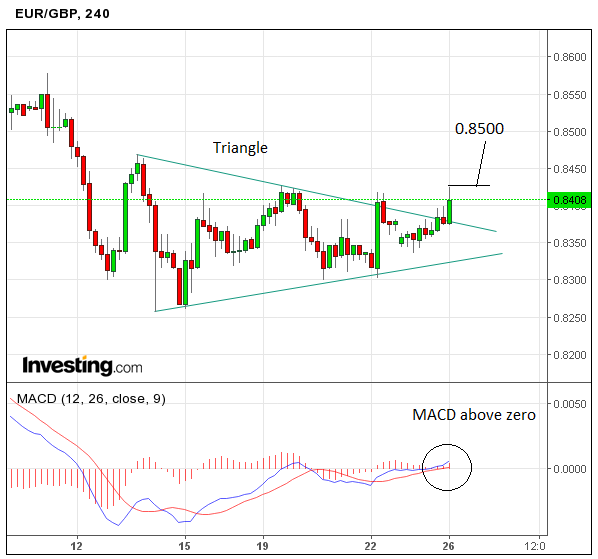
A move above the 0.8425 highs would probably confirm a continuation up to a preliminary target at 0.8500.
For those looking at the market from the GBP into EUR angle, 0.85 translates into 1.1765.
Eventually the pair would be expected to retouch the 0.8627 highs. This translates into 1.1592 GBP/EUR.
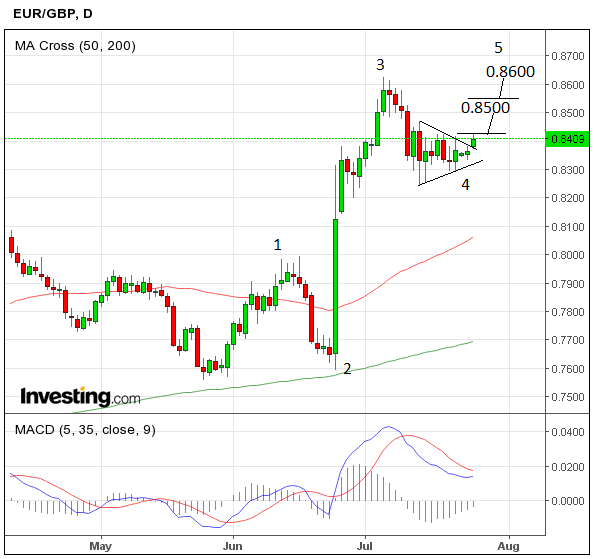
According to Commerzbank’s technical strategist, Karen Jones, the EUR/GBP pair is being dictated by an Elliot Wave which started at the late May lows.
Elliot waves are a form of market cycle analysis which are composed of 5 smaller waves, with 1,3 and 5 moving in line with the trend and 2 and 4 being corrective.
The Elliot wave analysis of EUR/GBP supports a move higher, with the wave count showing that the current wave 4 has probably finished and a wave 5 is now expected to move higher.
"Beyond a small correction the market remains on course for the 0.8815 February 2013 peak," concludes Commerzbank’s Jones.
The wave four is probably finished because according to Elliot wave theory, triangles are always the final development in wave 4 corrections.
“Triangles always occur in a position prior to the final wave in a pattern of one larger degree,” according to The Elliot Wave Principle by Frost and Prechter.
Therefore, this must be the end of 4 - it probably does not have a final wave down as previously thought.
We are now probably starting wave 5 higher, which should, at the very least reach the 0.8627 highs.
Economic Divergence to Keep Euro Favoured
The Euro is forecast to maintain a positive tempo against its cross-channel counterpart as the UK and Eurozone economies diverge.
For years now the British Pound has advanced against the Euro on the basis that the UK economy was growing at a notably faster rate than that of the Eurozone.
In response, the Bank of England was seen to be on the cusp of raising interest rates while the European Central Bank embarked on cut after cut to the basic bank rates while introducing a slew of exotic money-printing programmes.
This pro-GBP dynamic has certainly been dealt a death-blow by the UK's decision to exit the European Union in the June 23rd referendum.
The initial shock of the vote appears to have business and investor confidence in the UK, confirmed on Friday the 22nd when the first major economic data release since the vote was published for both the UK and the Eurozone.
Latest Pound/Euro Exchange Rates
  | Live: 1.1942▼ -0.05%12 Month Best:1.195 |
*Your Bank's Retail Rate
| 1.1536 - 1.1584 |
**Independent Specialist | 1.1775 - 1.1823 Find out why this is a better rate |
* Bank rates according to latest IMTI data.
** RationalFX dealing desk quotation.
In both areas economic activity was expected to have slowed due to the negative effects of uncertainty, however, in the end the data showed a much sharper decline in the UK than in the Eurozone.
It appeared that when it came to Brexit, analysts had overestimated the ripple effect on Britain’s neighbours.
Since the PMI data, there have been no other comparable econometric releases in terms of magnitude.
But the UK has had more data in the form of the CBI Industrial Trends survey for July, which was poor enough to prompt Capital Economics’ Paul Hollingsworth to suggest it was a sign economist’s fears about a Brexit-induced slowdown might be coming true:
“Taken together with last week’s Flash PMIs, the evidence is mounting that the economy has taken a hit from Brexit.”
Then on Tuesday we have had BoE policymaker Martin Weale changing his stance from arguing for more monetary thrift to one of supporting more monetary stimulus.
Weale was reported to have gone as far as advocating an extension of BOE quantitative easing, in which the central bank swells bank’s coffers by purchasing bonds from them, thereby encouraging banks to lend more money to the real economy.
Weale’s comments were the final piece of confirmatory evidence needed by some analysts to anticipate an August 4 BOE interest rate cut.
ING Bank’s Viraj Patel saw his position reinforced by Weale’s comments:
“This supports our view that the BoE will deliver a sizeable package of stimulus measures at next week’s MPC meeting (4th Aug).”
Patel further inferred a likely preference for asset purchases over interest rate cuts from the BOE rate-setters comments:
“Moreover, Weale’s comment that “asset purchases are still likely to be effective” suggests that there are material upside risks to our £50bn QE expansion call.
With some UK banks already warning business customers over the prospects of charges to their deposits (should the BoE introduce negative rates), we suspect that QE will be the MPC’s preferred policy tool in terms of delivering a more potent stimulus.”
Brexit Impact on Eurozone Proves to be Limited
In Europe, meanwhile, the Brexit bump has so far turned out to be far less of a hindrance than expected.
July PMI’s were down, but not as far as expected, falling to 52.9 from 53.1 for Composite PMI (Services 52.7 from 52.8, and Manufacturing of 51.9 from 52.8)
This compares to UK Services PMI of 47.4 from 52.3 and 49.1 from 52.1 previously.
A result below 50 shows contraction compared to expansion above 50.
The Eurozone also had important sentiment data in the form of the IFO Sentiment Index in July.
This showed a decline in the headline figure from 108.7 to 108.3.
According to the accompanying report, Manufacturers - not surprisingly in the automotive sector - were the most concerned about the outlook.
Nevertheless, this was taken as a positive, given it was not as bad as the 107.5 analysts had forecast.
In the wake of Brexit, ECB President Mario Draghi said the shock could have 0.3% off Euro-area growth over three years, however, at the post ECB press-conference on
Thursday he said his words should be taken with a “grain of caution,” revealing that he might think the fallout could be less since the initial Brexit shock hit.
Indeed, the ECB meeting surprised many who had expected an immediate policy response from the ECB, or at least the preparation for a response in September, as in the end the bank seemed to adopt a more neutral ‘wait-and-see’ stance instead.
If data continues to show less of an impact on the euro-system economy than expected, it could prompt the ECB to leave policy measures at their current level.
Analysts at Citibank see a lessening chance of a September policy change, although their economist colleagues continue to expect more stimulus in September:
“In the Eurozone, the resilience of the German IFO result overnight, perhaps backs ECB President Draghi’s rather non-committal comments on the prospect for a September easing at last week’s board meeting. The IFO result is the latest in a series of above consensus euro zone data (services and composite PMI’s last week also show similar resilience to the UK referendum) which makes it more difficult to call on the September meeting (although Citi Economics still maintain their ECB easing call).”
Overall, however, there appears to be a shift in expectations which could see a sudden divergence in ECB and BOE policy, from the current consensus view that both will ease in the next few months, and if this happens then, all other things being equal, it would naturally support the euro against the pound.
UK Economic Growth Beats Expectations, Could Soften Referendum Blow
Stronger U.K. growth last quarter was of little support to the pound as it wasn’t seen sustainable in the post-Brexit world.
Britain’s economy grew 0.6 percent during the April-June quarter, compared to the 0.4 percent rate during the first quarter.
The outlook for the U.K. economy has materially darkened to the point that the Bank of England next week could cut interest rates to in a bid to ward off a rising risk of recession as Brexit uncertainty bites the economy.
However, the stronger-than-expected reading will certainly go some way in minimising the impact of the referendum shock and the data itself could aid consumer confidence going forward.