The British pound to euro exchange rate (GBPEUR) is edging higher towards a test of 1.37 as UK inflation data proves little worry to the currency on Tuesday.
The British pound has struggled somewhat against the euro over recent trading days with resistance at 1.38 standing firm and opening the prospect of a return to 1.36.
The GBPEUR is caught in a sideways trend with 1.38 at the top and 1.36 at the bottom.
Note though that leading into the range momentum was negative and thus the prospect of a continuation of this medium-term move is valid:
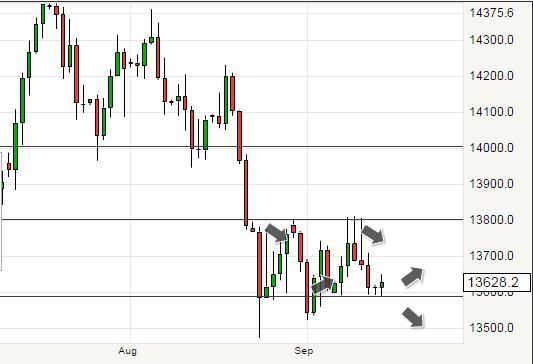
Should support at 1.36 hold then 1.38 is seen as a target, we would need to see some decisively positive macro economic data headlines come out of the UK for this to occur though.
Those with an eye on this market should be aware that a distinct lack of clarity on when the Bank of England will chose to raise interest rates will continue to promote GBP/EUR weakness in our opinion.
For global foreign exchange markets interest rate differentials remain the number one driver of direction. Those currencies tied to a central bank that is looking to raise rates will ultimately enjoy an advantage.
So for sterling the question remains - will the data remain strong enough to encourage the Bank of England to raise interest rates in coming months?
There are three important data points to watch in the coming week which will determine whether the GBP manages to advance against the EUR.
Latest Pound/Euro Exchange Rates
  | Live: 1.187▲ + 0.03%12 Month Best:1.1913 |
*Your Bank's Retail Rate
| 1.1466 - 1.1514 |
**Independent Specialist | 1.1704 - 1.1751 Find out why this is a better rate |
* Bank rates according to latest IMTI data.
** RationalFX dealing desk quotation.
1. August Inflation (15 Sep) (Reads at 0% - in line with predictions)
UK headline inflation for August read at 0%, as expected by currency markets.
"The results released today will ease pressure on the BoE to intervene, allowing governor Mark Carney to wait and see the impact of the mooted US rate rise later this week. The Bank’s inflation target is two per cent, which may prove difficult to achieve in the current climate of low crude oil prices and a strong pound,” notes Dennis de Jong at UFX.
The data is by no means a game-changer for the pound which continues its lacklustre August.
2. July Unemployment & Wages (16 Sep)
The UK labour market has been showing relatively healthy underlying dynamics in recent months, and most economists agree that the trend will continue into July.
The 3MMA u/e rate is likely to have notched down a tenth to 5.5% (consensus: 5.6%), putting it back at its March/April level.
“We’ll also be looking carefully at private-sector regular pay growth, which is favoured by the MPC for signs of tightness in the labour market, and the market sees inching a tenth higher to 2.9% y/y. With recent growth in this measure firmly above 3% y/y and inflation near zero, underlying real wage pressures are significant (though this will come off as inflation picks up in early 2016),” say TD Securities.
3. August Retail Sales (17 Sep):
Markets expect August retail sales to come back to life again (+0.3% m/m), following a couple of relatively tepid months.
“As highlighted in the MPC Minutes, the UK household remains an important part of the economic growth engine, and with core real wages growing above 3% year-on-year, retails sales growth momentum is likely to be maintained in coming months,” say TD Securities.
Are Markets Too Pessimistic on the UK Economy?
The market is now pricing the first full hike in the UK not before August 2016 and the pound sterling has weakened accordingly.
“While disinflationary risks stemming from emerging markets and commodity prices have shifted the risks around our call for a November2015 rate hike, a Q3 2016 liftoff paints an excessively pessimistic picture of the economy,” says Vatsala Datta, UK Rates Strategist with RBC Capital Markets.
Growth in the UK has been robust and despite the recent easing in the PMI data, we look for Q3 GDP growth of 0.7% q/q.
“Private wage growth also remains healthy and will continue to present itself as a main driver of medium-term inflation, which is ultimately what the BoE targets,” says Datta.
Admittedly, global events present themselves as the main risk, but at the latest Jackson Hole meeting, Governor Carney was quick at noting that recent events do not yet merit changing the MPC’s strategy (also reflected by the MPC minutes), sticking with the theme that decision time on a Bank Rate increase is likely to be "around the turn of this year".
In light of a market that could be overly negative on GBP there is thus value in betting on a recovery to the middle of the longer-term range. A rise back towards 1.38/39 has value in our opininion.
The Big Event Gets Closer
Will the US central bank raise interest rates on Thursday? This is an important question for the pound sterling as any move by the Federal Reserve on interest rates is highly likely to promot a similar move by the Bank of England.
Thus, a Fed rate rise is both GBP and USD positive against the EUR.
The market now assigns just a 30% probability to a September rate hike, while professional economists are split almost precisely 50-50.
Therefore the potential for a USD rally on the back of a rate rise has grown significantly.
Economic data has been more than supportive, but some measures of inflation expectations are now flirting with their lowest levels since the financial crisis and expected financial market volatility is now unusually high.
Neither of these are conditions that have historically supported a rising policy rate.
“We still believe the Fed is likely to raise rates before the end of the year. While the Fed is now shying away from explicit forward guidance about the timing of future policy decisions, it should at least leave the door clearly open to tightening later in the year, thus constituting a “hawkish pause” rather than a “dovish pause,” says a note on the matter from RBC Capital Markets.