
Why this coming week's data looks set to bolster the pound.
The British pound is set fair to register gains in the coming week if three key data events fall on the right side of expectations, which a number of economists we follow predict might happen.
"With most of next week's macro data, there's a risk it temporarily reinforces the Bank's caution on rate cuts and potentially could trigger a hawkish market reaction," says James Smith, UK Economist at ING Bank.
All else equal, a 'hawkish' reaction hints at gains for sterling.
🎯 On target: Pound Sterling Live warned readers ahead of last week's GDP data that the pound could be in for a bounce, as we presented research ahead of the release that showed the numbers would likely exceed expectations. That happened, and sterling's immediate post-release reaction was to go higher.
Will we be right again this week?
For sure, this coming week's data holds more significance for the Bank of England and money markets than the previous week's monthly GDP print. The data also comes at a time of increasingly tightening ranges in key pound exchange rates, most notably the pound to euro.
Expectant markets and the first real juicy data of 2025 make for market-moving potential.
GBP/EUR 2026 Consensus Forecast Report: 7-page analysis including bank-by-bank projections, quarterly trend charts, and actionable recommendations for pound-euro transfers throughout the year.
Access Free Report👁️ What we're watching
Tuesday's labour market data is the first major test of the week.
"Against consensus, we think there's a risk the unemployment rate (temporarily) drops next week," says Smith.
Such an out-of-consensus outcome would certainly trigger an upside reaction in pound sterling.
"We're also not convinced the recent signs of redundancies rising will turn into much more," he adds.
🛒 Wednesday's inflation numbers:
The Bank of England will be pleased with the recent disinflationary trends seen in the UK, while maintaining a weariness that there's still some way to go before popping the champagne over on Threadneedle Street.
"We see upside risk to our forecast arising from the CPI collection date. We expect December’s Consumer Prices Index report, due on January 21, to show CPI inflation ticking up to 3.3%, from 3.2% in November," says Pantheon Macroeconomics in a note to clients.
📈 An above-consensus reading would reinforce the view that the Bank needs to tread carefully. This would push back bets for a February rate cut, which can help the pound advance and extend its current revovery sequence.
Pantheon points out that other surveys - the DMP, PMI and BICS surveys - all point to services price disinflation having come to an end for now.
ING says a lot depends on air fares, which unsurprisingly tend to surge around Christmas.
"There's an outside risk we get a big spike here," says Smith. "Of course, it will be unwound in January, optically it wouldn't look great for the Bank."
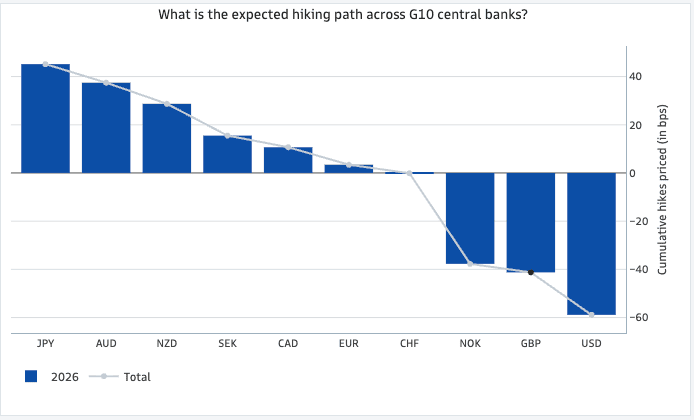
Above: GBP's interest rate profile is bearish, it has space to rise on the back of better than expected data.
📉 Beyond January, GBP headwinds blow:
Despite the potential for an upside surprise this week, ING thinks by April inflation will be back to the Bank's 2% target.
Therefore, if this week's data prints on the topside and lifts the pound, there's an implicit risk that a decent disinflationary pulse follows in subsequent months which would put the currency back under pressure.
In short, the solid recovery has more space to run, but there's still a potential reckoning ahead.
"There are strong grounds to expect activity to surprise on the downside over the next couple of years," says a recent UK economic overview from Oxford Economics.
✳️ Secure today's exchange rate for a future payment. You may also book an order to trigger your purchase when your ideal rate is achieved. Learn more.