Image © Bank of England
Pound sterling's advance against the euro has been capped, but it's not ready to fall either.
This means the pound to euro exchange rate (GBP/EUR) is caught in a wedge that will be exited via a breakout, which we think will occur in response to next week's busy domestic economic calendar.
The pound's recovery rally stalled early last week at 1.1563 when it hit the 200-day exponential moving average and has since been unable to break through this ceiling.
Yet, it remains supported by its rising nine-day EMA, currently at 1.1520, etching an increasingly tight and constrained wedge formation that has captured the exchange rate:
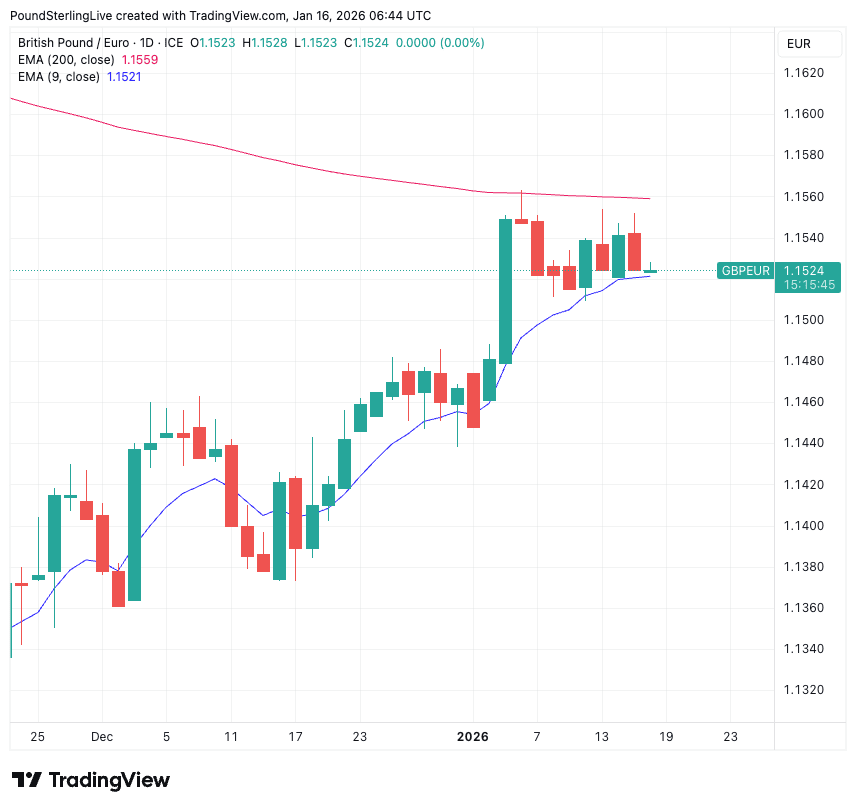
The constrained trading range will be resolved by a release of kinetic energy, either to the topside or the downside, depending on the nature of next week's data.
Our hunch is that the move will be higher, given the preceding uptrend in pound-euro and the generally weak tone in the euro.
"Demand for the EUR looks to be waning with most pairs trading heavy," says Haruya Ida, a Reuters market analyst.
There's also an emerging narrative amongst analysts we follow that shows improving sentiment towards the UK currency, suggesting it could potentially outperform subdued expectations in the coming months.
"Fundamentally undervalued and still carrying the burden of past shocks, the pound may stage a slow but uneven recovery in the second half of 2026," says analyst Karl Schamotta at Corpay.
The year-ahead consensus forecast for GBP/EUR, derived from polling of investment banks, shows expectations for the pound to fall against the euro. (The full consensus forecast is available on request here).
Should you convert GBP to EUR now or wait? Our Q1 2026 forecast report compiles expert predictions from 30+ banks to help you make informed currency transfer decisions.
Download Free ReportIf the consensus is right, downside pressures should start to re-emerge, likely triggered by poor economic data that points to UK economic underperformance.
If that trigger comes as soon as next week, then GBP/EUR will remain capped below the descending 200-day EMA and turn south again, effectively putting an end to the rally.
With this in mind, we're watching Tuesday's labour market data closely for further signs of increasing unemployment.
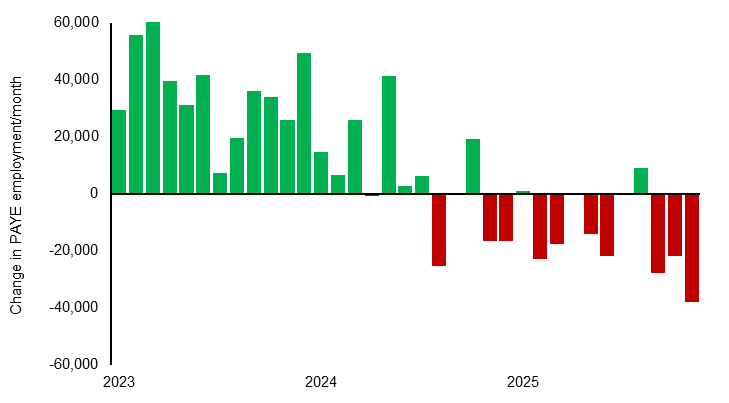
Above: The PAYE measure of UK employment change.
Employment has fallen in nearly every single month since the new government took power in 2024, and this points to building slack in the economy that the Bank of England could try to arrest with a series of interest rate cuts.
If so, then UK bond yields will underperform peers and weigh on the pound.
However, the Bank's ability to cut will be restrained by inflation data, and latest figures are due Wednesday.
Analysts at Pantheon Macroeconomics say they are ready for a surprise: "We see upside risk to our forecast arising from the CPI collection date. We expect December’s Consumer Prices Index report, due on January 21, to show CPI inflation ticking up to 3.3%, from 3.2% in November."
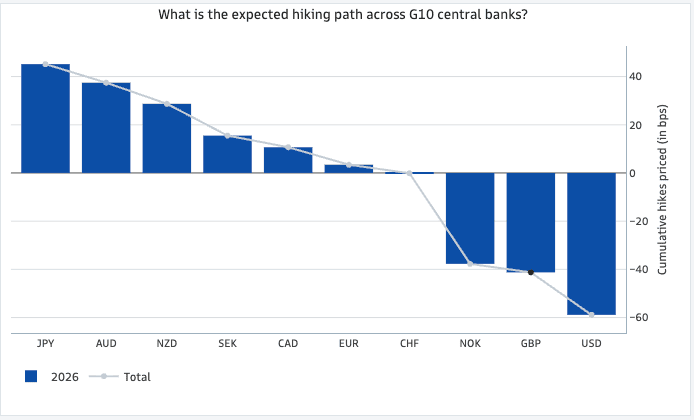
Above: The GBP is expected to be subject to more interest rate cuts than peers in the coming year.
For the pound to euro exchange rate to break higher, inflation and labour market data must land on the topside of expectations, as this would lower the odds even further of a February rate reduction at the Bank of England.
The opposite data outcomes would send GBP/EUR lower and back towards 1.1480 support.
"Sterling, having retaken September highs, looks susceptible for a material correction," says Jeremy Stretch, an analyst at CIBC.
✳️ Secure today's exchange rate for a future payment. You may also book an order to trigger your purchase when your ideal rate is achieved. Learn more.