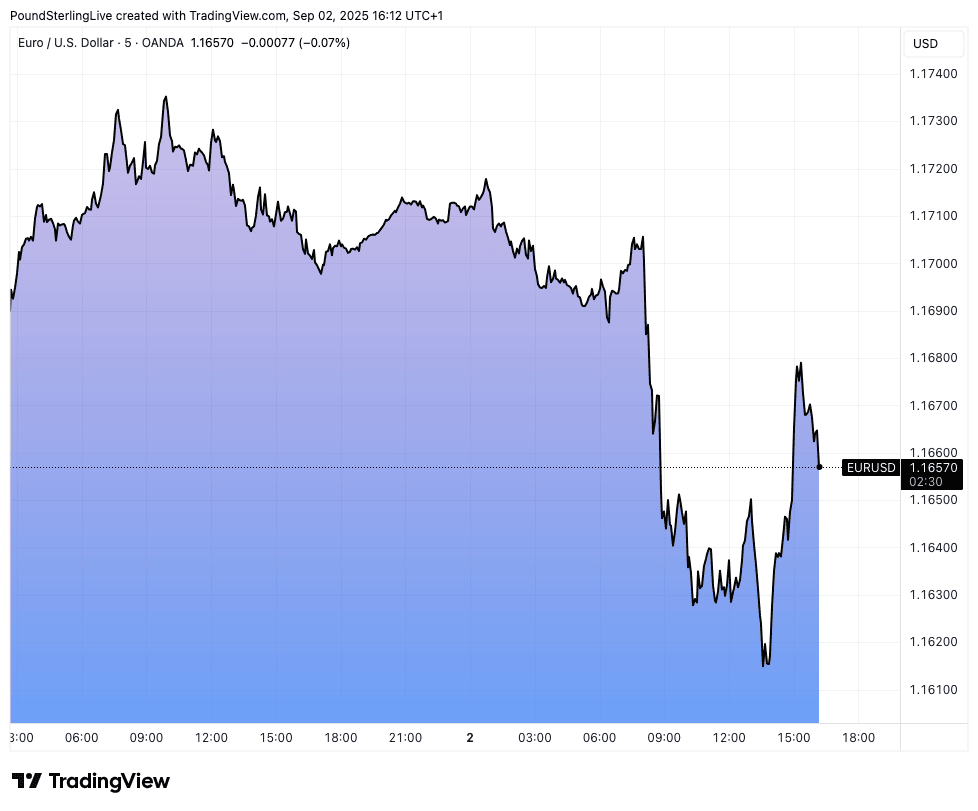
Above: EUR/USD at 5-minute intervals.
European bond yields are surging, and this is weighing on the Euro.
Global bond and stock markets are falling as investors express concern about burgeoning global government debt piles and slowing economic growth dynamics.
The Dollar is rising amidst this downturn in sentiment, fulfilling its role as a safe-haven when global concerns are at the forefront of investor concerns.
"Traders are cutting risk and global interest rates are ratcheting higher as investors sell long-duration instruments this morning, suggesting that a relatively calm summer in financial markets is quickly coming to a rude end," says Karl Schamotta, Chief Market Strategist at Corpay.
The focus of concern is on long-duration bonds, most notably the 30-year bracket; these bonds are not supported by central bank interest rate cuts, as is the case for 2-year bonds.
This leaves them particularly sensitive to investor sentiment regarding inflation and debt sustainability.
The issue is particularly acute in the UK, where the government must find £50BN in savings and tax rises to fill a budget deficit.
Debt sustainability issues are also flaring up again in France, where the current government is likely to be deposed next week, having failed to secure consent from opposition parties to pass a budget that would cut spending and raise taxes. As we note here, the Euro is not immune to a French-inspired rout, as was the case in December when the Barnier government fell.
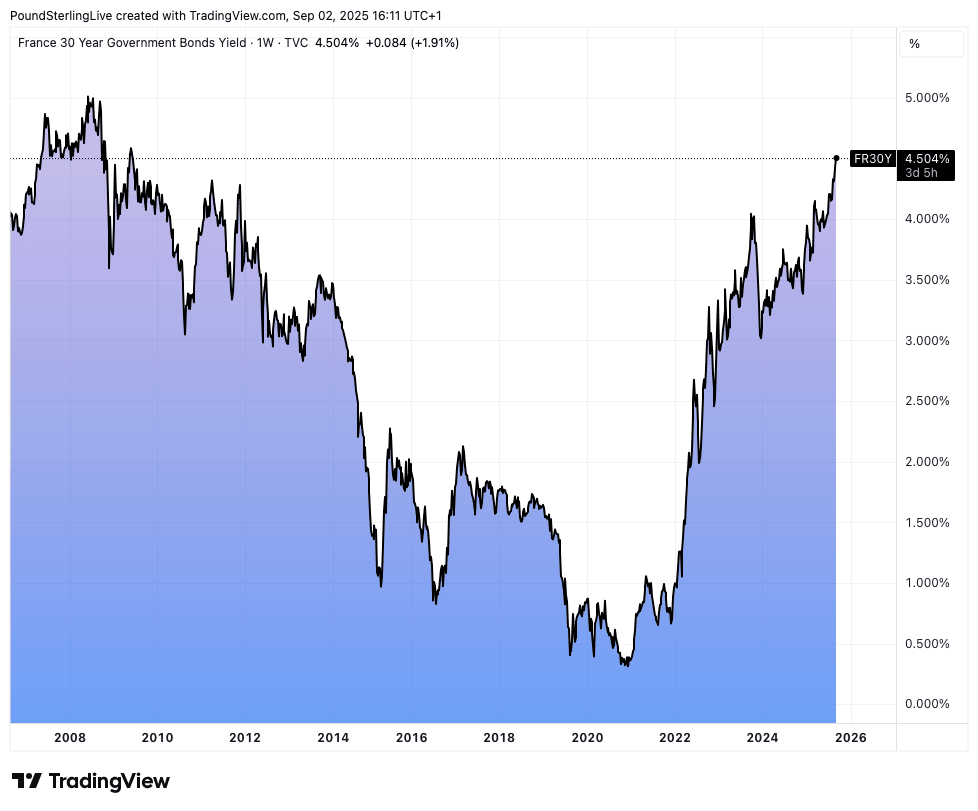
Above: 30-year French bond yields have surged as the corresponding value of the bond falls.
The Euro to Dollar exchange rate (EUR/USD) is lower by 0.35% on the day at 1.1667, but had been as low as 1.1612 earlier. If you are concerned about your euro payment budget, consider locking in current rates for use at a future date.
"The dollar is surging against all of its major rivals as a series of idiosyncratic events unleash turbulence across fixed-income markets," he adds.
In Japan, rates are climbing on news that Liberal Democratic Party Secretary Hiroshi Moriyama intends to resign, threatening to undermine Prime Minister Shiguru Ishiba's leadership.
Consensus projections for the next four quarters, compiled from leading investment banks.
Access the full forecast →
In the U.S., President Donald Trump's attacks on the Federal Reserve are eroding the central bank’s credibility, adding to the term premia built into long-term Treasury yields.
But, Schamotta points out a more fundamental issue:
"In short, yield may be rising not solely because of regional political dysfunction, but because the broader ecosystem has shifted: worsening economic efficiency, ageing societies, and weaker global savings all demand greater remuneration for locking in capital over the long haul."