
Image © Adobe Images
Wages are up, but job losses are mounting.
The British pound rose against the euro and dollar in the minutes following the release of consensus-beating UK wage data; however, we don't expect gains to persist due to overwhelming evidence of labour market deterioration.
1️⃣ First, the FX-relevant headline: average earnings, including bonus awards, grew 4.7% in the three months to October, said the ONS, a figure which defied consensus expectations for a cooling from 4.8% in September to 4.4%.
The earnings data were therefore unexpectedly strong, and the pound rose in response:
The pound to euro exchange rate rose to 1.1382 in the minutes following the release of the jobs data, having been at 1.1367 ahead of the release.
The pound to dollar exchange rate rose from a low of 1.3355 to 1.3378.
2️⃣ Unemployment is rising.
Despite the wage news lifting the pound, we think gains will be limited as it is hard to imagine wage pressures persisting from here:
The ONS also said its measure of payrolled employment showed a further fall in those in work of 38K, while the revised estimate of payrolled workers in October 2025 showed a decrease of 22K.
The UK unemployment rate climbed to 5.1%, a five-year high.
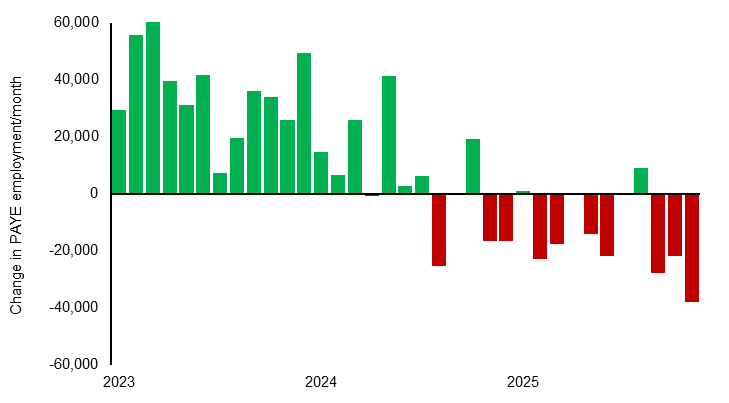
Above: UK payrolls show a clear trend since the 2024 election. Image courtesy of Simon French at Panmure Liberum.
📉 The chart above tells a compelling story: job losses are mounting, which means workers will lose bargaining power with employers, denting the advance in wages.
The Bank of England is acutely aware of how unemployment plugs into wage dynamics and, therefore inflation: falling employment and wages lower the pressure on inflation.
The Bank will cut interest rates to help businesses and households, and it will believe it can do so without risking stimulating inflation.
Given this, a rate cut at this Thursday's meeting is a shoo-in.
Consensus projections for the next four quarters, compiled from leading investment banks.
Access the full forecast →
3️⃣ Cutting up the data reveals gloomy undercurrents.
Breaking down the data, we see median pay growth is down to 2.7% y/y in November, which is entirely consistent with headline inflation falling back to 2.0%.
Slicing the data further shows that, incredibly, annual average regular earnings growth was 7.6% for the public sector and just 3.9% for the private sector.
Government spending is therefore propping up wage increases.
"The latest data paints a gloomy picture for jobs, opportunities and growth. It reflects what businesses tell us – they are less confident about hiring staff due to sky-high employment costs and a tidal wave of new employment legislation coming down the track," says Jane Gratton, Deputy Director of Public Policy at the British Chambers of Commerce.
✳️ Secure today's exchange rate for a future payment. You may also book an order to trigger your purchase when your ideal rate is achieved. Learn more.
The Bank of England will cut interest rates on Thursday, and the trajectory of the economy suggests further cuts in 2026.
With other central banks having ended their cutting cycles, this makes the Bank of England an outlier (alongside the Fed). It means a faster fall for UK bond yields relative to elsewhere, which will mechanically weigh on the pound against non-USD currencies.
4️⃣ Digging further into the numbers reveals more worrying news: the number of redundancies (layoffs) rose to its highest level since February 2021, reaching 5.3 per 1,000 employees in the three months to October.
This is from 3.5 in the prior three months. Andrew Wishart, Senior UK Economist at Berenberg, explains why this is significant:
"Concurrently, the increase in the unemployment rate to 5.1% in August-October from 4.7% in the previous three-month period was mainly due to a fall in employment. That makes it much more worrying than the previous increase in the jobless rate in the workforce due to an increase in workforce participation."
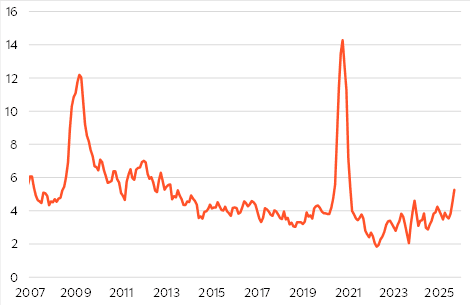
Above: "Redundancies approach recession threshold" - Berenberg.
Berenberg says the Bank of England will lower Bank Rate by 25 basis points on Thursday and will repeat the exercise on three further occasions next year, taking Bank Rate to 3.00%.
"Lower inflation enables the BoE to prioritise stimulating a recovery in demand to stem job losses," says Wishart.
Four more rate cuts from here would more than the market anticipates (just two more). If the view that more are required is adopted, UK bond yields and the pound will inevitably adjust lower.
✳️ Secure today's exchange rate for a future payment. You may also book an order to trigger your purchase when your ideal rate is achieved. Learn more.