Image © Adobe Images
A new high for the Euro leaves it needing a period on the sidelines.
The odds of a pullback in the Euro to Dollar exchange rate (EUR/USD) are growing with technical readings suggesting it has gone too far, too soon over recent hours.
"The EUR is currently on course for fifth straight daily gain; we have not witnessed such an extended run since the start of July 2024. Having traded a fresh year-to-date high at 1.1641 yesterday, 10 ticks above the previous extreme," says Jeremy Stretch, analyst at CIBC Capital Markets.
The pair reached a new high at 1.1641 on the sigh of relief that followed news of a truce between Israel and Iran in the Middle East, a development that sent oil prices and the dollar lower.
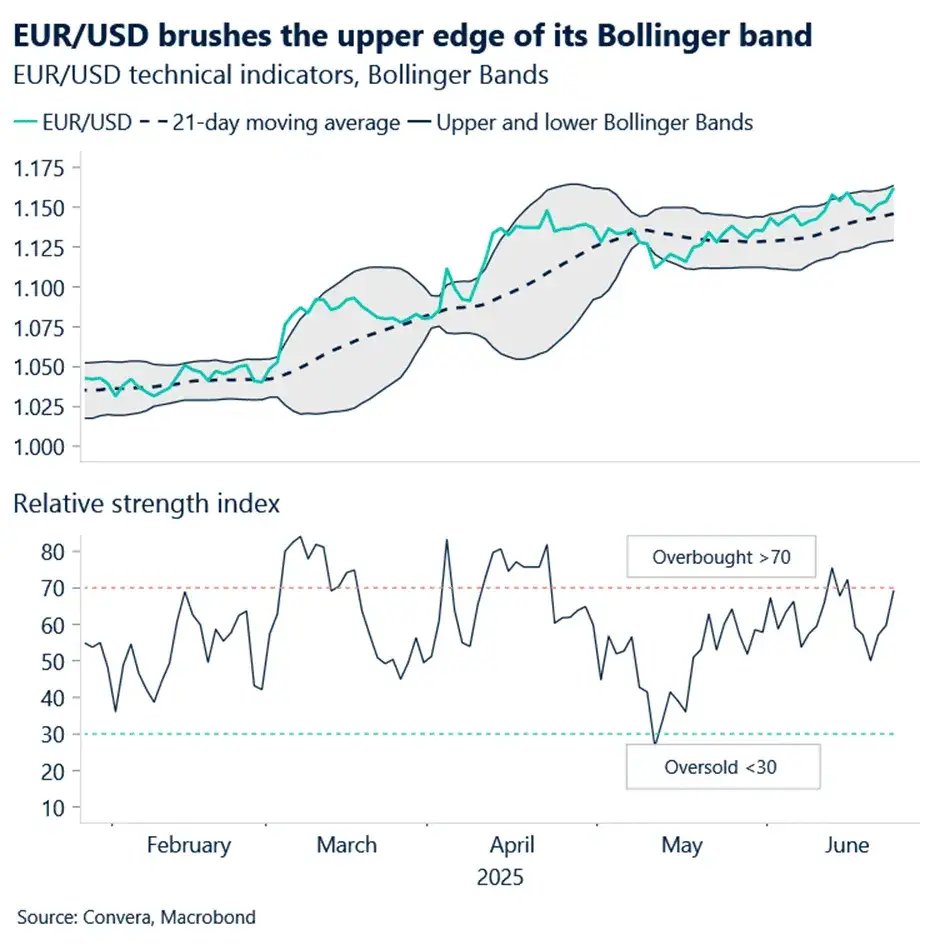
"The pair is up nearly 12% YTD, trading well above its major moving averages and brushing the upper edge of its Bollinger band," says Antonio Ruggiero, FX & Macro Strategist at Convera.
Above image courtesy of Convera.
The upper band is two standard deviations from the simple moving average of the exchange rate, which captures approximately 95% of the price data when assuming a normal distribution.
Reaching the upper band signals potential overbought conditions and heightened odds of a retreat back to the middle of the range occupied by the moving average.
Although the Bollinger band indicates overbought, we note the Relative Strength Index (RSI) is not verifying the signal. Typically, an RSI of 70 and above reflects overbought. However, the EUR/USD on the daily chart shows an RSI of 65.
"On a very short term basis we could be a bit toppy in EUR but the USD is not really impressing folks at this time either, and it's hard to build a short in EUR/USD with the USD so erratic," says W. Brad Bechtel, Global Head of FX at Jefferies Bank.
Any dollar strength in the near term looks likely to be short-lived, owing to the compelling fundamental arguments that run against it. Falling oil prices and the abandonment of safety assets are not the only headwind to the dollar; the Federal Reserve is indicating it might be inclined to cut interest rates sooner than previously expected.
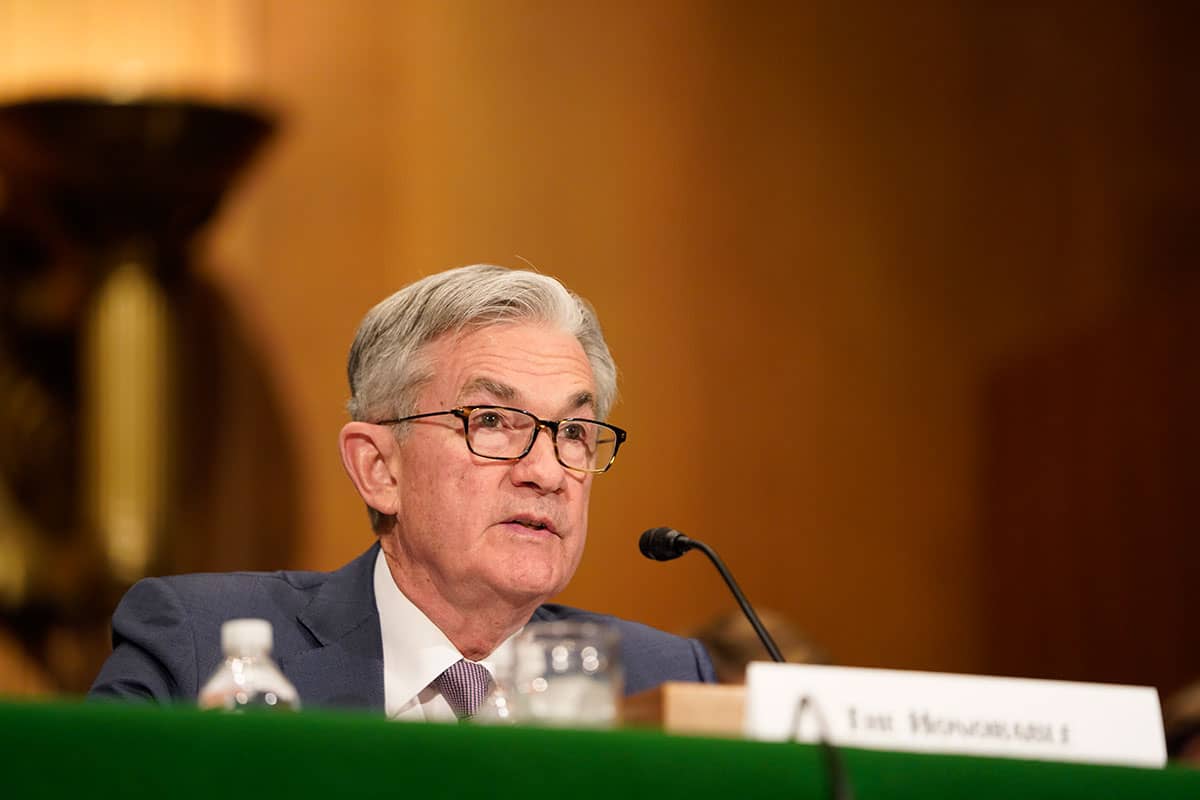
Federal Reserve Chair Jerome Powell said in a testimony to U.S. lawmakers that lower inflation and/or a weakening labour market could mean an earlier rate cut.
Above: File image of Federal Reserve Chairman Jerome Powell. Image © Federal Reserve.
This is the first time in a long time that a sentiment in favour of lowering rates has been expressed, and this encouraged markets to price in greater odds of a July rate cut.
The hint at an "earlier rate cut" echoes communications from fellow Fed members Michelle Bowman and Christopher J. Waller, suggesting a growing consensus that the central bank could afford to cut interest rates sooner rather than later.
Bowman this week called for an interest rate cut as soon as July, saying President Donald Trump’s trade war would have a smaller effect on inflation than some economists fear.
Waller said the Fed should not wait for the labour market to weaken. He said the Fed could act as soon as next month, citing the fact that its main reason for holding off, price increases from the president’s tariffs, may prove only temporary.
The fundamentals remain aligned for further U.S. Dollar weakness, even if a near-term rebound that pressures Euro-Dollar lower, is increasingly likely.
"Feels like we are in for another leg lower as we enter Q3 and into year end. I could see us closer to 1.1800 by the end of the year, maybe even a bit higher in EUR/USD," says Bechtel.