- EUR/USD aiming for 1.13
- Ahead of a resumption of the rally
- Softening inflation to deepen ECB rate cut profile
- USD could rebound on a successful Trump-Jinping call

Image © Adobe Images
The Euro to Dollar exchange rate (EUR/USD) can retreat further.
The Euro could lose further altitude on a combination of a 'dovish' European Central Bank (ECB) policy decision on Thursday and hopes that a direct call between the leaders of China and the U.S. will put a recent trade accord back on track.
"We think the pair can settle back close to 1.13 over the coming weeks, and that short-term rallies may still lose steam as they approach 1.150," says Francesco Pesole, FX Strategist at ING Bank.
Weighing on the Euro somewhat in the past 24 hours was news that domestically generated inflation - core inflation - had fallen to well within the ECB's comfort zone, raising the prospect of further interest rate cuts beyond Thursday's anticipated 25 basis point reduction.
Headline Eurozone CPI fell to below the ECB's 2.0% target, having reached 1.9% year-on-year in May, but the more relevant news for policy makers was that core CPI inflation fell to 2.3%, significantly lower than April's 2.7% and below consensus estimates for 2.5%.
"The euro faced selling pressure on Tuesday, weighed down by softer-than-expected inflation data and stronger US economic releases, reinforcing short-term headwinds for the currency," says George Vessey, Lead FX & Macro Strategist at Convera.
The ECB will reflect on these inflation figures in a Thursday policy decision that will see another rate cut, taking the main policy rate to 2.0%.
If new guidance shows the Bank is warming to an 'easier' stance on policy in light of inflation, the Euro can fall further.
"Eurozone inflation figures incidentally increased the chance of a more dovish message by the ECB. Aside from the print below the 2.0% target in headline inflation, core decelerated quite abruptly, from 2.7% to 2.3%," says Pesole.
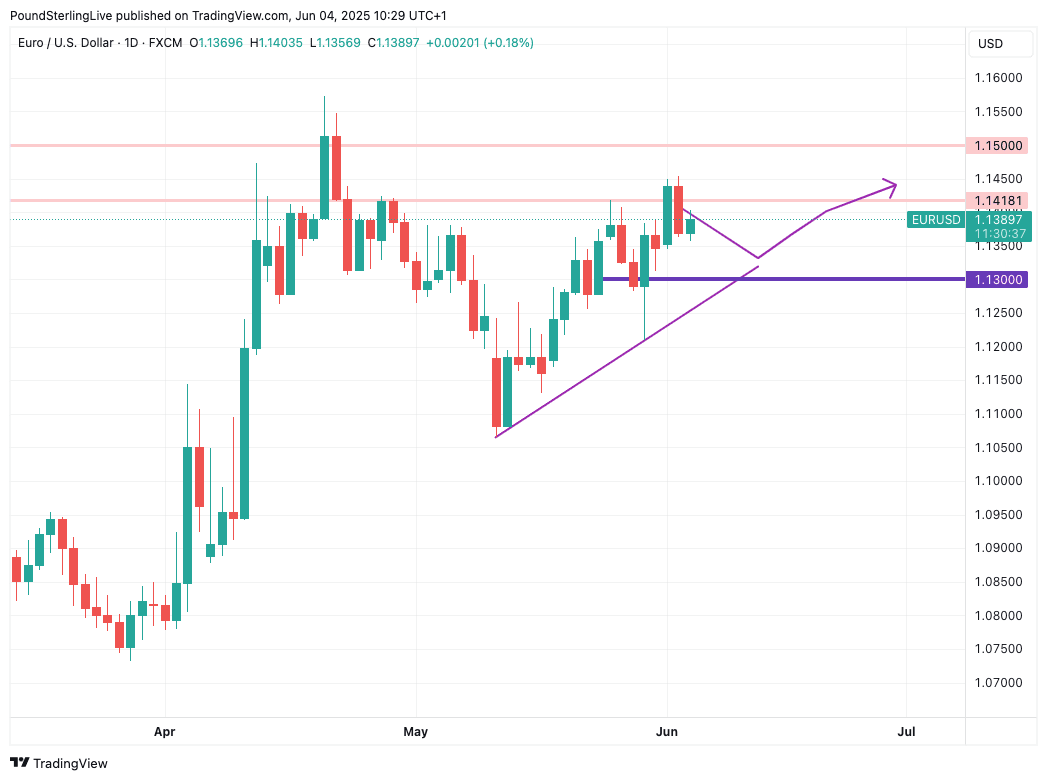
Above: EUR/USD at daily intervals.
Consensus projections for the next four quarters, compiled from leading investment banks.
Access the full forecast →
"While the longer-term EUR/USD trend is still likely to remain supportive amid ongoing concerns about the US debt situation, in the near term some weakness shouldn’t come as a major surprise," says Fawad Razaqzada, Market Analyst at City Index. "Support zones to watch lie at 1.1300 and around the 1.1215–1.1220 range."
The Dollar side of the equation could also apply downside pressure on Euro-Dollar, with a highly anticipated call between China's Xi Jinping and U.S. President Donald Trump mooted to take place soon.
Investors hope that it will unlock progress between the two countries in implementing a May trade accord that would lead to lower tariffs and put lingering fears of an all-out trade war to rest.
For the Dollar, which has been stung by trade tensions and waning international investor enthusiasm for a more erratic United States, this would offer a boost.
"Trump said Xi Jinping is difficult to make a deal with, as markets await details on the scheduled call between the two leaders this week. There is some positive USD potential here," says Pesole, referring to a late-Tuesday social media post made by Trump.
"Recently, such direct talks have eased trade pressures, and in our view, there is potential for a temporary uptick in the dollar after the event," he explains.
The Dollar fell after Trump on the weekend said China "totally violated" the U.S.-China trade reset announced in May, suggesting the improvement in sentiment on trade had ended.
U.S. Trade Representative Jamieson Greer, who helped establish the agreement made between the U.S. and China in Geneva, said China has been "slow" in rolling out its compliance to the recent trade agreement, "which is completely unacceptable and has to be addressed."
He said China has not followed through on withdrawing additional retaliation to earlier U.S. tariffs, such as curbing exports of rare earths that are critical to the tech, auto, aerospace, and defence sectors.
"If bilateral relations between the US and China sour further, the U.S. and Chinese governments may reinstate tariffs and non‑tariff measures on each other," says Kristina Clifton, Senior Currency Strategist at Commonwealth Bank.
GBP/USD trades at 1.3536 at the time of writing, with the 2025 high at 1.36, reached on May 26.
In the wake of a positive Trump-Jinping call, the exchange rate could extend a retreat back down to 1.3479, and then to graphical horizontal support at 1.3441.
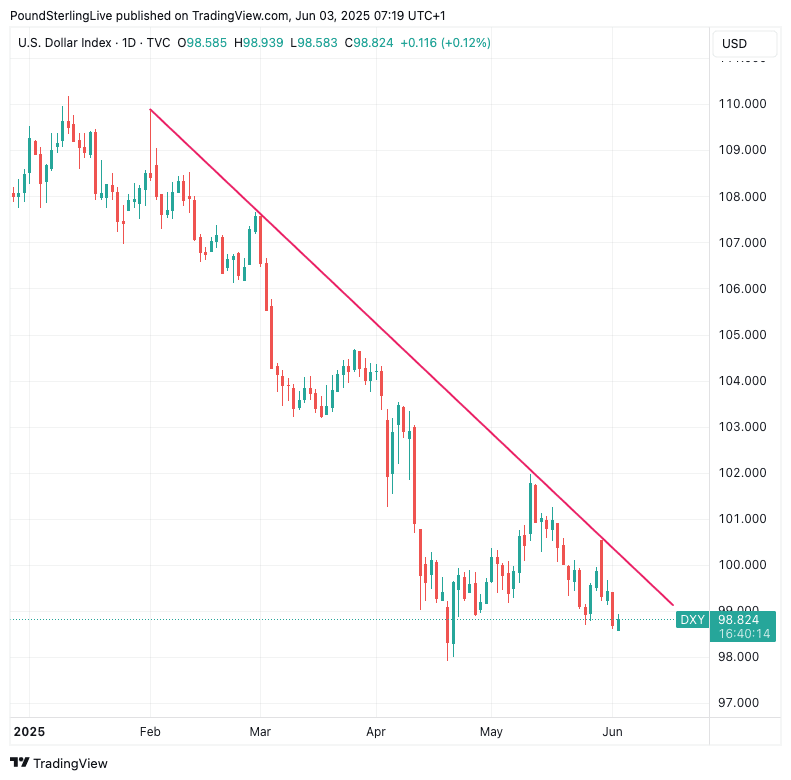
Above: The Dollar index is carving out a discernible downtrend.
Highly accurate consensus projections for the next four quarters, compiled from leading investment banks.
Access the full forecast →
This pullback would still be in keeping with our GBP/USD Week Ahead Forecast, which called for a near-term pullback ahead of an extension higher to fresh multi-year highs.
However, even if GBP/USD declines on trade positivity, analysts point out that periods of USD strength are ultimately likely to prove short-lived as the bigger trend is towards a weakening Dollar.
"We believe that the longer-term USD slide is just beginning, but this will be a marathon, not a sprint," says Mark McCormick, an analyst at TD Securities.
An additional concern for the Dollar is America's ballooning debt pile, which will become embedded by the imminent passing of Trump's Big Beautiful Bill, which will add $3.8 trillion to the $36 trillion national debt, according to the non-partisan Congressional Budget Office,
"With or without the bill, the U.S.' debt trajectory is unsustainable in the long run," says Rogier Quaedvlieg, an economist at ABN AMRO Bank N.V.
"The impact is also less sudden and dramatic, leaving more scope for this to play out over a longer period of time. The fiscal largesse points to upside risks to US long-term interest rates, which could eventually prove to be a headwind for both the economy and financial markets," he warns.
A huge portion of this debt will need to be financed by foreigners. However, the same bill makes provisions for the U.S. to arbitrarily tax the same foreigners in order to allow the administration to pursue its geopolitical agendas.
Analysts warn this 'revenge tax' will deter foreign investment when it is most needed, which will further undermine the Dollar.