- German economy reaches "escape velocity"
- UBS are buyers of EURUSD at current levels
- But Soc Gen says to temper enthusiasm
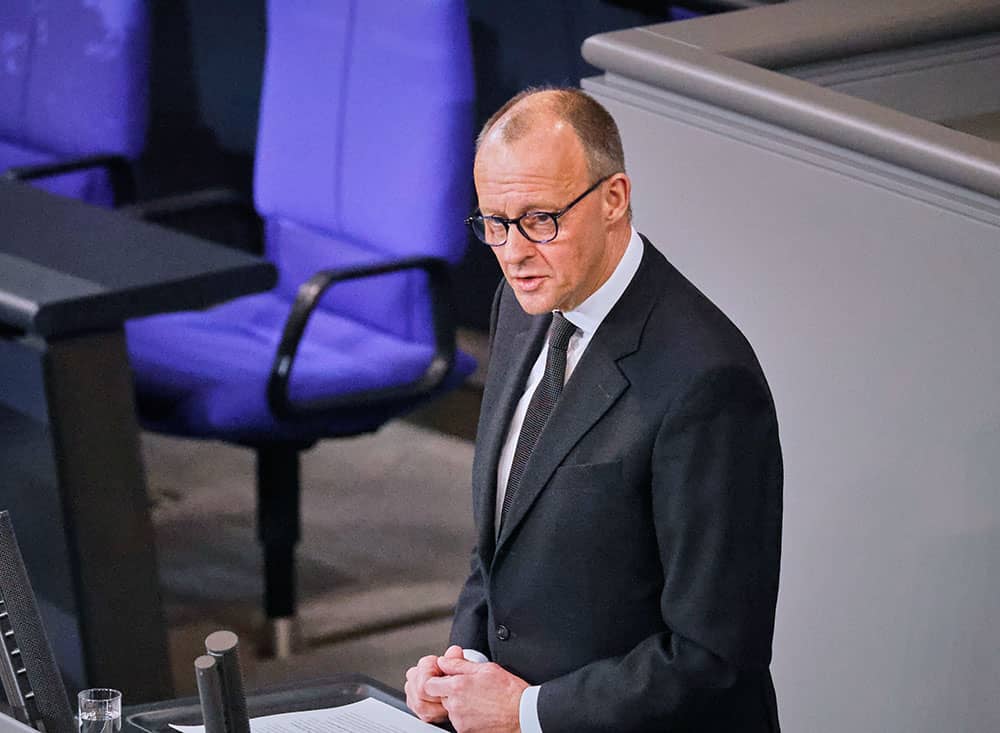
German economic revival can keep the Euro ascendant. Photographer: Marc Beckmann.
The Euro to Dollar exchange rate (EUR/USD) is on the rise again, helped by the broader USD decline and some good news out of Germany.
Europe's largest economy said its GDP data showed growth of 0.4% q/q in Q1, leading analysts at Deutsche Bank to say it has reached "escape velocity... we believe the German economy has gained sufficient momentum to escape stagnation this year."
Tariff front-loading, strong consumer demand and improved construction sector output all played a part in the strong outturn.
"We believe prevailing consensus forecasts for Germany – predicting another year of stagnation – are overly pessimistic," says Robin Winkler, Chief Economist at Deutsche Bank.
Hopes for a German economic revival under the new government of Chancellor Merz have been the lynchpin that has driven investors into the currency in 2025, judging that a genuine opportunity for Europe to play catch-up with the U.S. has emerged.
Holger Schmieding, an economist at Berenberg Bank, says "Europe is back", following an investor conference his bank hosted in New York this week.
"The U.S. looks less attractive due to the unsettling antics of President Donald Trump," he briefs following meetings with investors. "In Europe, Germany is finally assuming the leadership role which it should have played for the last 15 years already."
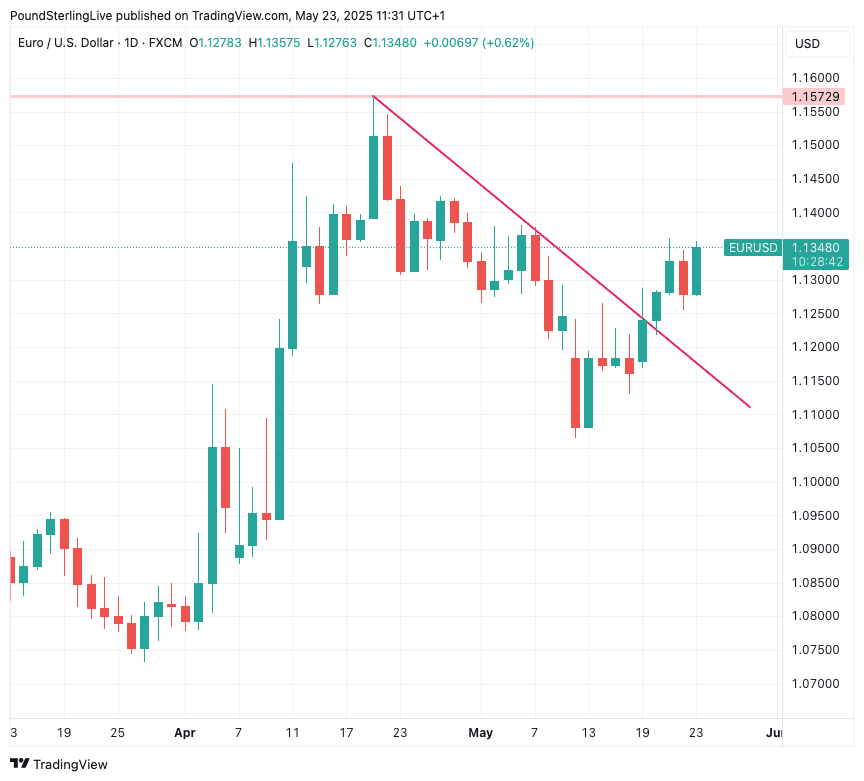
Above: EUR/USD is on the move again, breaking above a downward sloping trend line that determined the recent pullback.
Consensus projections for the next four quarters, compiled from leading investment banks.
Access the full forecast →
Euro-Dollar has risen 9.56% in 2025 as U.S. exceptionalism gives way to a 'sell America' theme, with investors seeking alternative destinations to invest.
"We think the euro is continuing to benefit from being the most liquid alternative to the dollar. There is also evidence that portfolio re-allocation is helping the euro," says Chris Turner, Head of FX Research at ING Bank.
The exchange rate peaked at 1.1572 on April 21 but then entered a consolidative phase with a retreat extending back to 1.11. Weakness found solid demand, and we could be witnessing a leg back to the 2025 highs.
With the Pound-Dollar exchange rate having broken to new three-year highs this week, the odds of Euro-Dollar eventually also delivering a break are elevated.
"We regard the recent consolidation to 1.12-1.13 as an attractive entry level to position for a higher EURUSD," says Constantin Bolz, FX strategist at UBS.
"Europe is shifting to fiscal expansion—especially with Germany lifting its debt brake and higher defence spending—supporting Eurozone growth above 1%. As European growth stabilises, monetary easing ends. As a result, we see scope for EURUSD to move higher," adds Bolz.
A list of risk factors leads UBS to conclude that "EURUSD is more likely to move to 1.20 instead of 1.10 in the coming quarters."
These include:
- The retirement and replacement of Federal Reserve Chair Jerome Powell in May 2026, where President Donald Trump could install someone who is far more likely to err towards cutting interest rates.
- Any move toward peace in Ukraine should support the euro.
- Weakening U.S. economic data could prompt markets to price in more Fed easing than currently expected.
However, not all analysts think now is the time to chase the Euro higher.
Analysts at Société Générale warn that there is already a degree of good news in the price, and investors should keep in mind lingering question marks that might put a dampener on sentiment.
"EUR/USD recovered from below 1.12 but the lack of progress on US/EU tariff negotiations and Russia’s refusal to negotiate peace cast doubts over the outlook fo the single currency. The underwhelming PMIs and lower oil prices reinforced the case for a 25bp rate cut by the ECB in June," says Kenneth Broux, a strategist at Société Générale.
The Eurozone's composite PMI for May fell to 49.5 from 50.4, undershooting expectations for 50.7.
Services disappointed at 48.9, down from 50.1 in April. However, a manufacturing recovery continues and the sector's reading of 49.4 suggests it could soon emerge into contractionary territory (i.e. a reading above 50).
Despite this manufacturing recovery, it is the composite PMI measure that the European Central Bank will watch, and it might be inclined to cut interest rates further to support economic activity.
A quicker pace of cuts from the ECB relative to the Federal Reserve and Bank of England might yet prove a headwind to the Euro going forward.