Official White House Photo by Daniel Torok
"Distrust of the USD" will impact the outlook, says HSBC.
A new note on the Dollar outlook warns that "ongoing distrust of the USD" will leave it "in a soft position over the coming quarters."
HSBC analysts say that although the U.S. Dollar has stabilised recently, "it remains in a weaker state overall because a sense of unease persists."
But how can "mistrust" be quantified and is there a correlation with the currency's performance?
Researchers at the UK bank say a loss of trust in the USD is evident in how it is trading weaker than what its weighted interest rate differential implies.
"This is very different to earlier this year when the DXY traded at a meaningful premium versus its relationship with the interest rate differential. More recently, it suggests the DXY should be closer to 104 but we can also understand why this cyclical influence is not working. It is very possible the DXY's weakness is saying something else, including a belief that the Fed may need to cut more than what is currently priced or other forces are having a greater role. It represents a lack of trust," notes HSBC.
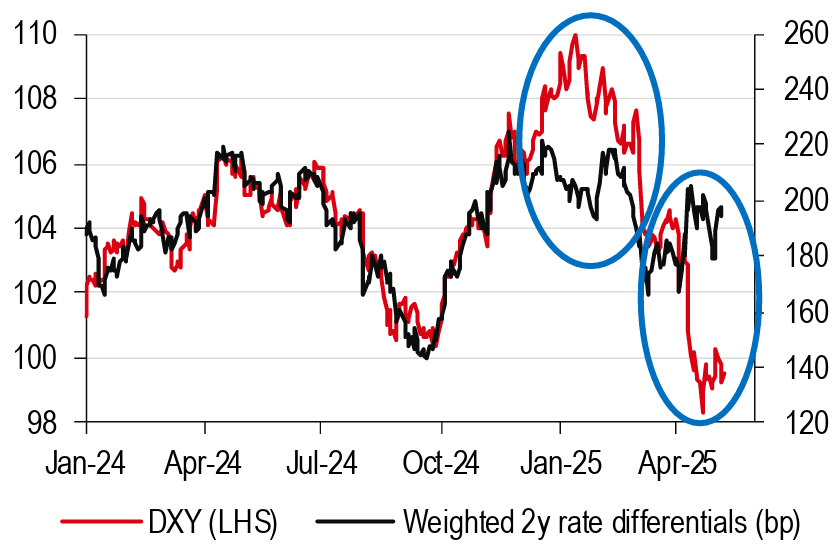
Above: The Dollar index is showing a premium that HSBC says reflects a trust deficit. Image courtesy of HSBC.
Highly accurate consensus projections for the next four quarters, compiled from leading investment banks.
Access the full forecast →
Analysts have now had the chance to take stock of FX markets in the wake of President Donald Trump's 'liberation day' tariffs, which triggered a significant selloff in U.S. assets.
They find the cyclical backdrop and U.S. policy uncertainty are now less supportive of the USD, and its structural properties could become more USD negative.
"We think the currency is poised for gains as real rate differentials play a more supportive role, but it could take time for the 'Sell America' theme to dissipate – and for trust levels to recover," says Karl Schamotta, analyst at Corpay.
Recent years have been characterised by a U.S. 'exceptionalism' mentality, where global investors bought U.S. assets to gain exposure to an economy that was outperforming its global peers.
However, Donald Trump thinks much of this outperformance is due to excessive government spending, while the trade imbalance is unsustainable.
His efforts to rectify the imbalances he sees have, however, often proven chaotic and have resulted in a notable loss in confidence amongst investors.
"Markets may recover quickly from this episode. But it will likely take some time before confidence is restored among consumers, corporates, and foreigners," says Torsten Slok, Chief Economist at Apollo Asset Management.
These findings by foreign currency analysts point to ongoing weakness in the Dollar and a gradual decline from the highs that it scaled during the U.S. exceptionalism phase.
However, a word of caution from HSBC is that the global outlook argues against being overly negative on the currency as "the USD usually performs better when the global economy is slowing."