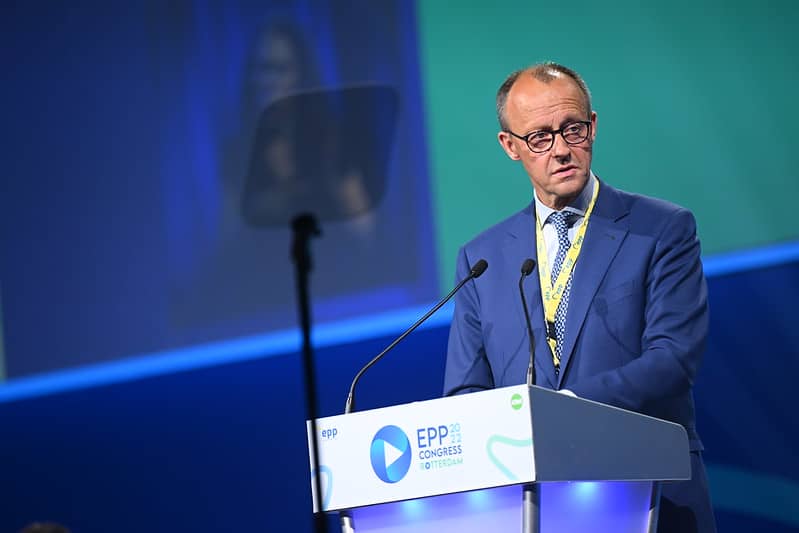
Above: File image of Freidrich Merz. Image source & rights: EPP Official.
The Euro will likely remain supported against the Dollar in a week dominated by German politics and the Federal Reserve decision.
The Euro to Dollar exchange rate (EUR/USD) trades with a mild upside bias on Tuesday, riding through news that Friedrich Merz failed to get the votes required to become Germany's next Chancellor.
Merz expected the vote to usher him into Germany's top leadership spot; however, he fell six votes shy of the required majority.
A key tenet of the Euro's rally in 2025 is the new era of German investment that Merz has promised, with significant spending earmarked for defence and infrastructure.
The Euro showed little concern about the headlines, holding onto the day's gains, which suggests the market does not expect this to be anything but a minor setback, as subsequent votes will likely see Merz garner the additional six votes he requires.
EUR/USD reached a peak of 1.1572 two weeks ago, but has since pulled back and entered a consolidative phase.
The broader uptrend is still intact and the next major directional move is therefore likely to be to the upside, but the near-term could see more of the same.
This means we look for trade to be confined to the vicinity of the 9-day exponential moving average, currently located at 1.1330, in the coming days. Support comes in at 1.1271, which marks last week's lows (and the low on April 15) that continues to find strong buying interest.
This is a dip-buying market, which should limit weakness in the exchange rate.
Should the trend higher extend, then a rise to 1.14 becomes likely ahead of 1.1572.
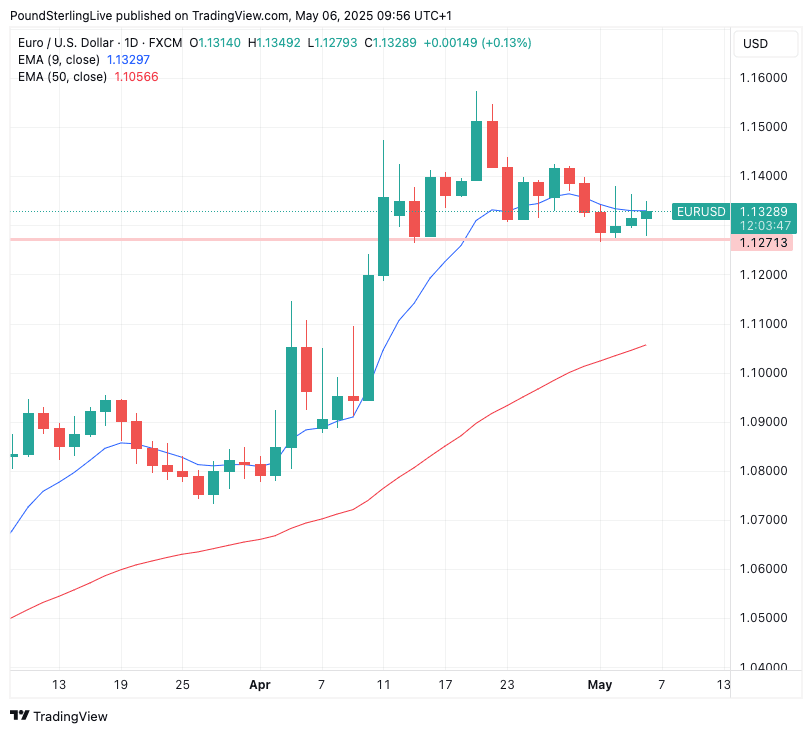
Above: EUR/USD at daily intervals.
Consensus projections for the next four quarters, compiled from leading investment banks.
Access the full forecast →
The midweek Federal Reserve policy decision is the week's main calendar event for the Dollar, and therefore should impact on Euro-Dollar trade.
The Fed has a lot to contend with, including tariffs that Federal Reserve Chair Jerome Powell has said are far more severe than he had expected. So comments and guidance will make for interesting reading.
The negative economic implications of the tariffs should, theoretically, invoke caution and potentially push the Fed to cut interest rates. In fact, the market has built up bets that some 'insurance' rate cuts will be forthcoming.
However, this caution is not yet obvious in the official data, with last week's employment report beating expectations and indicating ongoing resilience in the labour market.
So although survey evidence points to a weakening economy, there is nothing yet to warrant a major response from the Fed.
"We expect Chair Powell to remain noncommittal, and say policy is well positioned to wait," says Jonathan Pingle, an economist at UBS.
This means 'more of the same' for the Dollar (slow-burn weakness), and any post-Fed kneejerk reactions should be faded, allowing Euro-Dollar to remain relatively well supported.