
The British Pound to Euro exchange rate has bounced off a solid line of support which gives us some good ideas as to where the recovery could extend to.
GBP/EUR trades at 1.1157 at the start of the new month with the notable support level at 1.1078 proving its predictive powers remain intact.
We reported recently that Thomas Anthonj, a technical strategist at investment bank JPMorgan, was only looking for further weakness in GBP/EUR should the pair break below 1.1078.
If the level was defended further gains would remain possible.
At the time of the report of the publication we drew out the relevant levels set out by Anthonj as follows:
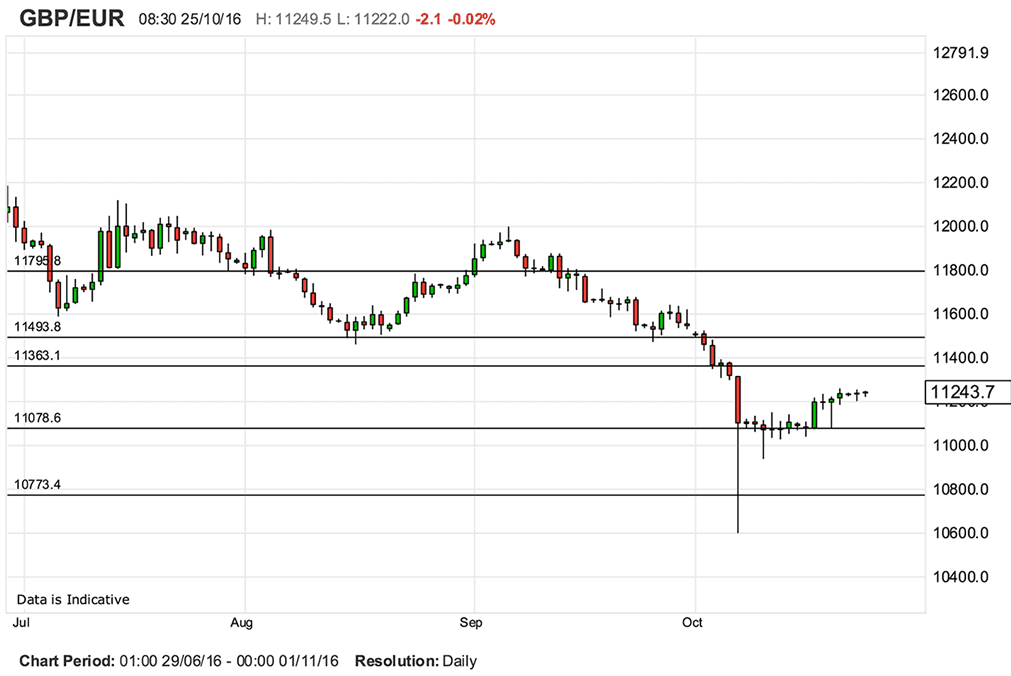
At the time of writing we see that support at 1.1078 appears to have held and a bounce higher is underway.
We can make out the next graphical levels that are relevant - to the upside the target would be resistance at 1.1490-1.15:
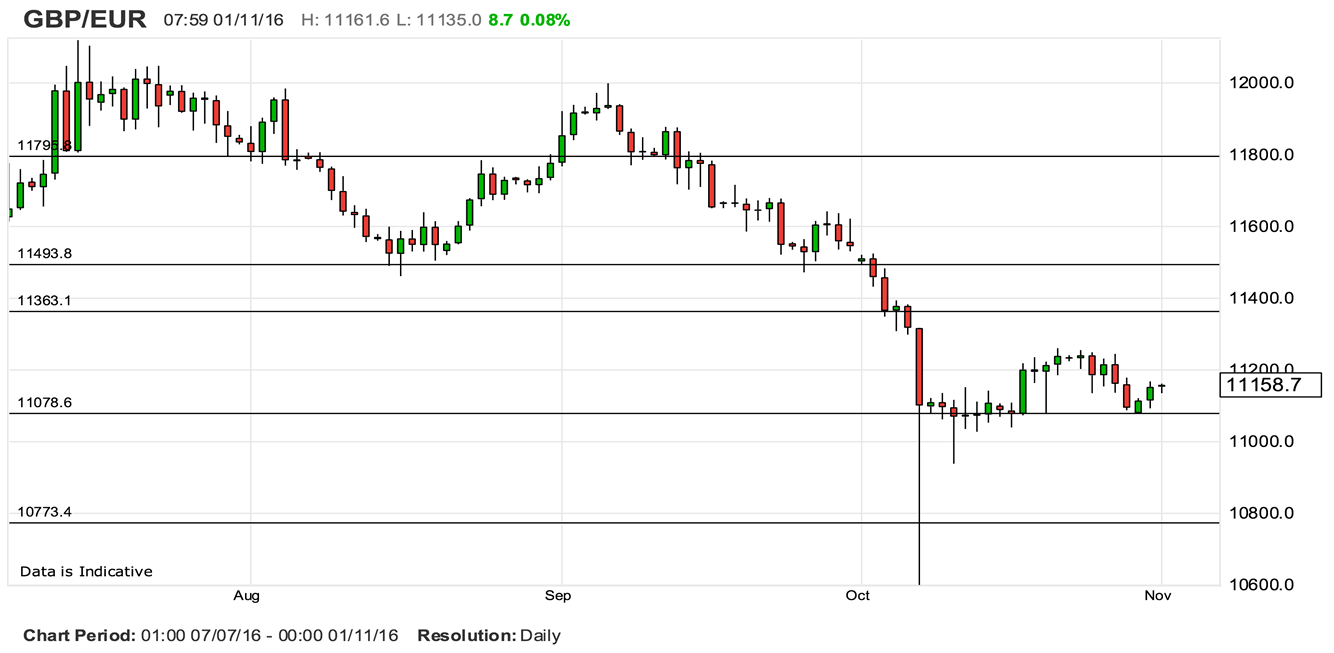
Our own studies also suggest gains are possible from here.
The Pound to Euro exchange rate has pulled back lower after hitting a tough ceiling of resistance at a major downtrend line.
In the process, it has corrected back from the 1.12s to the 1.10s:
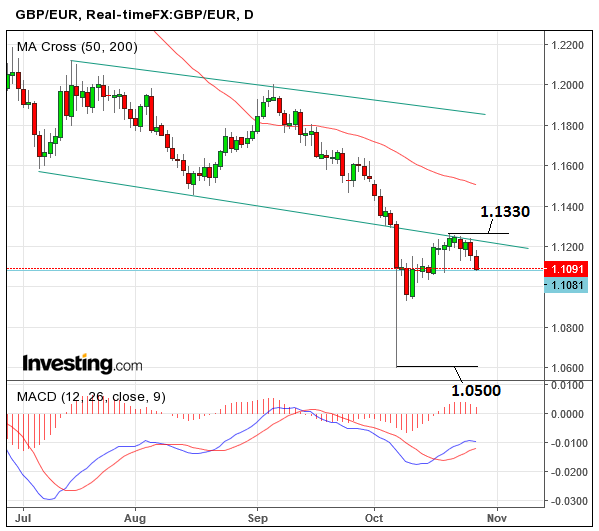
The long exhaustion bar formed by October's infamous flash-crash indicates the probability that a significant market bottom may have been established.
If the pair breaks above the trend-line and the 1.1265 highs, it is likely to continue up to a target at 1.1330.
It would take a break below the 1.0600 lows to confirm a continuation of the downtrend to a target at 1.0500.
Latest Pound/Euro Exchange Rates
  | Live: 1.1767▲ + 0.26%12 Month Best:1.1828 |
*Your Bank's Retail Rate
| 1.1367 - 1.1414 |
**Independent Specialist | 1.1602 - 1.1649 Find out why this is a better rate |
* Bank rates according to latest IMTI data.
** RationalFX dealing desk quotation.
Fundamental Themes for the Pound: Bank of England Interest Rate Decision, PMIs Due for Release
Sterling trades firmer on news that the Bank of England's Governor Carney has opted to stay in his role until 2019 which puts to bed speculation regarding his future at the Bank.
The period would, importantly, cover the period of negotiations surrounding Brexit which could see heightened market moves.
"The markets are breathing a collective sigh of relief that Carney has extended his term, after all, if he extended it once, could he do so again? The pound has enjoyed a major turnaround, and is the best performing currency in the G10 at the start of this week. It is higher by a decent 0.5% against both the USD and the euro, and has also done well against the yen," says Kathleen Brooks at City Index.
The highlight of the event calendar for the Pound is whether the Bank Of England (BOE) cuts interest rates any lower at its quarterly inflation report on Thursday.
Markets appear to be attributing a roughly 50/50 chance to the possibility.
The rate decision takes centre stage this week as trader’s position themselves on whether they think the Bank is likely to introduce more stimulus or not.
Recent comments from BoE’s Carney appear to have lowered the probability of another interest rate cut after he said the Bank would consider the impact of future decisions on the already weak pound.
This suggests the BoE may hold fire for fear of weakening the pound, which would make imports more expensive, and risk excessive inflation.
The other main releases in the week ahead are the October Purchasing Manager Indices (PMIs).
Tuesday, November 1 sees the release of theManufacturing PMI for October at 10.30 LT, which is expected to come out at 54.5 from a preliminary estimate of 55.4.
Construction PMI is out on Wednesday at 10.30 and is forecast to moderate to 51.8 from 52.3.
Thursday sees the release of Services PMI at 10.30 which is forecast to come out at 52.1 from a preliminary estimate of 52.6.
Data to Watch for the Euro
The current market consensus view appears to be that the Euro will stay pressured by the European Central Bank (ECB), who are more likely to increase stimulus in December than not, which would weaken the single currency.
The Euro is also subject to downside pressure from political risks in the run-up to an election-intensive year for the Eurozone and increasing support for anti-EU parties across the area.
Monday, October 31 sees a major data release for the Eurozone in the form of the preliminary release of CPI for October.
Wednesday, November 2 is set to be another important day for the Euro as the final estimate for Manufacturing PM in October is released at 11.00 London Time (LT).
On Thursday at 11.00 (LT) the Unemployment rate in the Eurozone will be released, with a drop of a basis point to 10.0% expected.
At 10.00 (LT) on Friday Services PMI for the Eurozone is released, with no change from the preliminary estimate of 53.5 forecast.
And Just Remember...
Sterling remains highly sensitive to Brexit-related headlines and this clear sign of intent for seeking a business-friendly relationship with the EU after exit could well prove beneficial to the currency.
The other major theme for Sterling relates to the current high court challenge to the government’s authority to trigger Article 50 on its own without the agreement of parliament.
The failure of a similar challenge in a high court in Belfast is thought to have set a precedent which the London court is likely to follow.
If the challenge is unsuccessful the Pound could fall; if not it could rally strongly.
It is not clear when the London court will make its decision.