 Our studies on the GBP to EUR exchange rate suggest the pair should trade with a soft tone over coming days should UK data meet or disappoint expectations.
- The Pound to Euro exchange rate today: 1.1820, month-to-date best: 1.1942
- The Euro to Pound Sterling exchange rate today: 0.8461, month-to-date best: 0.8682
Sterling trades a tight range against the Euro at the start of the week with both currencies apparently waiting guidance from external factors until the data calendar picks up on Tuesday.
With that in mind, we would suggest readers keep an eye on the Brainard speech due at 6PM today as expectations for a US Federal Reserve interest rate rise are the number one driver of foreign exchange markets at present.
The GBP/EUR hit the 1.20 mark over the course of the week starting 5th September, before falling back down to the 1.1790s.
The big question now with this pair is whether the pull-back is a just a correction and the exchange rate is about to turn around and go higher again?
Or will the down-turn extend and resume the longer-term bearish trend, which began after Brexit?
A look at the charts may help to resolve the question.
GBP/EUR has fallen for three consecutive days forming a pattern called Three Black Crows, which is a bearish candlestick patten that is used to predict the reversal of the current uptrend.
This is especially the case at the end of a three-wave ABC or ABCD move, as is the case here:
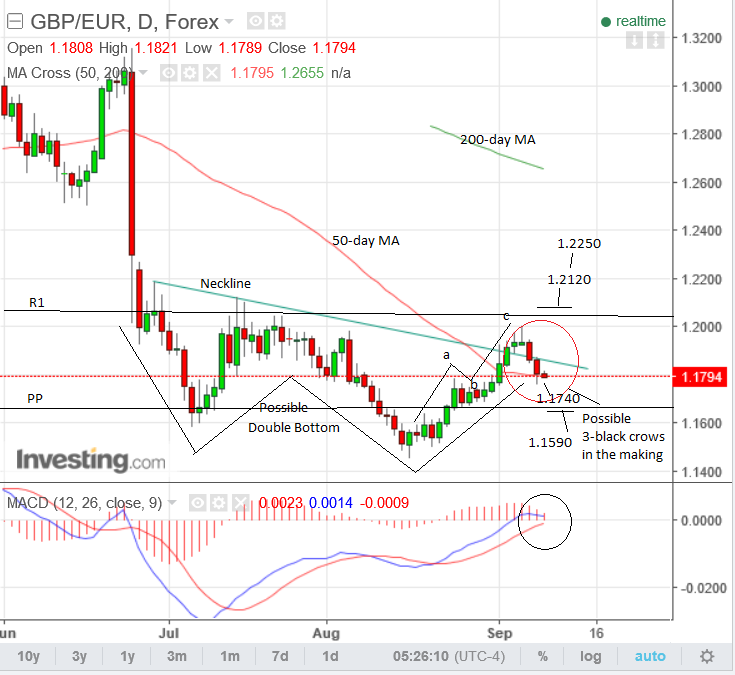
We remain bearish in line with our previous forecast that a break below the 50-day MA would lead to a clean move down to 1.1740.
A further break below an area of support and resistance at the monthly pivot (PP) at 1.1739, confirmed by a move below 1.1700, would signal a continuation down to the August lows at 1.1590.
For a more progressive, bullish, forecast, we would be looking for a clear break above the 1.20 highs and the R1 monthly pivot just above at 1.2020.
Such a clear break would probably be confirmed by a move above 1.2060, to an initial target at 1.2120, followed by an eventual target at 1.2250, based on the calculation using the height of the double-bottom.
The fact the MACD is still above the zero-line supports a bullish case.
The four-hour chart shows the current pull-back from the 1.2006 highs in more detail:
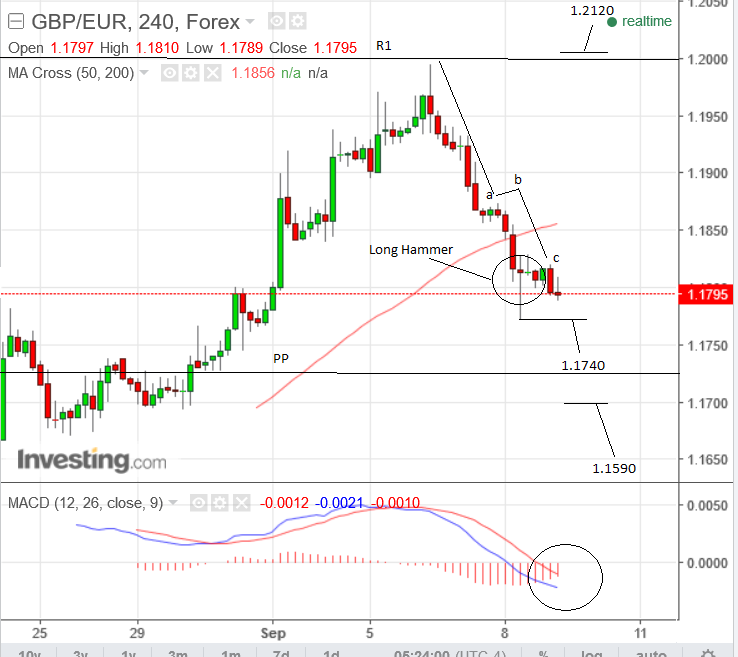
Apart from the steepness of the descent, which is a bearish indicator, the other signs are bullish.
The long hammer candlestick on the chart is a bullish indicator, as is the characteristic 3-wave a-b-c form of the correction.
Nevertheless, a break below the hammer’s lows at 1.1767 would be bearish and lead to a capitulation of bulls, and more downside initially to 1.1740.
The rally to 1.20 was fuelled by a super-charged combination of surprisingly positive data for the period after Brexit and ‘short-covering’ by traders.
Short covering is a phenomenon which occurs when the majority of traders are selling, or ‘shorting’, a currency – in this case sterling - so as to profit from its decline, and the currency suddenly switches direction and starts going higher, taking everyone by surprise.
Latest Pound/Euro Exchange Rates
  | Live: 1.1663▲ + 0.03%12 Month Best:1.1828 |
*Your Bank's Retail Rate
| 1.1266 - 1.1313 |
**Independent Specialist | 1.15 - 1.1546 Find out why this is a better rate |
* Bank rates according to latest IMTI data.
** RationalFX dealing desk quotation.
The ensuing counter-trend move leads many traders to suddenly close their losing short positions, which helps fuel the young move higher and is called a short-covering rally.
On Thursday after tipping 1.20, however, the short-covering rally appeared to end.
The release of sup-par Manufacturing Production data brought Sterling bulls back down to earth after showing a deeper-than-expected -0.8% contraction in August.
The move lower was aided further by the European Central Bank’s (ECB’s) decision to leave policy unchanged which had the effect of strengthening the euro.
A Break of 1.20 Would Turn GBP's Outlook Positive
A lot of good news appears to now be discounted by Sterling's valuation; this is why it appears to have fallen prey to a bout of profit-taking.
For the technical picture of sterling against the euro to improve, Piet Lammens at KBC Markets tells us the GBP to EUR exchange rate should break above 1.1984/1.20 and even 1.2120.
"This looks difficult short-term. A countermove is developing," says Lammens.
GBP/USD also saw a positive momentum develop and a first resistance at 1.3372 was temporary regained.
"1.3481/1.35 is key before concluding the bottoming out process after the steep post-Brexit fall is finished. We expect Sterling’s consolidation/correction on the August rally to continue," says Lammens.
A Big Week for Data Releases Lies Ahead
For sterling it is really all about the Bank of England (BoE) meeting and the release of inflation and employment data.
There will be much speculation as to whether the governor of BoE will increase stimulus measures or not over coming months - further rate cuts and quantitative easing announcements will likely sink Sterling.
Indeed, in his testimony to the House of Commons Select Committee on Thursday the 8th September Carney said that there was still scope to expand stimulus.
However, Carney added that the Current Account deficit, which stands at 7.0% is likely to fall to 4.0% due to Sterling depreciation.
This is an important observation as the UK’s gaping current account deficit is a key vulnerability for Sterling as it suggests a country that imports more than it exports.
This creates a balance between currency inflows and outflows that would normally pressure Sterling lower were it not for the huge sums of currency inflows submitted by foreign investors keen to take advantage of UK investment opportunities.
There are fears Brexit may impact these inflows, thereby removing a key crutch for Sterling. But, as noted, Carney sees the current account deficit coming down on growing exports, thus providing a more stable underpinning for the currency.
The Bank will be wary of implementing any further GBP-negative interest rate cuts or expanding the asset purchase programme should UK data continue to outperform expectations.
The analyst community do not expect the BoE to make any changes next week given how well the UK economy has held up.
“The UK economy is by now holding up better than expected, and that’s why we expect no policy changes from the Bank of England next Thursday,” said analyst Holger Sandte.
With the Bank likely to be focussed on data markets will be keenly anticipating the release of UK inflation data on Tuesday.
CPI is expected to show prices edging up by 0.7% in August as a result of the weaker Pound pushing up the cost of foreign imported goods.
On Wednesday, July Unemployment data and Average Earnings numbers are released.
Earnings are a closely-watched indicator for the Bank of England (BOE) as they see it as a major influence on higher future inflation and growth.
The claimant count is forecast to have risen by 1.5K in August, a deterioration on the previous month’s reading when the claimant count actually fell by 8.6K in spite of analyst expectations for a referendum-inspired increase in unemployment.
Average earnings are forecast to have risen by 2.1%.
Thursday sees the release of Retail Sales.
A number of -0.4% is forecast, down from the previous month’s surprisingly strong 1.4% rise.
The August release was execptional and it triggered the August-September recovery move - will we be in for another GBP-positive shock in September?
From an economic data perspective next week promises to be thin for the euro.
The key release for the Euro comes in the form of inflation data due for release on Thursday, which is forecast to remain at 0.2%.
If marginally lower it may not impact too much, as Draghi’s warning about the threat of low inflation on Thursday may have already prepared markets.