The GBP to EUR conversion has moved higher as a technical 'short squeeze' on the market takes place, further confirming an easing of downside pressures which should come as a relief to those looking to buy Euros over coming months.
- Pound to Euro rate today: 1 GBP = 1.1615 EUR, today's high = 1.1616
- Euro to Pound Sterling exchange rate today: 1 EUR = 0.8625 GBP, today's high = 0.8629
The GBP/EUR pair has moved up from the lows recorded in the mid-1.14s to the 1.16s once more as a long-overdue correction from oversold conditions took place.
Markets remain heavily biased against the UK currency at presesnt with data on the speculative markets from the US COmmodity Futures Trading Commission confirming historically significant 'shorts' on Sterling continuing to define the foreign exchange market.
Therefore, the market will be increasingly resistant to falling as so much of the market are already betting in one direction. When the Pound rises it forces other negative bets to close, creating a chain reaction as more and more negative bets are forced to close.
This explains why the Pound has rallied this week - the market will likely have to rebalance and in doing so the Pound must go higher in what is known as a 'short squeeze'.
The move has been triggered by some better-than-forecast economic data, the highlight of which were UK retail sales which came out better-than-expected with month-on-month sales growing 1.4%.
This has lead many analysts to question their previous bearish assumptions of a post-referendum economy.
The bullish tempo in Sterling saw the currency end the week as the third-best performer in the G10 complex.
This comes after consecutive weeks of taking the wooden spoon for G10 performance.
Only the Euro and Swiss Franc were able to put in greater gains.
Latest Pound/Euro Exchange Rates
  | Live: 1.1659▼ -0.02%12 Month Best:1.1828 |
*Your Bank's Retail Rate
| 1.1263 - 1.1309 |
**Independent Specialist | 1.1496 - 1.1542 Find out why this is a better rate |
* Bank rates according to latest IMTI data.
** RationalFX dealing desk quotation.
Our Studies Confirm Downside Pressures Easing
Looking at the daily chart for clues, we must remember we see that the pair has been in a down-trend since the May highs failed:
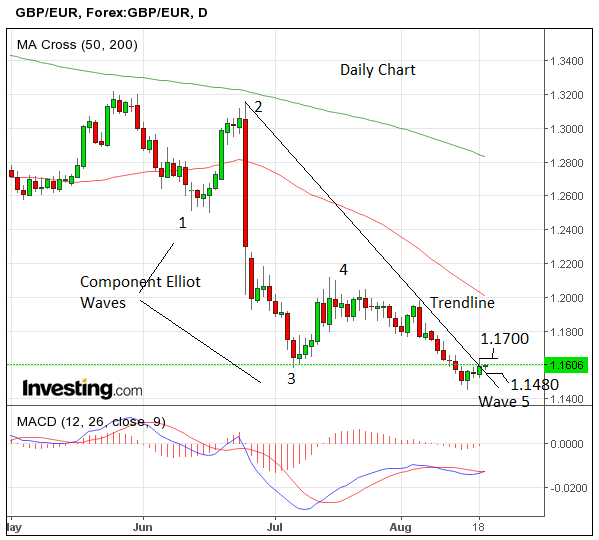
This move lower could well be an Elliot Wave, which has just completed, or is in the process of completing its final component (fifth) wave lower, suggesting a bottom is either currently forming, or close at hand.
The pair has bounced after making a low at 1.1457, and has broken above the trend-line for the move down at circa 1.1570.
On the four hour chart the pair has formed a classic three wave a-b-c reversal and then started weakening just recently:
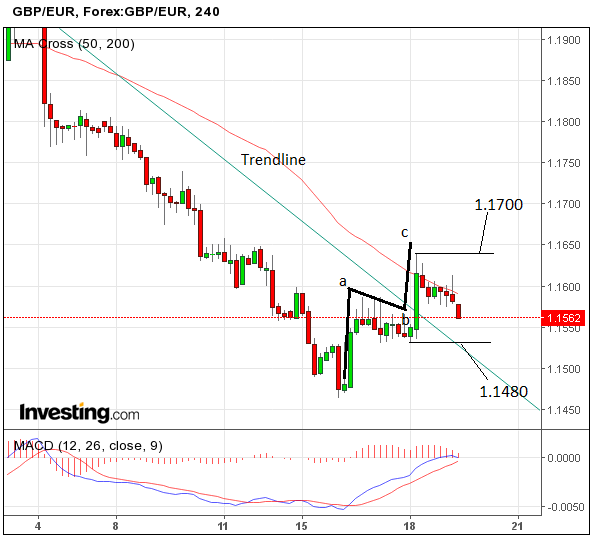
A break below the ‘b’ wave lows at 1.1531 would confirm an extension lower to a target just above the July lows at 1.1480.
A move above the highs at 1.1643 on the other hand, would prove the a-b-c correction was actually the start of a mini-up-trend, and could probably reach a target at 1.1700.
However, analyst Lucy Lillicrap at Associated Foreign Exchange says GBP/EUR has not yet done enough on the upside to secure even an interim low with local supports continuing to attract as a result.
"Buying interest will probably firm again towards the 1.1250 region (keeping 1.1000 out of reach initially) but this still leaves room for further erosion in coming sessions," says Lillicrap.
We are told to Eexpect interim support around 1.1450 then 1.1350 but rallies are acknowledging resistance at 1.1650/60 as well and this latter point must be overcome to reduce even shorter term downside pressure.
"Otherwise new cyclical lows beckon first/next," says Lillicrap.
Critical Week for Eurozone Data, Could Trigger Firmer GBP/EUR
One of the most important factors in determining the direction of GBP/EUR is the difference in the expected trajectory in central bank policy.
Currently many analysts still expect the European Central Bank (ECB) to increase stimulus at its September meeting despite signs the Eurozone was not as badly affected by Brexit as it had been feared.
A rate cut, or an expansion in quantitative easing, would certainly pressure the shared currency, although some argue that the ECB is suffering the law of diminishing returns when it comes to stimulating the economy through policy changes.
"On balance, we suspect that the ECB could extend its QE programme by a further six months to September 2017,” say Lloyds Bank in a brief to clients.
Lloyds add that this will ensure the Pound retains some stability against the Euro:
“Given this, it seems likely that the ECB’s balance sheet will continue to expand at a more rapid pace than that of the Bank of England, which on a relative basis argues for higher GBP/EUR. Overall, we expect GBP/EUR to drift gradually higher towards 1.19 by year end.”
The question of a September ECB cut will become clearer this week as some important Eurozone numbers are released.
On the European front, a wealth of sentiment indicators are on this week's calendar, led by tomorrow's preliminary purchasing managers indices in France, Germany and the euro area.
The previous month had revealed that political uncertainty due to the Brexit vote is not reflected as strongly as in sentiment surveys with expectation components.
Ralf Umlauf at Helaba in Frankfurt:
“Economic growth at the beginning of the third quarter looks positive. In Germany, the PMIs are well in expansion territory. In particular, the services sector is is proving strong and signals robust domestic economic growth.
“August's data are unlikely to alter this picture. We expect Thursday's release of the ifo business climate index to also come in correspondingly stable, with the ZEW survey providing a positive indication on balance.”
Pound Oversold
There remains an elevated chance the Bank of England (BOE) cuts interest rates by a further 15 basis points to 0.1%.
Since rate cuts are negative for the currency, his would seem to indicate more downside potential for sterling and therefore GBP/EUR.
However, set against this is the conviction amongst many analysts that Sterling is between 5-12% undervalued compared to most valuation models.
The sterling index is 10% undervalued according to analysts at Barclays, with 3.2% of that loss due to political and economic uncertainty.
Over time they see sterling clawing back this 5-12% loss in fair value as certainty returns to markets both from an economic and political standpoint.
UK Data to Watch in the Week Ahead
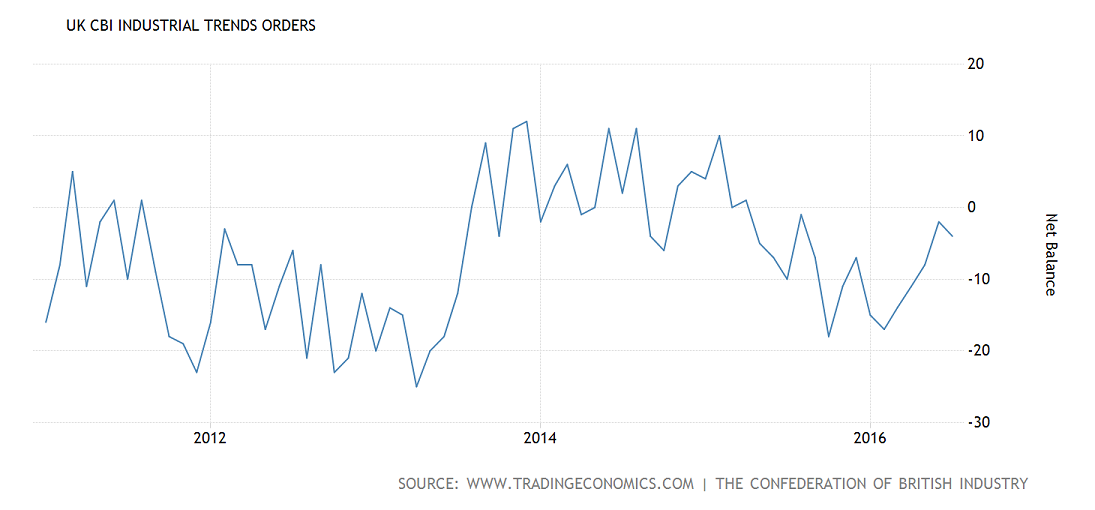
The week kicks off with the Consortium of British Industry (CBI) Order Book Balance in August on Tuesday 23.
This will be the first data for August, so may gain extra attention due its significance in assessing the impact of Brexit.
The July result was -4, which was better than the -6 expected, and was at about the level of the long-run average.
Wednesday sees the release of British Banking Association (BBA) Mortgage Approvals data, which is of limited import to sterling.
There is more significant data out on Friday, however, including Q2 Business Investment (qoq), and then the final estimate of Q2 (qoq) GDP growth data.
The preliminary figure was 0.6% and the consensus estimate for the revised figure is expected to remain at 0.6% qoq (2.2% yoy).
The data, however, does not reflect the impact of Brexit which occurred right at the end pf the period.