Photograph: Adobe Stock
The pound to euro exchange rate (GBP/EUR) is seen sitting just above support at 1.2720, a break of which could quickly invite a return to 1.2620.
- Sterling under pressure even as UK Manufacturing and Industrial Production data smashes expectations, fastest growth since 2012 recorded
- Hedging demand continues to inspire volatility in GBP complex
- Beware further declines in GBP/EUR as indicators remain negative
- Those looking to hedge exposure to UK assets and sterling should look to forwards and not options say DNB Markets
Sterling continues to look heavy on global FX markets and sits above an important level of support.
The GBP/EUR has pulled back to 1.2720 which has acted as a level of support and resistance for much of 2016 and confirms this to be a 'sticky' point for the market.
A break below here invites a decline towards 1.2620 - another area that is expected to be layered with buy orders and also suggests downside momentum is fading.
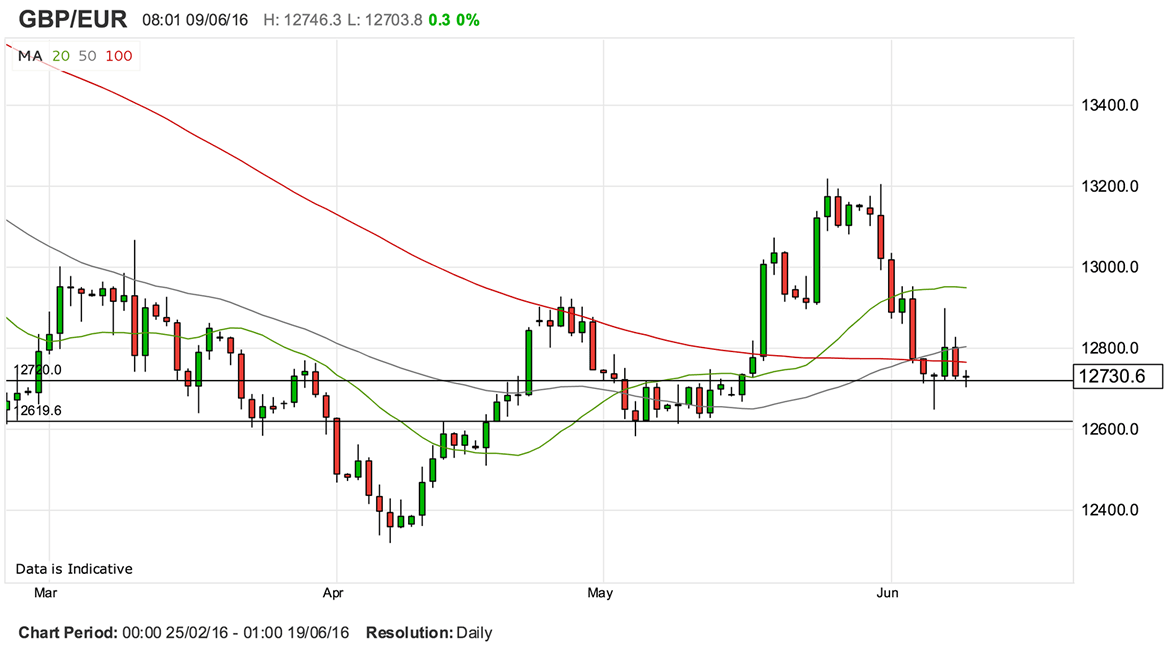
A break below these congestion levels will have to stem from some pro-Leave occurance in the EU referendum scene, something which we now know should not be discounted.
With two weeks to go before voting day expect market jitters to be heightened and this volatility could smash any of our expectations with regards to this currency pair.
Those with international payments within the next month should look to protect themselves.
“Time to hedge Brexit risk,” says Magne Østnor at DNB Markets, the Danish Bank. “The binary nature of the referendum outcome would under normal circumstances favor the use of options. However, levels of GBP implied volatility are extreme, and short dated options would see break-even spot levels way off current spot levels. The natural response is therefore to resort to the forwards,” says Østnor.
The retail market is seeing international payments ranging from 1.2335 on some personal bank accounts to more competitive rates around 1.2667 with independent FX specialists.
Strong Data Completely Ignored
A great mid-week session for the UK economy was had with official data confirming the manufacturing and industrial sectors are actually doing better than many analysts had forecast.
Industrial Production data for April read at 2%, a massive beat on the 0% forecast.
Manufacturing Production surged 2.3%, much better than the 0.1% expected.
In all, the data reflects the fastest rate of growth since 2012.
“The whopping 2% monthly gain in production was well above the consensus estimate of no change. What’s more, the rise was fairly broad based,” says Paul Hollingsworth at Capital Economics, “on the face of it, suggests that the production sector could pull out of recession in Q2.”
 Hollingsworth notes that any weakness caused by referendum uncertainty increases the scope for a rebound after June (assuming a vote to “remain”!) but there are other factors which are likely to keep a lid on growth, not least the weakness in global demand.
Yet, despite the surprising data, the British pound is actually moving lower against the dollar and euro following the release.
In normal times markets would have bought sterling, but these are not normal times and markets are fixated on one thing: Brexit.
With uncertainty being the only guarantee for coming weeks, sterling is likely to suffer a downside bias.
A Recovery or a Wild Ride Ahead?
The British pound is currently being bucked by volatility in the options market.
The options market is where corporates and investors go to hedge their investments. The idea is that they will be taking out insurance using options against a sudden decline in sterling in the event of an EU exit.
Demand for hedges has risen sharply resulting in levels not seen since 2004 (the preference for puts over calls has risen to extreme levels) and the referendum is still more than three weeks away.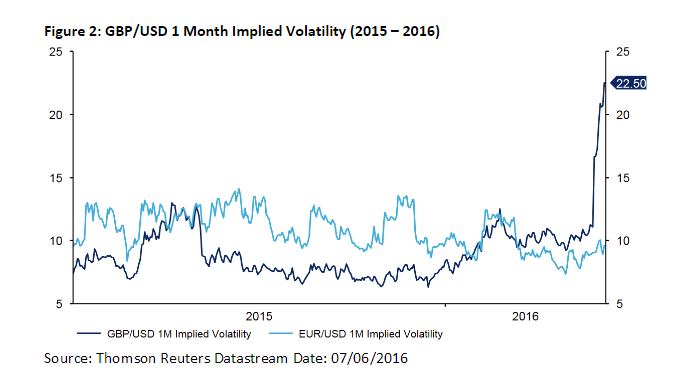
The options market is less liquid than the spot market, so for a while, the hefty volatility seen in options has been smoothed out by the vast liquidity of the spot market.
“The depth in the spot market could currently be large enough to absorb these option market related flows,” says Roy Teo, an analyst with ABN Amro, the Dutch lender.
However, the volatility would surely have to boil over, and I suspect this could be the driver behind Tuesday’s rally.
Analyst Peter Krpata at ING notes we are witnessing historically extreme volatility in the GBP/EUR pair in particular:
“EUR/GBP 1-month implied vols skyrocketed this week, being not far away from their all-time highs seen in the 2008 financial crisis – evidence of a very high degree of uncertainty and looming risks.”
Meanwhile, DNB's Østnor suggests those looking to hedge exposure at this stage of the game are better off avoiding options.
"The binary nature of the referendum outcome would under normal circumstances favour the use of options. However, levels of GBP implied volatility are extreme, and short dated options would see break-even spot levels way off current spot levels. The natural response is therefore to resort to the forwards," says Østnor.
Knife-Edge Polls to Keep Sterling vs Dollar Unstable
Stability in sterling is unlikely going to be a feature of the forex market place for the next two to three weeks.
Driving the wild swings of late has been the uncertainty implied by the EU referendum polling results that have been coming through.
The pollsters are certainly busy and it appears surveys are being released on a daily basis now.
A look at a collation of the latest polls show Remain has retaken the advantage with a 51% share. On Monday the 6th Leave enjoyed a 51% lead and we don’t expect either side to take a decisive lead over coming weeks.
The message to take away from the above is that the outcome is balanced and there is little certainty for sterling to settle on.
“Two further voting intention polls ahead of the referendum of 23 June have been published. Their findings are mixed. Although the lead of the “Remain” campaign has weakened on the whole, the surveys are photographing a confused and highly uncertain situation, which is translating into strong exchange rate volatility,” says Asmara Jamaleh, an analyst at Intesa Sanpaolo.
On Monday sterling dropped from GBP/USD 1.45 to 1.43, whereas on Monday it opened on the rise, hitting a high in the GBP/USD 1.46 area.
“In the next few days, fluctuations should stay between GBP/USD 1.43 and 1.47, save for particular surprises from surveys, which could push the exchange rate outside this range,” says Jamaleh.
Against the euro, Jamaleh says the predominant corridor should be between 1.2987 and 1.2821.
With regards to GBP/USD's technicals, the incredible volatility of the past few days which has resulted in three strong bull, bear and bull candles successively could be showing some signs of settling today with little significant movement overnight.
"The technical outlook is though still very choppy and indecisive. Although there is a marginally bullish bias to momentum, this is rather indicative of the fluctuations within a range, with the RSI hovering around 50, the MACD lines all but neutral and the Stochastics mildly rising again," says Richard Perry at Hantec Markets.
Medium term support in at $1.4330 (added to at $1.4350) and up towards resistance at $1.4770 (added to at $1.4723) with much in between just noise now.
The hourly chart is very messy with no real trends or consistent momentum.
There is minor resistance around $1.4600 with $1.4475/$1.4500 minor support.