A pro-risk environment, polling data and short-covering have helped aid the British pound higher while UK inflation data provides an upside limit.
- Pound to euro rate looks to be rejected at 100 day moving average - again
- Market sentiment appears in the driving seat, could make today’s inflation data irrelevant
- Best level to buy euros since late April seen earlier in the day

The pound to euro exchange rate was seen trading notably higher on Tuesday the 17th having achieved a day-on-day gain of 0.66% against the euro before the pair was brought back to earth by UK inflation data that showed price rises are starting to reverse once more.
The conversion is quoted at 1.2780 at the time of writing, off today's best exchange rate at 1.2819.
The pound took off early in Asian trade rising in generally illiquid conditions on some Brexit polling data that showed the Remain vote pulling ahead.
Earlier in the day the pair appeared to have found support, "and the move in Asia may have been prompted by short covering more than anything else," says Boris Schlossberg, a Director at BK Asset Mangement.
The move confirms there could be a great deal of technical issues at play in the market.
A big wall that has obstructed further advances in the sterling-euro exchange rate has been the 100 day moving average.
The 100 day MA blocked advances in late April, the supply of sterling at this point was strong enough to prompt the decline back to the 1.26 area we have witnessed in May.
Today therefore should be a big test for GBP/EUR in that a break above the 100 day MA could finally take place while a failure... well no need to explain.
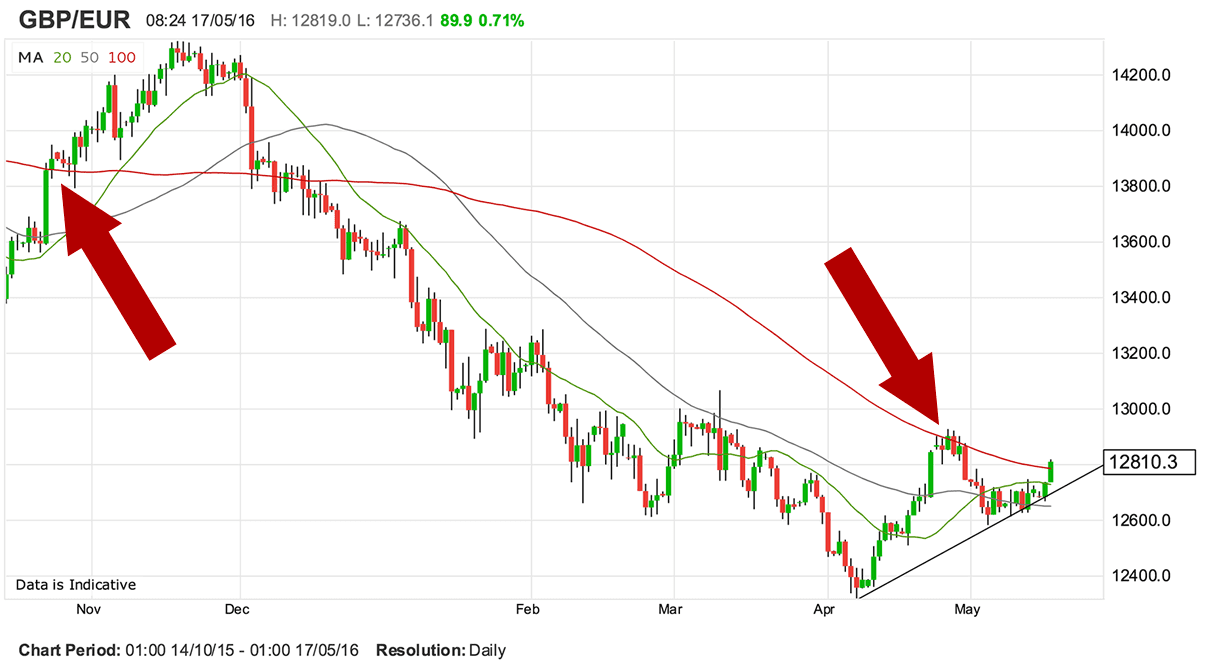
Should this happen then the prospect of further gains becomes possible; back in October 2015 the GBP/EUR managed to break through this barrier and enjoy a strong rally from 1.39 through to the 1.42s.
Moving averages are areas where traders typically lay orders - a good portion of them are counter to the trend that has taken the currency pair into the average suggesting they are betting on a failure and reversal.
Latest Pound/Euro Exchange Rates
  | Live: 1.1655▼ -0.02%12 Month Best:1.1828 |
*Your Bank's Retail Rate
| 1.1259 - 1.1305 |
**Independent Specialist | 1.1492 - 1.1538 Find out why this is a better rate |
* Bank rates according to latest IMTI data.
** RationalFX dealing desk quotation.
Of course, sometimes the underlying momentum is too strong and the level breaks ensuring they are forced out of the market.
Using GBP/EUR as an example, this would suggest the sell orders are GBP/EUR are cleared out on a positive move through the 100 day moving average. As these orders are shut the losing bettors are forced to buy sterling and sell euro - this results in an acceleration of the move through the other end, hence we often see big breaks when cleared.
Note though that there is a great deal of risk lying ahead and with sterling shorts cleared out of the market, as per the latest CFTC data, there is now scope for the pound to go up, and down.
With the UK’s EU referendum mere weeks away, and important data on tap this week, we would remain wary of betting on excessive pound strength.
Risk Sentiment Provides Support Early On
The move mirrors the gains seen on Germany’s DAX which is higher by the same amount and confirms that the pound sterling remains positively correlated to risk sentiment.
When investors are buying, so too the pound sterling is rising.
We have argued for some time that the relationship between the German 30 and the GBP/EUR + GBP/USD appears to be more reliable than the relationship between the two currency pairs and the FTSE 100. We would suggest that this is owing to the heavy mining and oil stock weighting that characterises the London market.
Analyst Viraj Patel at ING says much of the April to May recovery in the GBP complex can be attributed to the influence of positive risk sentiment on global markets:
“The initial shift in global risk sentiment in recent months (from bearish to tentatively neutral) has been a positive driver for GBP, accounting for more than half of last month’s recovery.
However, we reported yesterday that ING are sellers of the British pound this week citing some difficult hurdles that lie in the way.
There are three important data points due for release this week: UK inflation on Tuesday, employment on Wednesday and retail sales on Thursday.
ING’s economists are forecasting a below-consensus outcome on all three, and while sterling has brushed off poor data releases over the past month, “we do not suspect that lightning will strike twice," says Patel.
EU Referendum Polling Seen Giving a Boost, Inflation Sapping Confidence
As mentioned, one of the potential reasons behind some of the short-covering observed at the start of the day may have been triggered by release of news showing an increasing percentage of UK voters supporting the Bremain campaign.
55% of voters are expected to choose to stay in the EU, up from 52% recorded in a similar survey in April, before the referendum scheduled for the Jun 23.
However, weak inflation numbers released this morning are likely to translate into a headwind for future gains.
Consumer prices climbed 0.3%yoy in Apr, down from 0.5%yoy seen in Mar and 0.5%yoy forecast.
"Falls in air fares and prices for clothing, vehicles and social housing rent were the main contributors to the decrease in the rate."
"These downward pressures were partially offset by rising prices for motor fuels and for certain recreational goods and cultural services, and by food prices, which were unchanged during Mar and Apr 2016."