Pound and euro forecasts from Lloyds Banking Group suggest GBP is now oversold and suggest the potential for a recovery back towards 1.40.

Have institutional forecasters got it badly wrong on their predictions for the pound to euro rate in 2016?
On evidence 2016 is not going well for the major forecasters when we look at their submitted data.
Pound Sterling Live's polling data shows that the average forecast for GBPEUR amongst 15 leading banks is for an excxhange rate at 1.4493 by the end of March. The average for the end of December 2015 was also at 1.4493.
At the time of this article's update the sterling-euro is at 1.3259 and on target for its 7th consecutive weekly decline.
This is a big deal for those with an interest in the currency. “We’ve received a number of calls over the past few weeks from nervous business owners and CFO’s who remain exposed,” says Andy Scott, an economist with brokers HiFX, who have today said the decline to the early 1.30’s has hurt a number of unhedged corporates.
“The overwhelming reason given for them not having hedged their risk by purchasing Euros needed in the months ahead through a forward contract for example, was a number of banks forecasts for the Euro to weaken further in 2016,” says Scott.
GBP/EUR has plummeted by over 6% since late November to key support at around 1.34 – close to its range low throughout 2015. No doubt many will be kicking the next bank forecast that lands on their desk into the long grass!
But there were those in early December who foresaw a decline back to the early 1.30's and as always the more searching you do the better become your chances at calling the markets correctly.
Latest Pound/Euro Exchange Rates
  | Live: 1.166▲ 0%12 Month Best:1.1828 |
*Your Bank's Retail Rate
| 1.1264 - 1.131 |
**Independent Specialist | 1.1497 - 1.1543 Find out why this is a better rate |
* Bank rates according to latest IMTI data.
** RationalFX dealing desk quotation.
Of the Banks, Lloyds Have Always Been Cool on GBPEUR
An outlier in forecasting the pound to euro conversion are Lloyds Bank Group who are amongst the most bearish on the exchange rate in our coverage universe.
Back in September 2015 analysts were warning that the exchange rate would slump to 1.31 by mid-year 2016.
That said their first quarter 2016 forecasts were higher, nevertheless the message was one in which sterling-euro was never going to advance well beyond 1.40.
But - is Sterling Weakness Overdone?
Lloyds have just released their first currency forecasts for 2016, and based on previous form we are interested to hear where they see the GBP/EUR heading in light of recent weakness.
“The early emergence of Brexit uncertainty has brought forward some of the weakness of the pound that we had anticipated for later this year,” say Lloyds.
And, the news is good for those holding out for a higher exchange rate.
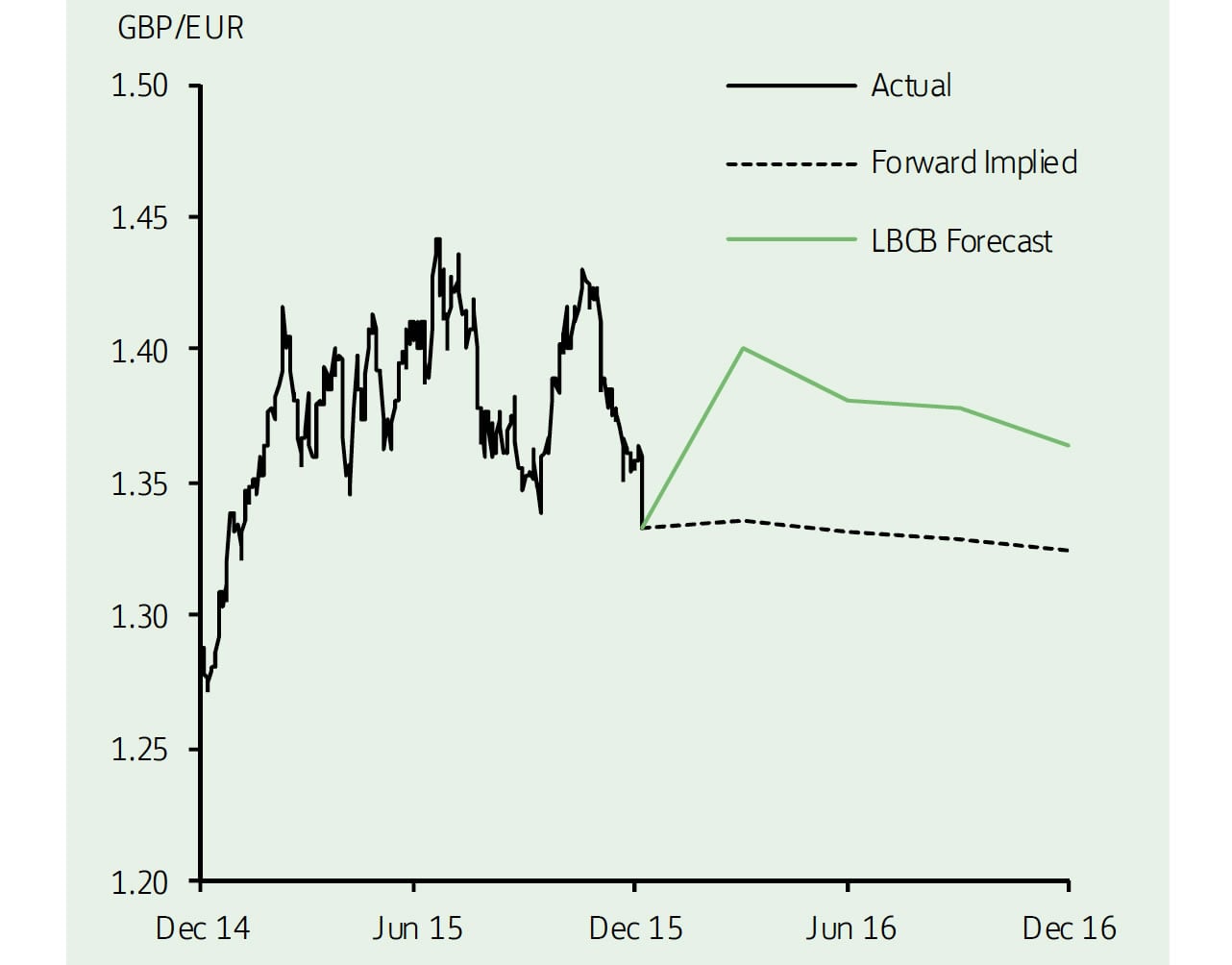
“On balance, we believe the extent of the recent drop is overdone and look for a near-term recovery towards 1.40 – mostly driven by a softer euro rather than a stronger pound,” say Lloyds Banking Group.
However it is cautioned that event risk surrounding the UK currency remains high.
The picture remains one of gradual sterling-euro declines, but a bounce in the near-term could well take place:
No 2016 Interest Rate Rise at Bank of England
The one thing that could turn the fortunes of sterling is the Bank of England - the pound desperately needs the support of higher sovereign yields that a higher interest rate environment would deliver.
Forward money market rates now imply no rise in UK Bank Rate until Q1 2017, with only very gradual increases thereafter, a situation that helps explain recent weakness.
Recent dovish comments from various Monetary Policy Committee (MPC) officials, including Martin Weale and Minouche Shafik, suggest that their perception of the balance of risks has shifted.
“The recent plunge in oil prices, signs of cooling wage growth, downward revisions to UK GDP growth and most recently heightened global asset price volatility, have no doubt weighed on their thinking,” say Lloyds.
Against this backdrop, the risk that the MPC continues to delay raising interest rates has risen, nevertheless Lloyds Banking Group stick with their prediction of a year-end interest rate rise.
Forecasts
The UK bank sees the GBPEUR exchange rate rising to 1.40 by the end of March before declining to 1.38 by the end of June. This is where the pair will likely hover until December where a close of 1.36 is seen.
More losses in 2017 are likely though.
Euro Grows in Confidence Grows, But Watch Inflation
Recent data releases provided confirmation of the ongoing cyclical recovery in the euro area. Real GDP had continued to grow in the third quarter, while other incoming information, including the latest survey evidence available up to November 2015, remained consistent with a continued moderate economic recovery.
And most importantly the governing members at the European Central Bank believe the policy measures they have put in place are working:
“The recovery, although modest but still with growth rates above potential, remained intact,” read the account of the last meeting held by the Governing Council at the ECB which markets have read as a suggestion that no euro-negative actions will be taken for some time yet.
The minutes of the ECB’s last policy meeting does however show governing members remain concerned about the large amount of slack that was estimated to remain in the euro area economy.
The December 2015 Eurosystem staff projections pointed to the output gap not being fully closed over the projection horizon.
They also indicated that the rate of unemployment would not fall below 10% even by the end of the projection horizon in 2017. Moreover, it was noted that – in contrast to consumption – investment remained very weak and had again disappointed recently, with the December projections showing a downward revision.
Therefore the risk remains for more potentially euro-negative policy decisions to be made at the ECB over coming weeks.
This should keep euro strength capped.