
File image of Andy Burnham: Pound Sterling Live.
The new Prime Minister inherits an economy that is doing far better than expected.
Economists have reacted to Thursday's latest GDP growth figures with surprise, saying the economy is outperforming expectations and could offer incoming Prime Minister Andy Burnham unexpected tailwinds.
"Burnham to inherit surprisingly resilient economy," says Andrew Wishart, UK Economist at Berenberg Bank. "If this continues incoming Prime Minister Burnham should fare better than his predecessor."
GDP rose by 0.1% in May, exceeding the consensus expectation for no growth. That makes for a 0.7% rise in the three months to May, leaving Q2 growth on track for 0.4% q/q, even if output is unchanged in June.
That's amongst the fastest growth in the G7.
"That would leave GDP growth averaging around 0.5% per quarter in the first half of the year. Such an outcome would point to a surprisingly resilient economy, particularly given the backdrop of renewed conflict in the Middle East," says Jeavon Lolay, Head of Market Insights at Lloyds Bank.
Productivity Gains: The Secret Sauce
Berenberg's Wishart points to one potentially underappreciated development in the economy seen over recent quarters that is confirmed by the latest numbers: improving productivity.
He explains that a combination of resilient growth and flatlining employment implies that the pickup in productivity growth we saw in 2025 has continued into 2026.
"With headcounts steady, the increase in services sector output must be down to companies finding ways to operate more efficiently," he says.
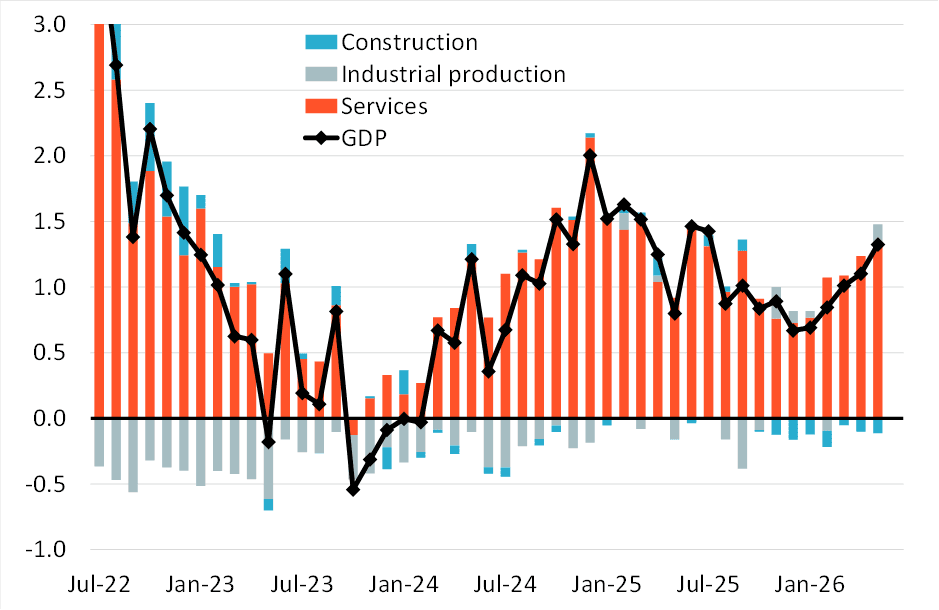
Image courtesy of Berenberg Bank.
The UK has long suffered poor productivity outcomes, with output per worker ultimately stagnating since the 2008 crisis.
"The UK's fundamental problem remains exceptionally weak productivity growth, and policies that increase uncertainty, distort investment decisions or weaken incentives to expand would make that problem harder, not easier, to solve," says Martin Beck, Chief Economist at WPI Strategy.
That matters, as personal wealth is linked to productivity: the more you produce, the more you earn, at least theoretically.
"The UK economy has been mired in a weak productivity / low growth environment since the peak of the financial crisis in 2008. The repercussions of this for living standards have been stark and politically consequential," says Philip Shaw, economist at Investec.
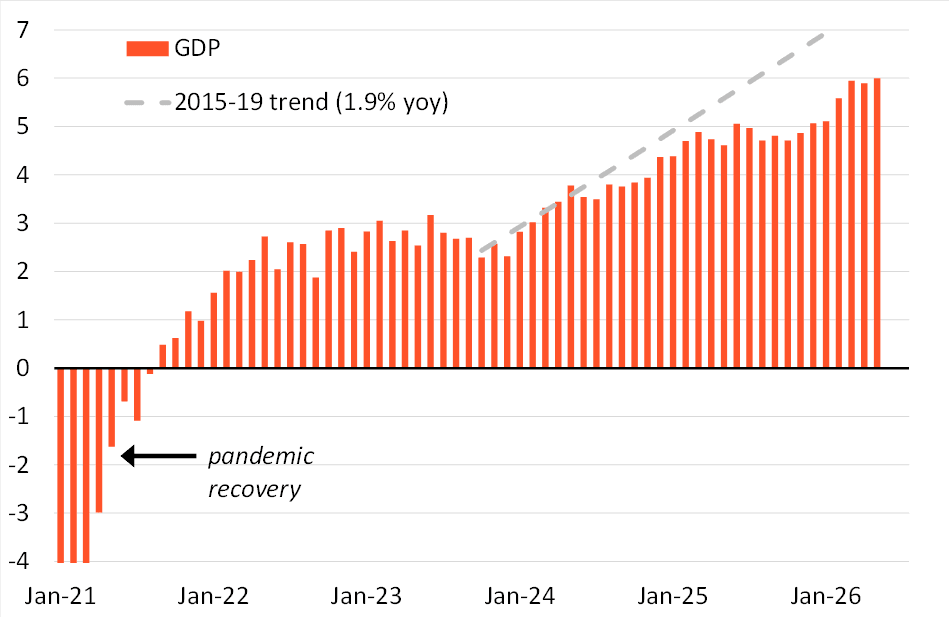
Image courtesy of Berenberg Bank.
Without productivity growth, it's hard to foresee any meaningful lift in living standards, and hopes for a new productivity revolution would prove to be a meaningful development in the country's socio-economic outlook.
"After a lengthy productivity disappointment in the 2010s through to the early 2020s, improvements in technology may finally have shown up in the GDP data again," says Wishart.
He adds that, "if this continues incoming Prime Minister Burnham should fare better than his predecessor. Stronger trend productivity growth would enable the economy to grow somewhat faster before inflation begins to take off and makes it easier to generate sufficient tax revenue to fund public spending."