
The GBP/CAD remains in an uptrend but we would like to see some key levels broken before calling an all-out recovery.
Pound Sterling trades on the cusp of a fresh six week high against the Canadian Dollar at 1.7438 at the time of writing.
GBP has risen against the Canadian Dollar for five consecutive weeks now with the most recent weekly rise coming after Canadian employment data disappointed and the CAD uncoupled from rising crude prices which it normally tracks quite closely.
This is quite unfortunate for CAD bulls as the currency would have rocketed higher following the surge in oil and gas prices seen last week thanks to the unexpectedly large drawdown in US oil reserves.
The pound meanwhile held its own despite losing ground following dovish remarks by Bank of England (BoE) governor Mark Carney who indicated that he was still seriously considering more stimulus.
On the charts the pair has rebounded strongly from the August lows and is threatening to reverse the Brexit-induced down-trend:
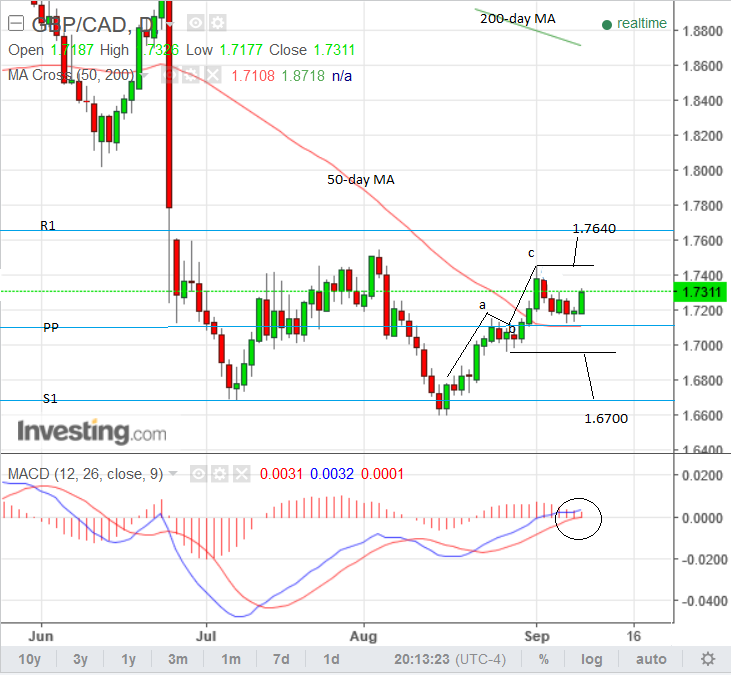
A clear break above the 1.7459 September 1 highs would signal the start of a fresh trend of peaks and troughs higher, with an initial target at 1.7640.
Alternatively, it is possible to interpret the rebound from the August lows as a three wave a-b-c correction in the midst of a dominant down-trend, which is likely to resume now the correction is complete.
If that is the outcome then the pair could start to work lower again, with a break below the 1.6965 lows, leading to a continuation down to a target at 1.6700.
Scotiabank’s FX Strategist Shaun Osborne is bearish, preferring the second interpretation:
“We remain bearish the GBP overall and continue to feel that risks are tilted lower for the GBP unless or until new cycle highs are reached (above 1.7550).”
However, he also cites, “a fair degree of resilience” in the pound, saying, “the market will have to crack support at 1.7150 now to see losses extend. Fade GBP gains while below 1.7550.”
At the present time the spot market rate is seen at 1.7430, your bank account is likely to offer payments of between 1.6942 and 1.6820 while indpendent providers are quoting between 1.7273 and 1.7151:
Latest Pound / Canadian Dollar Exchange Rates
  | Live: 1.8738▲ + 0.04%12 Month Best:1.9044 |
*Your Bank's Retail Rate
| 1.8101 - 1.8176 |
**Independent Specialist | 1.8476 - 1.8551 Find out why this is a better rate |
* Bank rates according to latest IMTI data.
** RationalFX dealing desk quotation.
Canadian Dollar Weaker Now, Stronger in 2017
As mentioned, the Canadian Dollar has apparently detached itself from oil prices.
There are a couple of important reasons for this.
"Given the recent influence of oil, we would have expected CAD to have benefitted from a sharp rally in crude oil prices. WTI rose by 3.2% last week while WCS rose by 4.7%. However, the FX market got caught a bit short USDCAD ahead of Wednesday’s BoC Interest Rate Announcement (IRA), which was more dovish than expected," says Stephen Gallo at BMO Capital.
"Then Friday’s Fed scare forged a fierce USDCAD rally and took out another layer of USDCAD shorts," notes Gallo.
Gallo says the combination of the USD 2Y yield rising 1bp and the CAD-denominated 2Y rate falling 2bps has the USD’s yield advantage as big as it has been since early August - this has exerted notable downside pressures on the Canadian Dollar.
Yet, oil prices should start yielding influence again, but bulls need to be patient as we are told this support will only likely be felt in 2017.
"It’s likely that traders will overshoot in the move to a stronger USD, with the CAD being one of the many beneficiaries of a broad selloff in the greenback next year. In addition, oil prices should continue their slow push higher in 2017, adding further support to the C$," says a note from CIBC.
Data and Events that Could Shake GBP/CAD Over Coming Days
On the data front, Wednesday sees the release of Canadian Wholesale Sales in July but Friday is the main day for the currency as it is when inflation data will be released.
Inflation needs to start picking up in Canada, after the very low -0.2% reading in July, otherwise pressure may start to increase on the Bank of Canada (BoC) to lower interest rates from their already low 0.5%, which will have a negative impact on the loonie.
For sterling it is really all about the Bank of England (BoE) meeting and the release of inflation and employment data.
There will be much speculation as to whether the governor of BoE will increase stimulus measures or not over coming months - further rate cuts and quantitative easing announcements will likely sink Sterling.
Indeed, in his testimony to the House of Commons Select Committee on Thursday the 8th September Carney said that there was still scope to expand stimulus.
However, Carney added that the Current Account deficit, which stands at 7.0% is likely to fall to 4.0% due to Sterling depreciation.
This is an important observation as the UK’s gaping current account deficit is a key vulnerability for Sterling as it suggests a country that imports more than it exports.
This creates a balance between currency inflows and outflows that would normally pressure Sterling lower were it not for the huge sums of currency inflows submitted by foreign investors keen to take advantage of UK investment opportunities.
There are fears Brexit may impact these inflows, thereby removing a key crutch for Sterling. But, as noted, Carney sees the current account deficit coming down on growing exports, thus providing a more stable underpinning for the currency.
The Bank will be wary of implementing any further GBP-negative interest rate cuts or expanding the asset purchase programme should UK data continue to outperform expectations.
The analyst community do not expect the BoE to make any changes next week given how well the UK economy has held up.
“The UK economy is by now holding up better than expected, and that’s why we expect no policy changes from the Bank of England next Thursday,” said analyst Holger Sandte, an analyst with Nordea Bank.
Inflation data out on Tuesday is expected to show prices edging up by 0.7% in August, as a result of the weaker pound pushing up the cost of foreign imported goods.
Inflation is forecast to read at 0.7%, a nudge up from the previous month’s 0.6%.
On Wednesday, July Unemployment data in general and Average Earnings in particular, are released.
Earnings are a closely-watched indicator for the Bank of England (BOE) as they see it as a major influence on higher future inflation and growth.
The claimant count is forecast to have risen by 1.5K in August, a deterioration on the previous month’s reading when the claimant count actually fell by 8.6K in spite of analyst expectations for a referendum-inspired increase in unemployment.
Average earnings are forecast to have risen by 2.1%.
Thursday sees the release of retail sales -0.4%, down from the previous month’s surprisingly strong 1.4% rise.
This beat on expectations in August was one of the triggers of the recovery rally seen in the GBP complex that stalled in early September.