The GBP to CAD conversion is correcting higher in the midst of a more protracted down-trend. Thursday's Bank of England meeting and Canadian Trade data are seen as primary hot-spots for the pair in the coming week.
The British Pound has roared by over a percent higher against its Canadian counterpart; Sterling is buying C$1.7493 on the inter-bank market at the time of writing, ensuring the pair remains towards the top of the mid- to late-July range.
The pair has risen rose up from a post-referendum low at 1.6694 to achieve a July best of 1.7455.
The GBP/CAD gains come despite the looming risks posed by the Bank of England's Monetary Policy Committee Meeting, due to fall on Thursday.
The Bank is widely tipped to cut interest rates and boost quantitative easing; two moves that would traditionally be seen as GBP-negative.
However, there are uncertainties to the exact mix of policy measures, and traders will be wary of being exposed to the currency. As such, we believe there is a good degree of profit-taking underway.
The market is betting heavily against the GBP, and exiting these positions naturally requires the purchase of GBP.
The move higher in GBP/CAD could therefore be purely technical in nature.
Latest Pound / Canadian Dollar Exchange Rates
  | Live: 1.8738▲ + 0.04%12 Month Best:1.9044 |
*Your Bank's Retail Rate
| 1.8101 - 1.8176 |
**Independent Specialist | 1.8476 - 1.8551 Find out why this is a better rate |
* Bank rates according to latest IMTI data.
** RationalFX dealing desk quotation.
With regards to the outlook, both the monthly and weekly charts for the Pound to Canadian Dollar exchange rate are looking increasingly positive.
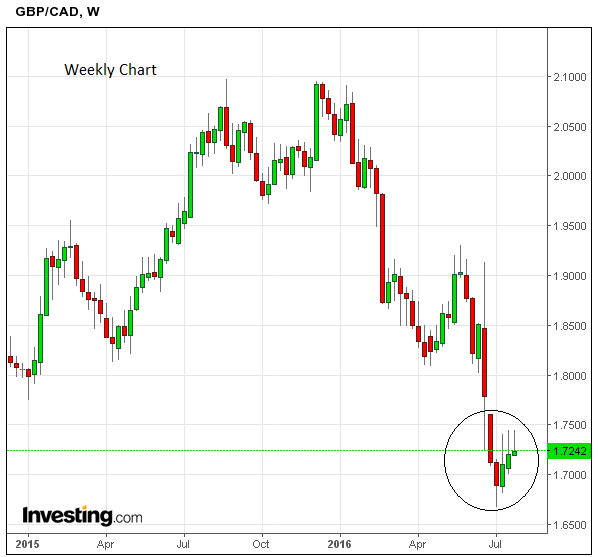
On the monthly chart, July has formed a long hammer candle, and on the weekly chart it has given a bullish signal by producing three up weeks in a row after the completion of a measured move.
Measured moves are three wave zig-zags where wave A and C are of similar length (see chart below).
These signals mean there is an increased possibility of more upside on the horizon.
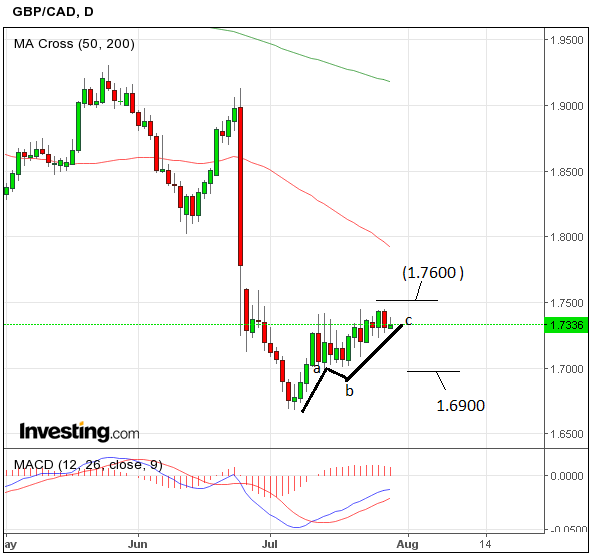
The daily chart looks less bullish: the move up from the early July lows, still looks very much like a correction, rather than the start of a new up-trend, given its classic 3-wave corrective structure.
This means the down-trend could be about to resume.
A break below the 1.6694 lows would be required to confirm a continuation of the bear-trend.
Another possible closer confirmation point for more downside would be under the 1.6990 lows, with short-term downside targets at 1.69, 68 and 67 near the early July lows.
Nevertheless if the higher timeframes are accurate in forecasting more upside, then a move back above the 1.7500 level would probably confirm a continuation up to 1.7600.
USD/CAD Continues to Strengthen
Betraying a sense of all-round CAD weakness is the price action in the headline USD/CAD rate.
"Since the big 3 month Loonie rally finished at the end of April with a low of 1.2468, the dollar has steadily been strengthening," notes Richard Perry at Hantec Markets. "With the occasional correction against the recovery uptrend, this has resulted in the formation of a series of higher lows but with a solid uptrend, which is currently rising with support at 1.2950."
Perry notes the recent correction seems to have found support at 1.2998 once more around the pivot of the 23.6% Fibonacci retracement of the 1.4689/1.2458 sell-off which has previously acted as a turning point.
The recent correction also found the bulls returning once more with the RSI at 50, with the momentum indicators now suggesting that corrections are seen as a chance to buy.
"With the buyers returning with a solid positive candle that should now help to reinvigorate the bulls. The July highs of 1.3240/1.3250 are now likely to come back under pressure and a move back towards the 38.2% Fibonacci retracement at 1.3310, with resistance at 1.3295," says Perry.
Fundamentals: Canadian Trade Data in focus
The major event for the loonie in the week ahead will be the Trade Balance, scheduled for release on Friday August 5.
According to broker TD Securities, the Trade Balance is a major consideration for the Bank of Canada (BOC), when it is considering monetary policy.
Analysts expectations are for the -3.2bn deficit to narrow to -2.8bn in June, however TD think it will remain wider at -3.0bn.
Such a result would be negative for the Canadian dollar as it would increase the possibility that the BOC will need to keep interest rates low.
Lower interest rates are a drag on currencies as they attract less demand from international investors who prefer higher yielding currencies.
“While almost certainty to be overlooked given the simultaneous release of nonfarm payrolls & Canadian employment, international trade remains the most important indicator to the Bank of Canada. The June release is also important as it marks the beginning of the post-wildfire bounce in activity. The trade deficit is expected to narrow to a still significant $3.0 billion, with stronger exports outpacing a forecasted gain in imports.”
One factor which reduce the negative impact on the Canadian dollar from a widening trade deficit, however, is the increasing surplus in net portfolio capital inflow.
This has come about since a wide share of global bonds saw their yields fall below zero, leading international investors to seek out triple A bonds which still had a positive yield, such as Canadian government bonds.
The net surplus flows added up to 10bn in May, which would more than offset the 3 billion or so trade deficit.
As such the overall flow of money may show an increase in net demand for the CAD, increasing its value – not decreasing it.
Given the fall in yields to below-zero gathered pace after Brexit, demand for relatively high-yielding Canadian bonds may even have peaked in June or July, at a higher level than May, leading to a possible Current Account surplus in the second quarter, which again, would strengthen the loonie.
The Current Account recorded a deficit of -16.8bn in Q1.
Oil Continues Poor Run
Oil has a high degree of correlation with the Canadian dollar, especially in the USDCAD pair, but also in general, and fluctuations in the price of oil impact on the value of the loonie.
Oil continued falling on Friday, dropping to $41 per barrel, and putting downwards pressure on the Canadian dollar in the process.
Whilst most analysts see this current down-trend as just a correction, it may continue in the week ahead.
Scotiabank’s Chief FX Strategist, Shaun Osborne, said he for one see’s softer oil prices in the short-term:
“We expect crude will retain a softer bias and will continue to act as a drag on the CAD’s performance near-term at least.”
This could be a dampening factor for CAD in the next five days.