The Canadian dollar slipped against the greenback overnight as crude oil and commodities inched lower.
However, against the British pound the Canadian currency is exerting relentless pressure which may accelerate over coming days.
CAD will take its cue from Canada’s budget announcement on Tuesday.
"A big increase in state spending by Prime Minister Trudeau’s Liberal government could be seen as alleviating some pressure on the BOC to cut rates again in the near future and would likely send the CAD higher," says a note from Commonwealth Foreign Exchange.
The GBP/CAD's monthly chart is looking decidedly bearish in the long-term with three-down months in a row after a lengthy rally.
This sign of extended weakenss increases the probability that a more persistent longer-term down-trend may be establishing itself.
The pair has now reached as low as 1.8505 (from 2.0000 not so long ago) which corresponds with the target for the double-top price pattern at the highs (see chart below).
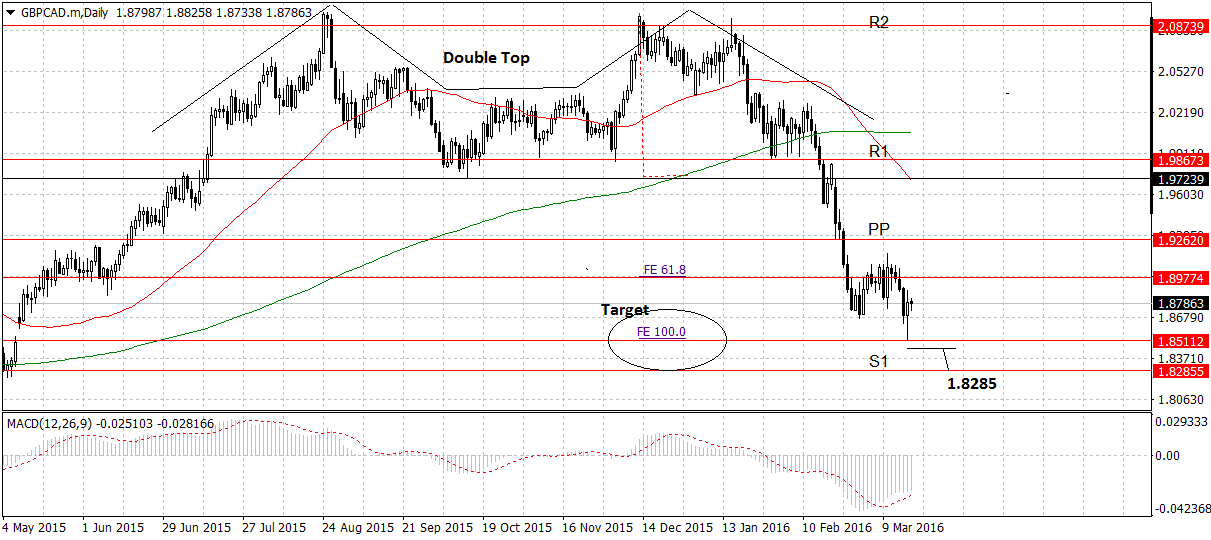
The double top is a bearish reversal pattern which forms at the end of a down-trend, and is made up of two peaks with an intervening dip.
This 'double' occurred when two peaks in GBP/CAD formed in August and December 2015 before the rate broke lower.
The swift breakdown following the formation of the pattern has seen the exchange rate achieve the target implied by the double-top at the 100% extrapolation of the height of the pattern lower.
That target was at 1.8500.
Latest Pound / Canadian Dollar Exchange Rates
  | Live: 1.8741▲ + 0.06%12 Month Best:1.9044 |
*Your Bank's Retail Rate
| 1.8104 - 1.8179 |
**Independent Specialist | 1.8479 - 1.8554 Find out why this is a better rate |
* Bank rates according to latest IMTI data.
** RationalFX dealing desk quotation.
We believe the medium-term down-trend will probably continue, with further confirmation coming from a break below the 1.8505 lows which would see a probable extension down to the next major support level at the S1 monthly pivot at 1.8285.
(Monthly pivots are areas of increased trading activity where prices often stall, bounce or consolidate).
Brexit remains main risk to sterling
Concerns about the impact of Britain leaving the EU have dogged the pound and are likely to continue to until the matter is decided at the June 23 referendum.
This is likely to have a downwards impact on the pound over the next three months, which dovetails nicely with the technical forecast for further declines in the exchange rate.
According to Charles Purdy of Smart Currency Exchange Brexit remains a constant danger to sterling:
“With concerns around the “Brexit” lingering on, sterling is still lacking the ability to gain meaningful ground against the euro. The downside risk for sterling certainly seems to exceed by a significant margin its upside potential.”
CAD – Federal Budget is Highlight of Calendar
The main highlight of the coming week for the Canadian Dollar is the Federal Budget by the newly elected liberal government on Tuesday March 22.
The budget is expected to contain a strong pro-growth agenda which is expected to support the Canadian Dollar as it will take the pressure of the Bank of Canada (BoC) to use monetary policy easing.
That is, if the government’s budget contains plans to increase investment spending in infrastructure , this will stimulate the economy and make it less likely the BoC will have to ease policy or cut interest rates to stimulate the economy with monetary measures.
Remember the golden rule of currency dynamics - when central banks are cutting interest rates or printing money (quantitative easing) in order to boost the economy - the currency tends to suffer.
A country with low interest rates will not enjoy strong global investor demand for its high-yielding assets, which in turn keeps demand for the domestic currency on the international market place subdued.
CAD should therefore rise as a result of a reduced likelihood of the BoC having to use easing, as monetary easing normally means reducing interest rates which make the currency less appealing to foreign investors looking for high interest returns.
According to Brokerage House TD Securities:
“The upcoming federal budget is expected to reveal a $30B deficit for 2016/17, of which $18B reflects a shortfall in revenue due to a weaker economic outlook (including a $6B contingency).
"The balance will be filled with platform commitments, including tax breaks and infrastructure spending; our projections have fiscal stimulus adding 0.1% to GDP growth in 2016 and 0.3% in 2017. The deficit will likely be funded by an increase in bond issuance from $92B to $120B.”
Newly elected prime minister Justin Trudeau, highlighted how the budget would support infrastructure and investment, when he said last week he was committed to fast-tracking infrastructure investments in the oil- and gas-rich province of Alberta, which is suffering from the global slump in energy prices.
“The budget, which the Liberals have pledged will include major new spending aimed at boosting a flagging economy,”
Retail Sales up in January
Recent Retail Sales figures for Canada also surprised to the upside, comments Western Union’s Joe Manimbo:
“Canadians went on a surprise spending spree in January when retail sales soared some 2.1%, a good sign for first quarter growth. Headline inflation cooled to a 1.4% annual rate in February, down from a 2% pace in January.”
A rise in Retail Sales would be expected to be CAD-positive as it signals a potential rise in inflation, and therefore reduced chances of the BoC using monetary easing, which tends to weaken the currency as it reduces interest rates, and therefore scares away foreign investors looking for high interest rate returns.