The Canadian dollar is likely to retain strength despite recent Chinese Trade data hitting confidence in the commodity complex.
- Canadian dollar softer on Tuesday as Chinese data hits commodity markets
- CAD gained 3.2% against the USD and 2.9% on a trade-weighted basis in February
- Risk elevated ahead of BoC meeting (9th), FOMC (16th) and the OPEC+Russia oil discussion (20th?)
- "We would look to accumulate USDCAD below 1.34 targeting 1.37 in 1M and 1.45 in 3M" - BMO Capital
The Canadian dollar is softer against the British pound, euro and US dollar in the wake of data out of China which has drawn a question mark over the recent recovery in global commodity markets.
China’s Trade Balance data for February read at 32.59 BN USD, well below consensus forecasts for 50.15 BN USD and almost half the 63.29 BN reported in January.
Exports fell 25.4 percent on-year, double the amount analysts had forecast the decline to read.
Oil prices are softer as a result which has predictably passed on weaker sentiment to the Canadian currency.
Nevertheless, the trend in oil is upward at the moment with present losses looking miniscule in comparison to the 6% gains seen at the start of the week.
"In addition to oil, the price of gold, silver, copper and iron ore also extended higher, paving the way for gains in the Canadian and Australian dollars,” notes Kathy Lien, analyst at BK Asset Management of recent CAD market action.
"But," notes Lien, "the gains in these currencies should have been stronger given the magnitude of the increase in commodity prices."
Latest Pound / Canadian Dollar Exchange Rates
  | Live: 1.8741▲ + 0.06%12 Month Best:1.9044 |
*Your Bank's Retail Rate
| 1.8104 - 1.8179 |
**Independent Specialist | 1.8479 - 1.8554 Find out why this is a better rate |
* Bank rates according to latest IMTI data.
** RationalFX dealing desk quotation.
We believe we could well just be witnessing a soft patch for the currency as the general trend for appreciation remains alive.
Over recent weeks the CAD has moved higher in tandem with its commodity cousins the Australian and New Zealand dollars.
"Having been in a deep bear market for the past few years, there are signs in some markets that life could be returning to the commodities markets. Gold, in particular, is advancing nicely and is already back in a long-term uptrend," says Phil Seaton at LS Trader.
Strength is evident in Silver, Palladium and Copper. Silver is the next most likely to complete a change of trend to up, with Copper not that far behind.
Pound to Canadian Dollar Exchange Rate Entering a Bear Market
With the tailwind of an improving commodity sector the Canadian dollar has pushed a number of G10 competitors lower.
The pound to Canadian dollar exchange rate's 50-day Moving Average has now crossed the 200-day Moving Average forming what is called a ‘Death Cross’, which is a very bearish medium term signal.
Indeed, a death cross signals the potential beginning of a long-term bear market and suggests that perhaps the longer-term recovery in GBP/CAD, in place since early 2015, may have reversed.
In fact, a consideration of historical data suggests the GBP/CAD is all but headed for its post-crisis trading levels.
The short-term down-trend remains intact and the bounce over the last few days has now reached a significant resistance level at 1.8980.
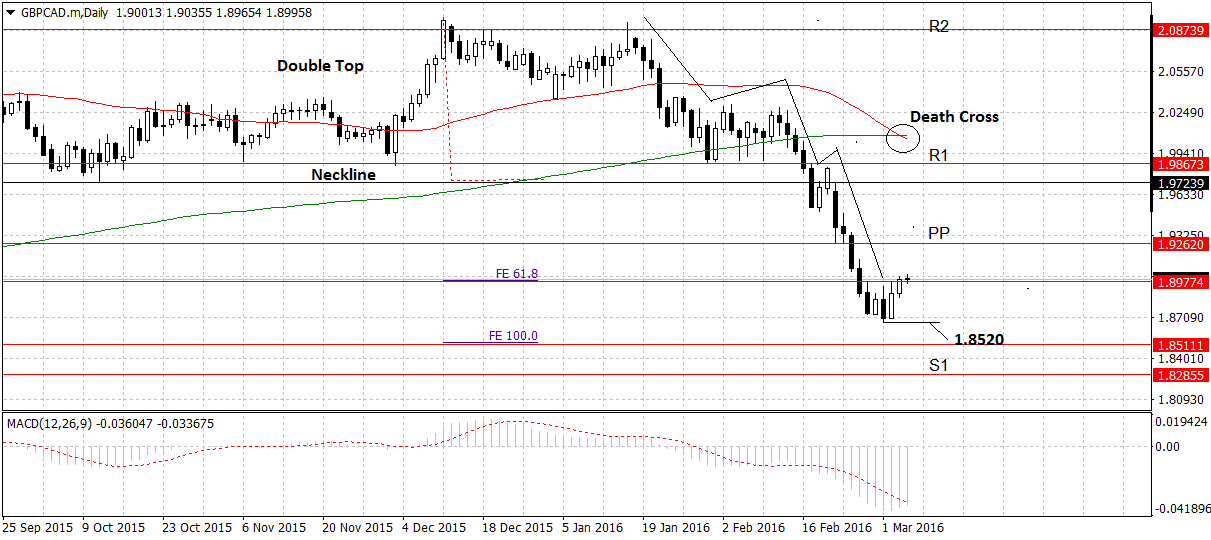
This was the minimum target from the double-top reversal pattern at the highs.
Double tops are patterns which occur at the end of bull trends and mark reversals of the trend.
They are formed when the market peaks, falls back and then peaks again at a similar level to the first peak – painting on the chart what is essentially a ‘double top’.
The price is then expected to fall steeply to a target at the 100% extension of the height of the pattern lower.
The neckline is at the low of the intervening trough of the pattern; it must be breached to confirm more downside and in order to validate the pattern.
The minimum target is at the 61.8% extrapolation- rather than the 100% - due to the significant properties the 61.8% ratio discovered by the Italian Mathematician Fibonacci.
Since the minimum target on GBP/CAD has been met (at 1.8977), it lessens the chance of more downside, and increases the chances of either a consolidation or recovery.”
Also as per my previous report: “the pair may have fulfilled the 61.8% minimum target from the double top, but it still has not met the 100% target at 1.8520ish, and there is a still a candle-lit possibility of a move down to 100%.
So for intrepid bears willing to front some risk, a break below the 1.8650 level would confirm a move down to 1.8520 at the 100% target, especially as it will be complemented by the Death Cross.
Sell GBP/CAD on Strength: Scotiabank
The GBP managed to trade a little above resistance in the upper 1.89 area of late but gains were not sustained and the cross has dipped back under 1.8980 in late trading.
"Short-term bear pressure has moderated somewhat but we continue to view longer-term risks as being geared to the downside. We are targeting a drop to 1.85 (1.8515 is the measured move target of the 1.9740 double top breakdown)," says strategist Shaun Osborne at Scotiabank.
Corrective GBP rebounds remain a sell suggests Osborne.
But USD/CAD Below 1.34: BMO Capital
Elsewhere on the startegy front BMO Capital are looking to buy the USD/CAD pair ahead of a recovery.
"We would look to accumulate USDCAD below 1.34 targeting 1.37 in 1M and 1.45 in 3M," says analyst Greg Anderson at BMO Capital.
BMO's economists still have a June Fed rate hike and an April BoC rate cut in their forecasts.
"They have freely told us that those calls are tenuous for those precise dates, but confidence is high that the Fed will hike at least once and the BoC will cut once in 2016. Neither is fully priced in," says Gallo.
Canadian Dollar Will be Concerned by CAD's Strength
Market pricing suggests most traders expect the Bank of Canada to stand on the side-lines and wait for the outcome of the Federal Budget before making any decisions at their monthly meeting on Thursday.
But, the meeting comes at a time of notable strengthening in the Canadian dollar with some analysts suggesting there is a chance the Bank may express displeasure with the currency's new-found strength.
The move higher is, “outpacing increasing oil prices,” say TD Securities who suggest the main risk to the currency now is that the central bank, “acknowledges the strengthening currency.”
Scotiabank agree: "risk is elevated as we approach Wednesday’s BoC, with concerns surrounding the statement tone following CAD’s 10% rally off the January lows."
Scotiabank are keen to emphasise CAD’s notable divergence from levels implied by yield spreads, essentially the currency is getting ahead of itself.
Consensus is the Canadian decision-makers are not ready to attack the value of CAD.
“The Bank of Canada is likely to remain in pause mode at Wednesday’s meeting,” say National Bank of Canada who note the central bank decided not to cut the overnight rate further despite significantly lowering its 2016 GDP growth forecast for Canada.
N.B.C point to the fact that the bank withheld a rate cut in January despite substantially revised down growth forecasts.
In fact N.B.C argued bank in January, at the height of oil price concerns, that a rate cut would not actually help the Canadian economy as Canadian businesses who import were struggling with the cheap CAD:
“Currency instability has become a concern, and we think the Bank of Canada must take note. For Canadian businesses, currency depreciation has already sent the price of machinery and equipment (73% of which is imported) to a new record high. This is bound to complicate Canada’s transition to a less energy-intensive economy," wrote N.B.C’s Stefan Marion.
Further, high hopes for the ‘shot in the arm’ from government spending kept the Bank of Canada from pushing the button on further interest rate cuts at the start of the year - this remains a factor for this week's meeting given the up-and-coming budget:
“The rationale at that time, i.e. upcoming fiscal stimulus will give a lift to the economy, is still valid. Moreover, the apparent stabilisation of oil prices and an uptrending inflation rate both argue against a rate cut,” say N.B.C.
There is, however, an outside risk of BoC target the exchange rate which has depreciated from 1.46 against the USD, just a few weeks ago, to round 1.34.
“So, a surprise cut to take some steam out of the currency can never be ruled out,” say N.B.C.
A press conference from Governor Stephen Poloz is scheduled for the day after the BoC meeting.