The Canadian dollar exchange rate complex (CAD) is unlikely to benefit from a recovery in oil prices in 2016 argues Sweden's Handelsbanken who cite Iran and China as being key drivers of lower prices.

The Canadian dollar has fallen against sterling since October - the declines coincide with the latest leg lower in the price of Brent crude oil.
It is no secret that the Canadian dollar remains intimately tied to the movements in the oil price markets. Given, it is not the only factor, but it does matter.
Oil is a key component of the commodity basket with the overall basket contributing around 27% of the total value of Canada's GDP.
Canada is one of the only developed nations that exports energy - oil therefore matters to the country's finances and the currency. When exports and prices are up so is international demand for the country’s currency.
While the day to day movements of brent crude prices may not matter to moves in the Canadian currency, any major decline below current levels in oil prices will perceivably have an impact.
Step in the latest forecasts from Sweden’s Handelsbanken which see a notably lower oil price over coming months.
Latest Pound / Canadian Dollar Exchange Rates
  | Live: 1.8766▼ + 0.19%12 Month Best:1.9044 |
*Your Bank's Retail Rate
| 1.8128 - 1.8203 |
**Independent Specialist | 1.8503 - 1.8578 Find out why this is a better rate |
* Bank rates according to latest IMTI data.
** RationalFX dealing desk quotation.
2016: 30 USD a Barrel
During the last two weeks, the impact of OPEC abandoning its production target and the end of the drop in US shale oil production alongside Iran’s approaching return have all been traded into the oil price; consequently, the oil price has fallen below USD 40/bbl.
“Of these factors, we consider Iran’s approaching return to be contributing the most to oil price movements, although the impact from shale oil is difficult to interpret,” says Martin Jansson, Strategist, Commodities Handelsbanken.
As long as 2016 does not bring about a total collapse in shale oil, Jansson sees few arguments for prices to increase and believes that Brent will reach USD 30/bbl during the first six months of the year.
Iran is Back
There is now broad consensus that the sanctions on Iran will be lifted in Q1 2016, and Iran claims that it will then be able to increase production by 1 Mbpd.
Bloomberg’s latest survey shows that analysts are expecting less than half of that volume to reach the market this year.
“We believe that there is reason for the current government to exaggerate the available volume of oil, but we also believe that analysts’ forecasts are overly modest because they are based too much upon parallels to Iraq’s recovery,” says Jansson.
Iran’s return led OPEC to abandon its production target at its meeting on December 4 after Saudi Arabia’s oil minister Al-Naimi was unwilling to give market share to its archrival Iran, represented by oil minister Zanganeh.
“If OPEC takes Iran that seriously, then so do we,” says Jansson.
Chinese Oil Imports are Cracking
So, weighing oil prices down is OPEC, Iran and the stubborn US shale industry.
There is more though - the Chinese import trend has been strong, but in the
past three months it has slowed to being on par with, or below, the trend.
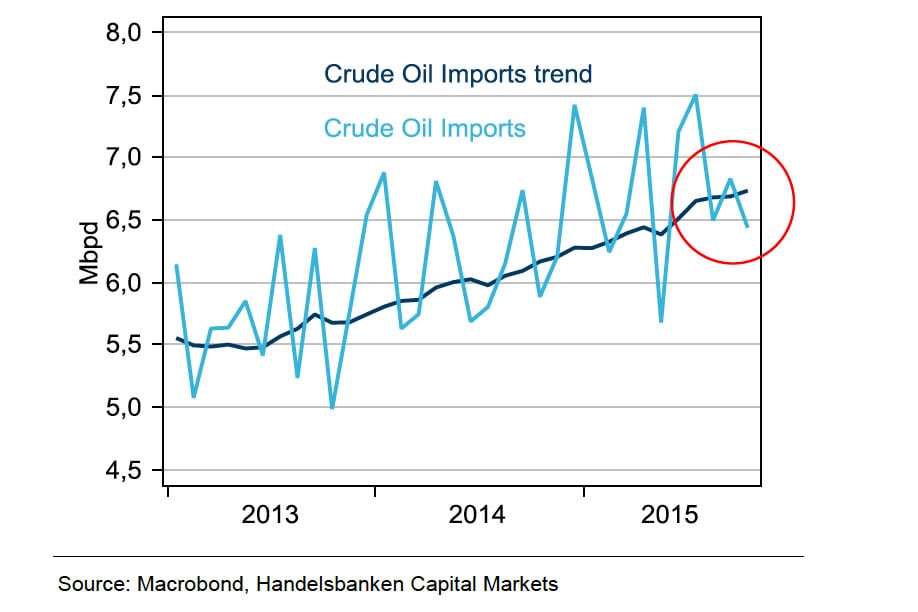
“Imports are volatile, but we would like to see them clearly exceeding the trend to alleviate our concerns that oil is the last of a line of commodities where imports to China are slowing in the wake of lower industrial production,” says Jansson.
Handelsbanken point out that oil is much more of a consumption commodity than others, but the growth rate for vehicle sales has fallen to zero, except for cars with smaller engines that have been subsidised since September.
Put this together and it is understandable why many in the market are finding it hard to get behind oil in 2016.
While the strengthening US economy is likely to provide support to the Canadian economy and dollar in 2016 and hope for an oil-lead CAD recovery looks as remote as ever.