Image © Adobe Images
The Canadian dollar is expected to strengthen against major counterparts according to Desjardins Bank, citing improved trade clarity.
Desjardins says the loonie’s recent pullback reflects temporary concerns rather than a shift in direction, noting that it expects USD/CAD to fall over time, a view that implies broader Canadian dollar resilience against both the U.S. dollar and other majors.
“The Canadian dollar strengthened in December on narrowing interest rate differentials implied by forwards but retraced some of those gains in the new year,” Desjardins says.
It cites potential headwinds about a potential oil supply glut south of the border.
That move underscores what Desjardins calls an ongoing “tug of war between fundamentals and political noise,” which it expects to remain a defining feature of markets in 2026.
Yet, the bank says its core view is unchanged, adding, “We expect the loonie to extend gains against most currencies, but the path won’t be smooth.”
Desjardins says investors should be prepared for volatility linked to trade headlines and a soft domestic economy, particularly around the review of CUSMA.
Assuming positive momentum, the bank says clearer signals on the trade deal should help spur business investment.
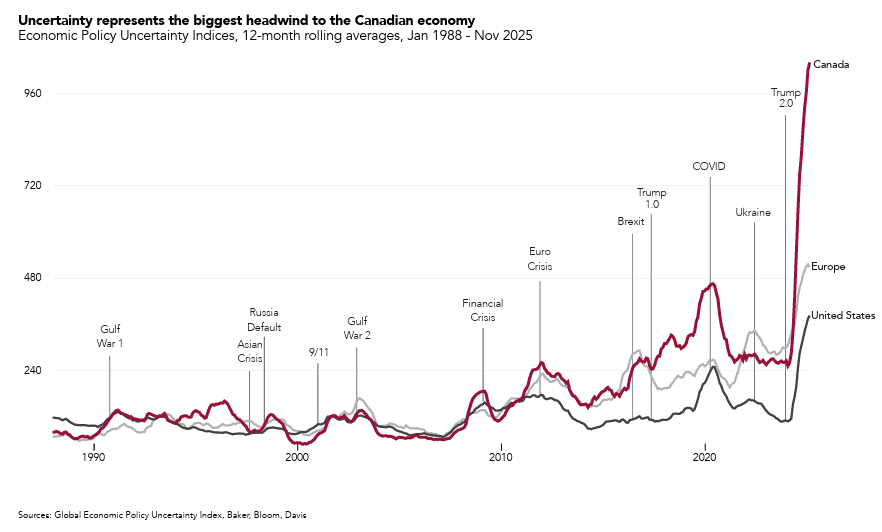
Above: Uncertainty is deemed to be a significant headwind to CAD by a new forecast analysis from Corpay.
Desjardins also says Canadian asset managers are likely to raise foreign exchange hedge ratios as the cost of hedging declines, driven by expected U.S. Federal Reserve rate cuts.
Concerns about lower Western Canadian Select prices are likely overstated, according to Desjardins, even if Venezuelan oil exports are diverted to the United States.
The bank says Canada’s energy export mix is changing, noting that crude shipped through the TMX pipeline now supplies refineries in China where it commands a premium over WCS.
Desjardins adds that liquefied natural gas exports to the Asia-Pacific region are set to rise as the LNG Canada project ramps up to full capacity.
✳️ Secure today's exchange rate for a future payment. You may also book an order to trigger your purchase when your ideal rate is achieved. Learn more.
These developments point to greater resilience in Canada’s energy exports, the bank says, alongside what it describes as a growing political consensus to invest in east–west energy corridors to reduce reliance on the U.S. market.
Desjardins says it expects USD/CAD to be volatile in the first quarter due to trade headlines but to trend lower thereafter as more clarity emerges ahead of the July CUSMA review deadline.
The bank says it has upgraded its year-end USD/CAD forecast to 1.34 from 1.35 and expects the pair to fall below 1.30 by the end of 2027.
✳️ Secure today's exchange rate for a future payment. You may also book an order to trigger your purchase when your ideal rate is achieved. Learn more.