
Image © Adobe Images
The Canadian dollar faces another unsettled year in 2026, owing to still elevated levels of economic uncertainty, says Corpay.
On the upside, the international payments firm says the currency’s "fundamental undervaluation" may partially unwind over the course of the year.
However, for that to happen, a key headwind to the currency must disolve, namely the chronic levels of uncertainty holding down businesses and consumers.
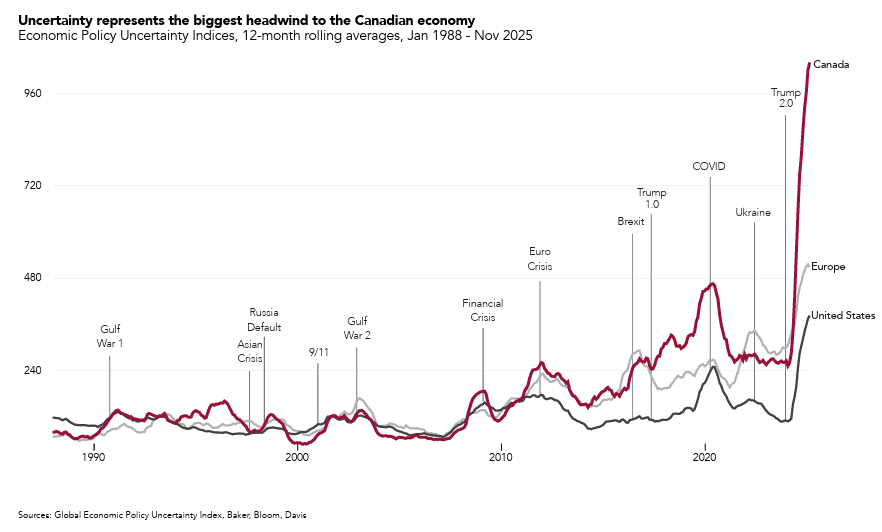
Image courtesy of Corpay.
"The Canadian dollar looks destined for another unsettled year in 2026 as the economy adapts to a changed global environment," Corpay analyst Karl Schamotta says in a year-ahead outlook.
He explains that business investment, job creation and economic growth have suffered since Donald Trump focused on Canada last year, compounding an existing slowdown in real estate and forcing what it describes as a painful structural transition.
Schamotta says monetary policy is unlikely to be the main driver for the currency, arguing that Bank of Canada has effectively sidelined itself after cutting rates to the lower end of the neutral range.
Recent Bank of Canada communications show the current base rate is "about the right level" if the outlook holds, and are wary of adding to still-stubborn inflation pressures or overstimulating an economy with high household leverage.
Given this, Corpay says trade uncertainty is a more material source of potential volatility for the Canadian dollar, particularly in the run-up to July’s joint review of the USMCA.
✳️ Secure today's exchange rate for a future payment. You may also book an order to trigger your purchase when your ideal rate is achieved. Learn more.
The review period is likely to leave the currency vulnerable to bouts of volatility, citing Trump’s "well-established penchant for hyperbolic rhetoric," warns Schamotta.
With roughly 90% of Canadian exports compliant with USMCA rules, Corpay says any threat to unwind the agreement could prove consequential for the currency.
However, the firm says downside risks may have less longevity than headlines suggest, noting that actual tariff rates remain low and that Congressional support for higher import taxes on U.S. households will be difficult to secure ahead of the late-2026 mid-term elections.
Corpay says there are also signs of resilience in the domestic economy, pointing to real estate markets showing signs of stabilisation, labour markets tightening at the margins and improving measures of business and consumer confidence as government stimulus feeds through.
“We expect some of the Canadian dollar’s fundamental undervaluation to unwind over the year, but its progress will be punctuated by recurrent setbacks,” Corpay says.
“The economy is not yet on firm ground—and neither, for that matter, is the exchange rate,” the firm adds.