The GBP/AUD pair remain's rangebound after the Reserve Bank of Australia (RBA) July minutes. Westpac's algo picks AUD as G10 currency with the strongest outlook
Analysts at Westpac bank have singled out the Australian dollar as the currency with the best prospects in the short to medium term, due to a combination of rising commodity prices, strong yield differential versus other G10 currency's and robust domestic economic outlook.
They say that according to their G10 portfolio allocation model which selects and decides what share of a hypothetical G10 currency portfolio each of the 10 currencies will have, the AUD has the largest share with 22.7% of the total portfolio.
“Our medium and short term signals are trending in AUD’s favour. Growth has been a reliably positive AUD signal for over a year (blue bars), the main positive inputs being the downtrend in the nation’s unemployment rate (from 6.3% to 5.8%) and the recovery in business conditions from the NAB business survey (from around +5 to +12).” Says Westpac Strategist Richard Franulovich in a recent note.
Although this has been the fifth week in a row AUD has come top, Franulovich continues to see more upside ahead, although he cautions the going could get tough versus the dollar if speculation increases of a hike in US rates.
Aussie rises after RBA minutes mention data driven stance
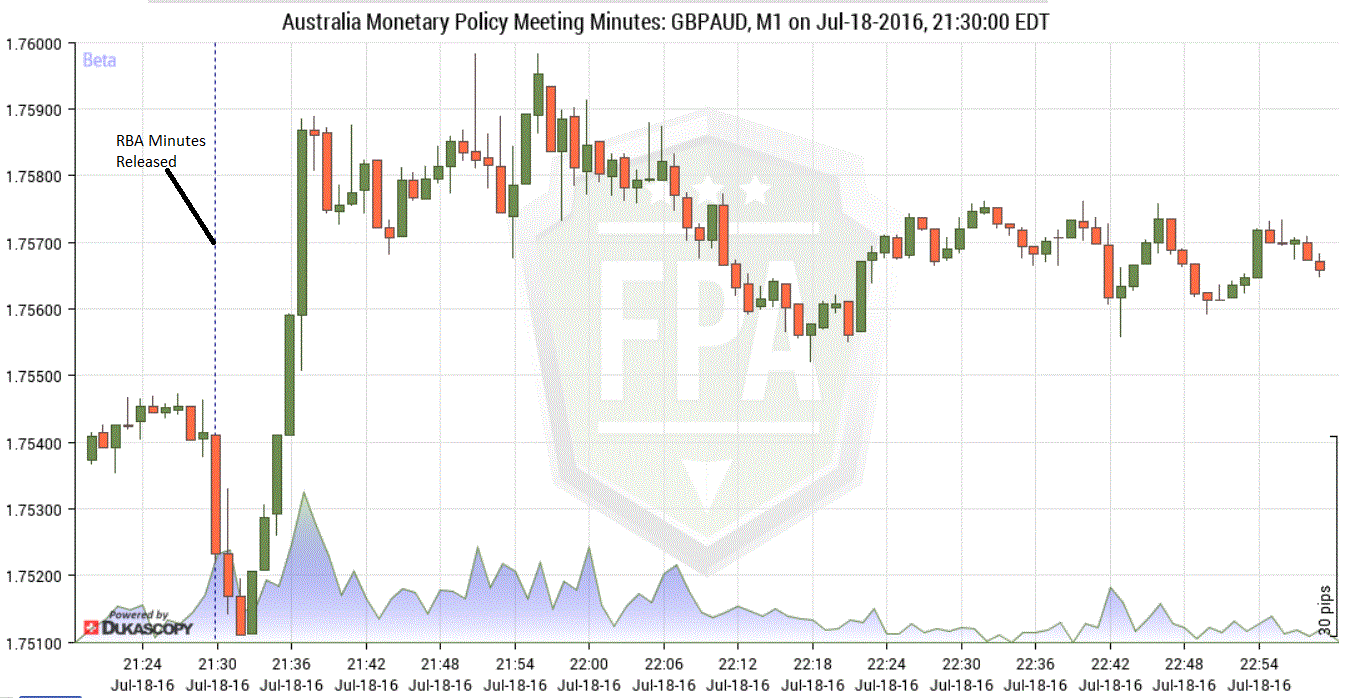
The pound to aussie pair slid temporarily but the rose from 1.7540 to 1.7580 in the ten minutes following the release of the RBA 5 July meeting minutes, as traders interpreted the statement as increasing the chances the central bank will reduce interets rates in August, seen by many as a likely time for a rate cut.
The aussie weakened following the news as it is generally accepted that lower interest rates attract less flows of foreign capital, thus reducing demand for a currency.
The conclusion to the minutes suggested the RBA had adopted a broadly ‘data dependent’ stance when it came to assessing whether they would make further changes to policy:
“The Board noted that further information on inflationary pressures, the labour market and housing market activity would be available over the following month and that the staff would provide an update of their forecasts ahead of the August Statement on Monetary Policy. This information would allow the Board to refine its assessment of the outlook for growth and inflation and to make any adjustment to the stance of policy that may be appropriate.”
Throughout the report there were references to inflation remaining subdued, which further increased the chances of the RBA moving to cut rates.
“Measures of inflation expectations – from consumers, market economists, union officials and financial markets – had remained below average.”
As far as the labour market went, there appeared to be little change with employment levels at long-running averages and the large leaps in employment seen at the start of the year having subsided.
On the subject of housing house prices in Sydney and Melbourne continued to rise, but in other cities there had been modest declines since the previous meeting - overall housing data was mixed:
“Other indicators of housing market activity had been mixed over recent months. Auction clearance rates and sales volumes had been lower than a year earlier, although both remained a little above average. Housing credit growth had eased further, consistent with a relatively low level of turnover in the housing market and the earlier tightening in lending standards.”
Technical Outlook
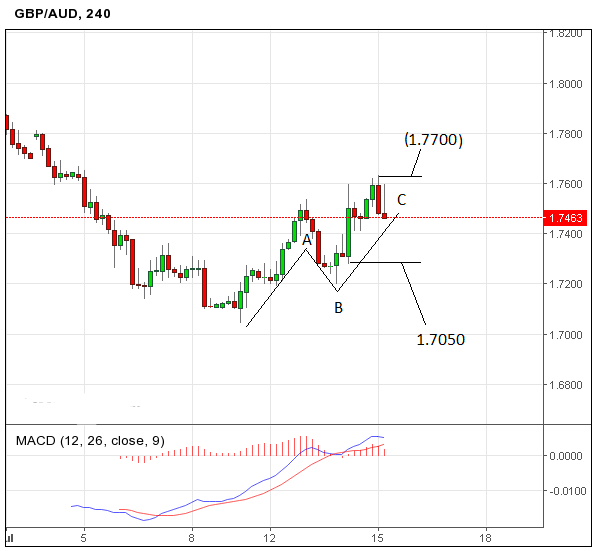
The price charts are showing that the pair has completed a correction within a dominant down-trend and is now poised to resume going lower.
The roughly three wave 'ABC' (e.g wave A, wave B and wave C) correction can be seen more clearly on the chart below.
The pattern looks like it has finished and the pair is now expected to resume falling, with confirmation already coming from the posting of a 'three black crows' candlestick pattern on the four hour chart. This involves three down periods in a row and augurs bearish for rates, particularly coming after an ABC, zig-zag or measured move.
A break below 1.7280 would probably confirm a continuation down to at target at the 1.7050 lows.
Only a bullish break above the 1.7636 highs would change the bearish overall outlook as it would show a new trend of peaks and troughs had established themselves higher.
Such a move might target 1.7700 to the upside.
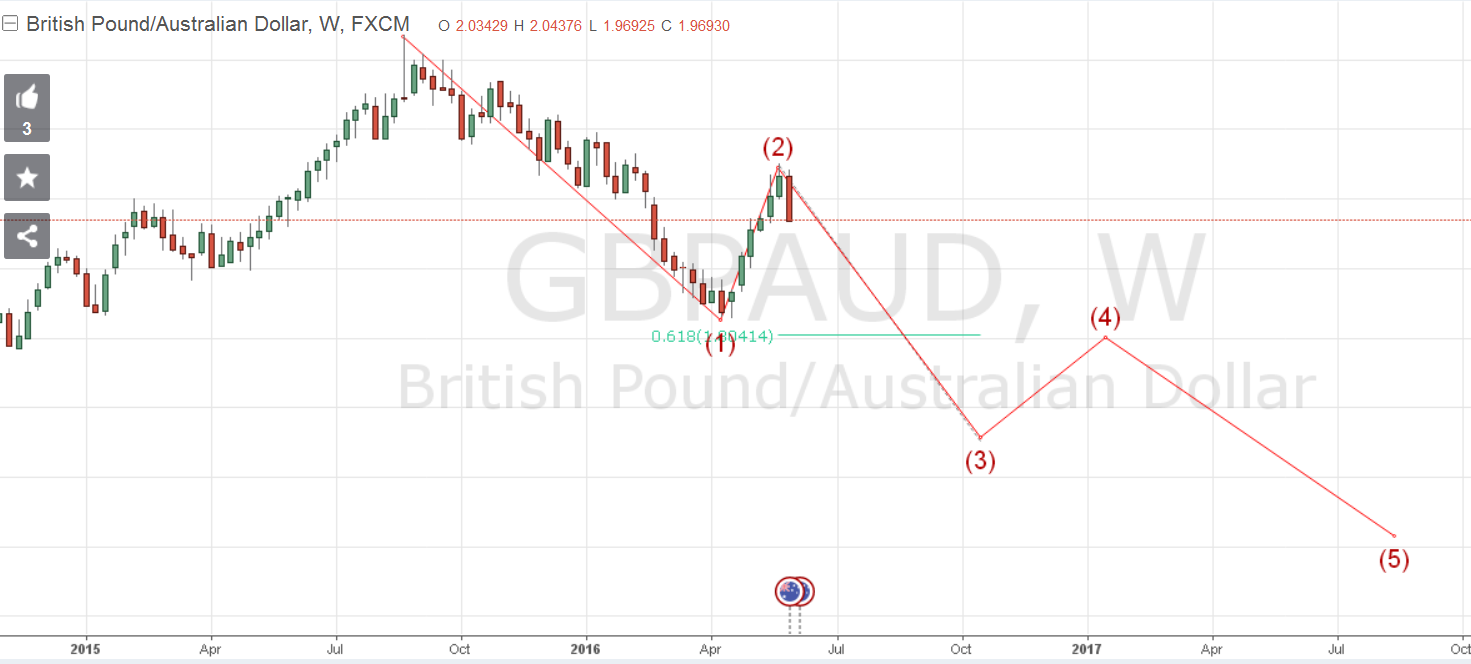
Elliot Waves are a form of market cycle which analysts use to predict the future.
The Elliot Waves on GBP/AUD they are indicating probably more downside longer-term.
In late June, Blogging Elliotician Jake66, on TradingView.com said he was, “Shorting wave 3 down to 1.65000.” (See pic below).
His analysis suggests that after 2015 we began a strong impulse wave down which is likely to go all the way to the mid-1.60s.
The recovery rally in April was a smaller wave (2 ) within the larger wave down, and we are on the cusp of beginning a strong move down, or wave (3).
Wave 3's tend to be the strongest most impulsive waves.
Foreign Factors
Outside factors have been seen as a major consideration in the RBA’s shift to considering a rate cut.
These included Brexit and China slowdown as the most important, according to FX Strategist David Fernandez at Barclays Capital, who commented recently that:
“We think this change to the statement could have been made in light of the potential downside risks (although still highly uncertain at this stage) to business confidence and economic activity in Australia posed by recent developments, such as the UK voting to leave the EU, the possibility of a hung parliament in Australia as suggested by early vote counts, and recent moderation in economic activity in China.”
If this is so, then there is a chance the RBA's stance could have shifted recently as the fallout from Brexit has not been as a bad in terms of financial market volatility as previously thought.
Also recent Q2 Chinese data was better than hoped, after several metrics showed a rise, including GDP, which came out at 1.8% (1.6% exp 1.1% prev), Retail Sales at 10.6% (10.0% prev and 10.0% prev) and Industrial Production, which rose by 6.2% (6.0% prev, 5.9% exp).
Given the main criteria for the RBA considering cutting interest rates have diminished, there must now be less of a probability of a cut, which should feed through to higher rate expectations and a stronger Aussie dollar. (Interest rates increase a currency’s attractiveness to foreign investors as they promise higher returns).
Indeed, this is echoed by Jeremy Stretch of CIBC Capital markets:
“The better than expected China Q2 GDP release, (see the piece by Patrick Bennett entitled ‘China activity, GDP and loan data beat expectations’ for more details) helped to boost the AUD, prompting the market to test the 76.4% Fibonacci retracement level of the 0.7145-0.7835 range traded over the last three months, that comes in 0.7672.”
Couple this with recent Aussie employment data, which was considered ‘good enough’ and the outlook for the currency looks positive – and therefore negative for GBP/AUD.
Latest Pound / Australian Dollar Exchange Rates
  | Live: 1.8746▼ -0.05%12 Month Best:2.0851 |
*Your Bank's Retail Rate
| 1.8109 - 1.8184 |
**Independent Specialist | 1.8484 - 1.8559 Find out why this is a better rate |
* Bank rates according to latest IMTI data.
** RationalFX dealing desk quotation.
Attractive Yield
The Aussie still promises investors one of the best rates of return in the G10 at 1.75%, and this is expected to keep demand for the AUD high.
This is a major factor in keeping the currency strong, according to Managing Director of Research at Morgan Stanley, Hans Redeker:
“Coupled with USD depreciation and investors’ continued hunt for yield, AUD may stay relatively well supported in the near term. While we believe the RBA will eventually cut rates in August, there is no catalyst until the 2Q CPI report in a few weeks. Until then, we expect AUD to perform well particularly in light of the decent employment report this week. In addition, political risks have now reduced for the AUD as a majority coalition government is likely.”