The Australian dollar (AUD) is in recovery mode, moving higher in sympathy with commodity markets, and a list of other reasons.

The Australian Dollar is rising strongly, snapping a two week decline, which had taken it to multi-year lows.
The twin influence of two fundamental drivers appears to be at the root of this newfound strength.
The first of these is the strong rebound in oil after it reached the $27 per barrel low, which charts are showing could now be an exhaustion low - or at least a temporary bottom for the commodity. The commodity complex, in general, is finding sentiment highly correlated to what is happening in the oil market; therefore what happens in oil matters.
Given Australia is such an important commodity producer the rebound is expected to help the currency higher.
"The turnaround in oil, recovery in currencies and rebound in global equities has many investors hoping that 3 weeks into the New Year, we've finally seen a bottom," says Kathy Lien at BK Asset Management.
Asset Cycle Possibly Turning
The current sell-off in equities, following on from 2012’s peak in Treasury bonds and commodities reaching extreme lows, are all symptoms of a critical change in the phase of what is known as the Major Asset Cycle Model of financial markets.
According to classical cycle theory, the prices of Bonds, Stocks and Commodities form peaks and troughs in a predictable series, one after another in a “consistent chronological fashion.” (Donald Pring, Technical analysis Explained).
This fact means that in theory it is possible to predict which asset will be the next to peak assuming you know the last asset to have peaked.
If equities have indeed peaked and we are witnessing the start of a deeper bear market for stocks then it is possible that commodities may gain some relief – however it is still too early to say equities have indeed peaked, and there is a long lag between the two largest world economies – America and the Euro-zone, which may also account for the longer-than average lags in the current cycle.
Latest Pound / Australian Dollar Exchange Rates
  | Live: 1.8799▲ -0.01%12 Month Best:2.0851 |
*Your Bank's Retail Rate
| 1.8159 - 1.8235 |
**Independent Specialist | 1.8535 - 1.8611 Find out why this is a better rate |
* Bank rates according to latest IMTI data.
** RationalFX dealing desk quotation.
However, BK Asset Management's Lien believes it is far too early to call the end of the commodity sell-off:
"There are rallies in every bear market and most importantly nothing significant changed over the past week. Of course most markets are not in bear territory, which is typically defined by a more than 20% drop from a recent high but many markets are oversold and a short-term recovery is not unusual."
Carry on Down Under: One Key Reason Why the Aussie is Being Bought
The other factor which is probably supporting the Australian dollar could be demand from carry traders seeking to make money on the rollover fees from holding the Australian Dollar versus other majors.
A rollover fee is calculated from the interest rate difference between two currencies, which is based on the base lending rate set by their central banks.
In Australia the base lending rate set by the RBA is significantly higher at 2.0% than in the U.K, Euro-zone or U.S where they are 0.5%, 0.05% and 0.25-5% respectively.
Therefore, a trader can make money from rollover fees regardless of changes in the exchange rate simply by holding Australian dollars versus U.K pounds, euros and dollars, and this sort of trade is called the “Carry Trade”.
There has been a resurgence in demand from carry traders because of the dovish stance adopted by Mark Carney and Mario Draghi in commentary this week.
In addition, according to a survey of global investors published by BofA this week, their views on how aggressive the Federal Reserve is likely to be in relation to hiking interest rates this year has also changed, with the majority now expecting two rather than three of four hikes in 2016.
With monetary considerations appearing so subdued carry traders are once again taking advantage of the rate differential to start buying higher yielding currencies such as the Aussie and kiwi dollars.
Chartists for Charts
Fundamentals aside, what are the charts saying and what are the next levels to watch?
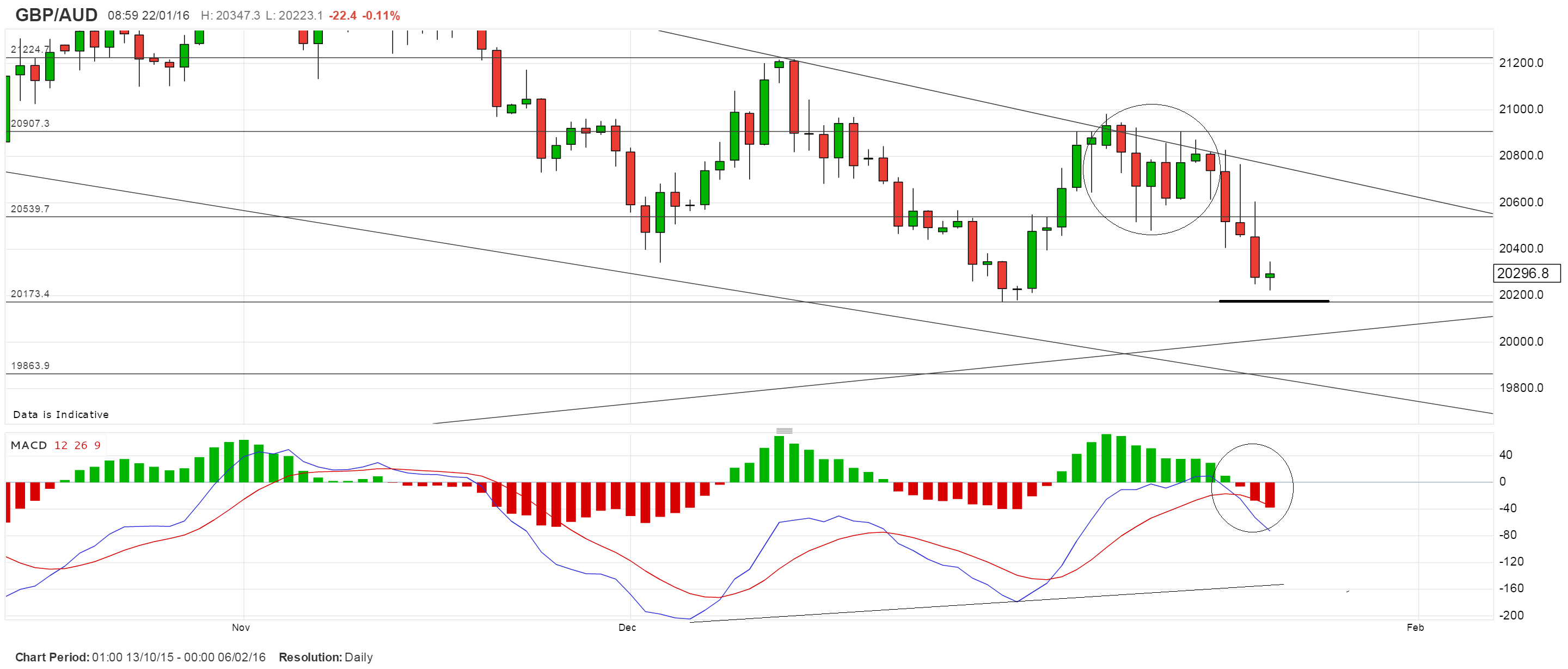
The pound to Australian dollar exchange rate has renewed its down-trend after a pause in which sterling strengthened.
It is now close to a support low at 2.0180, where it could base and find support.
After that there is even more support at around the 2.0000 level from even more support as well as round-number support.
The short-term outlook is for more down-side in a continuation of the current down-trend but given the clusters of support not far below at 2.0000 I’d be hesitant to trade the pair lower until the 2.0000 level had been definitively broken.
European Tour
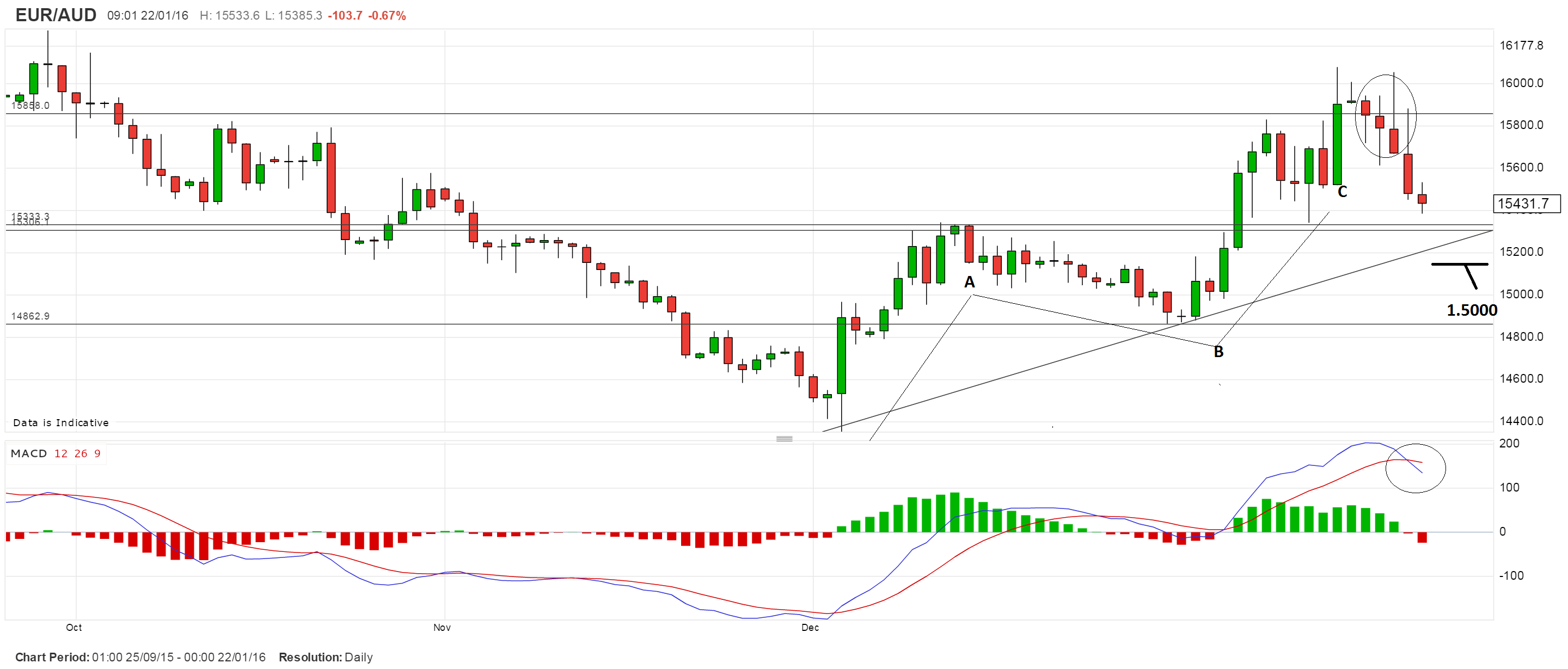
The Euro to Australian dollar exchange rate has broken down after completing an a-b-c correction followed by 3-black crow’s bearish candlestick pattern and is also set to move lower, probably down to 1.5330 where there is a double layer of robust support.
For a continuation lower, I would ideally want to see the trend-line for the correction breached, confirmed by a move below 1.5180, with a target then at 1.5000, followed by support at 1.4880.