
Image © Adobe Images
Week-ahead forecast: The balance of probabilities favours further recovery while GBP/AUD remains above its 21-day moving average and recent breakout zone.
The Aussie dollar, which is highly sensitive to broader sentiment, has fallen over recent sessions in tandem with another deterioration in global risk sentiment that extends into the new week.
"Stock and bond markets are under pressure from a triple headwind: a pullback of the AI trade, rising Fed rate hike expectations, and a jump in crude oil prices triggered by escalating tensions between Iran and Israel," says Elias Haddad, Global Head of Markets Strategy at Brown Brothers Harriman.
South Korea's stock market tanked 8.8% in Asia trade, triggering a 20-minute halt to trading, after investors dumped memory-chip makers Samsung Electronics and SK Hynix.
The falls are a symptom of a wider pullback in a heavily inflated AI trade, and signal the prospect of further corrections in the coming days that would no doubt weigh further on the risk-linked Aussie dollar.
"South Korea’s stock index underperformed across the board undermined by the unwinding of the AI trade and ongoing energy shock," says Haddad.
Price action underscores a base forming underneath the pound to Australian dollar pair (GBP/AUD), from which a more durable recovery can evolve.
Chart studies suggest there's now scope for a test of the 100-day moving average near 1.9050 in the days ahead:
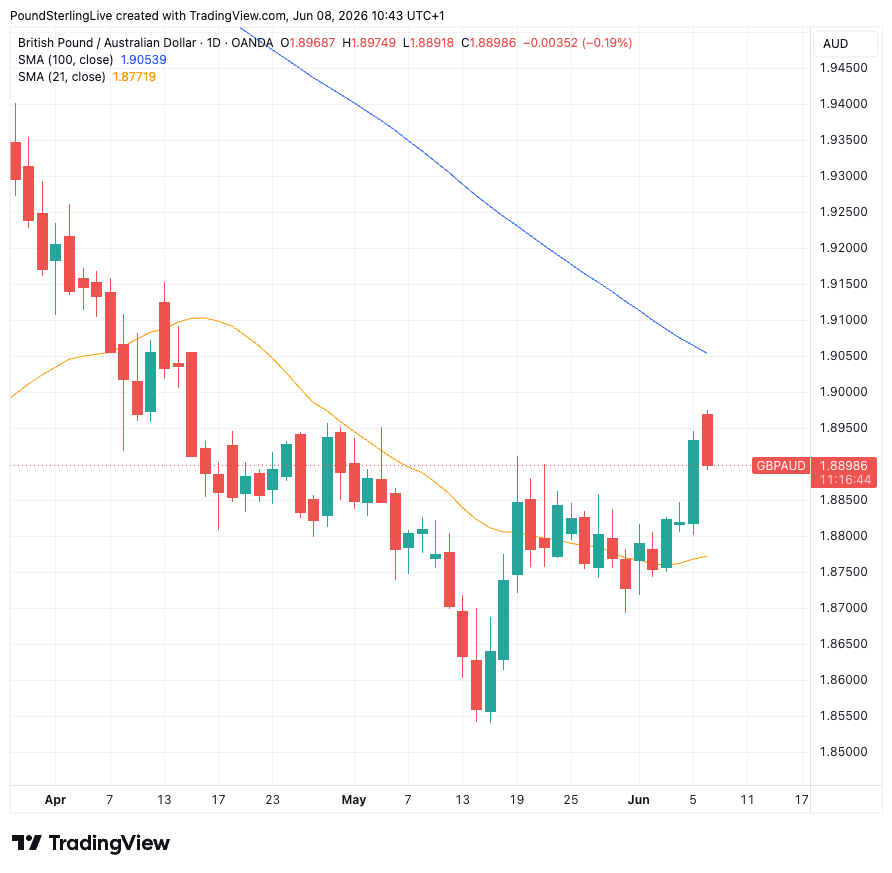
Although the broader medium-term trend must, as a rule, remain cautious below that level, the near-term technical bias has shifted modestly in favour of sterling and a test of the 100-day.
Sterling has pushed above its 21-day moving average near 1.8770 and is holding comfortably above it, confirming short-term momentum has shifted in favour of the pound. The recovery from the May low near 1.8550 remains intact, with the market now producing a sequence of higher lows and higher highs for the first time in several weeks.
The moving-average configuration has improved: The 21-day average has turned higher and price is trading decisively above it, indicating buyers have regained near-term control.
Provided GBP/AUD remains above the 1.8770-1.8800 region, dips are likely to attract renewed demand.
U.S. Data to Determine Sentiment This Week
Beyond the Middle East and the gyrations of the AI trade, the robust nature of the U.S. economy is proving an important trigger for markets, and is something we'll be watching again this week.
AUD fell in response to Friday's strong U.S. jobs report that prompted traders to fully price a rate hike from the Fed by year's end. That raised interest rate expectations and bond yields, which naturally boosted the dollar and weighed on stocks.
With sentiment clearly in control of AUD, we're looking to the broader calendar to see where the next challenges for the currency might be.
The highlight of the week in this regard is the release of U.S. inflation data on Wednesday, where a hot print would boost bets the Federal Reserve will need to raise rates, which would negatively impact markets and AUD.
Headline CPI is seen printing at 0.5% m/m, up from 0.6% in April, helping nudge the headline to 4.2% y/y from 3.8% in April.
Core CPI is seen at 0.3% m/m vs. 0.4% in April or 2.9% y/y vs. 2.8% in April.
These are the numbers the market will be watching: below here, AUD and stocks recover. Anything above, and sellers gain control again.