
Image © Adobe Images
A period of stability in GBP/AUD might be coming to an end, and a retest of May lows at 1.8613 might come into play.
The pound to Australian dollar exchange rate (GBP/AUD) starts the new month in the red at 1.8757 and there are hints that downside momentum is rebuilding after a brief hiatus.
The dominant feature on the chart remains that descending trendline that has capped every meaningful rally since late March:
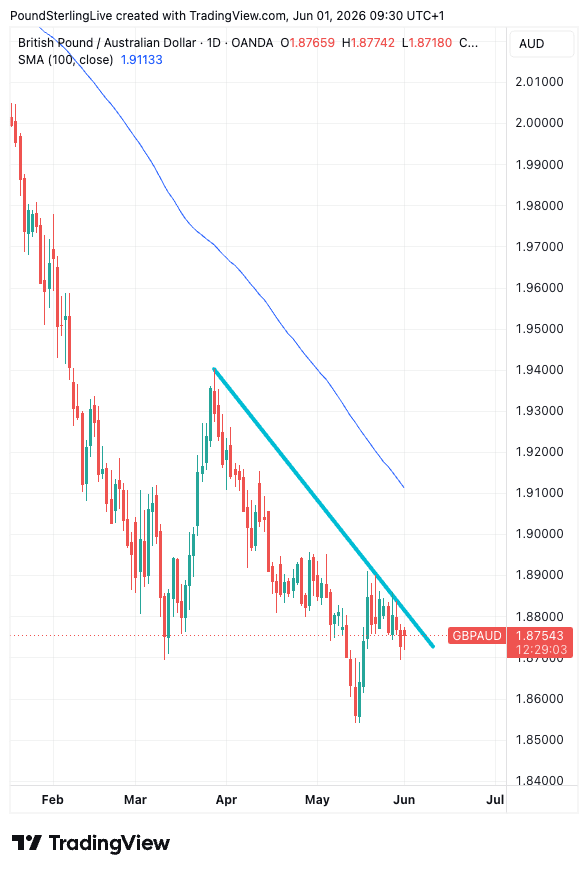
The descending line is mirrored by the downsloping 100-day moving average near 1.91; while below the line the medium-term trend remains bearish.
The selloff does encounter setbacks and recent price action saw GBP/AUD recover from a mid-May low at 1.8613 to 1.89, suggesting sellers lost their way, but that's likely a minor setback.
Indeed, since May 19 we've seen a succession of daily declines that hints the sellers are starting to regain control, which puts the mid-May low back into contention in the coming days.
The key battleground for the coming week is the downtrend line currently intersecting around 1.88, where a decisive break could trigger a squeeze higher back toward 1.89.
However, until the 100-day moving average is challenged, we'd remind readers GBP/AUD is in a concerted selloff and that it's best not to fight this well-established trend.
Global sentiment is mildly constructive Monday, and that's usually a good thing for the Aussie dollar, helping explain why it's on the front foot.
In a Truth Social post early on Monday President Trump said Iran "really wanted to make a deal" and suggested critics "just sit back and relax". Markets are taking him at his word.
We'll be watching headlines for further sentiment shifts, but readers should note that setbacks in the market due to the Iran situation tend to be swiftly reversed.
In terms of data, Wednesday's GDP data for Q1 is due for release; it's a bit backward-looking in nature given it's for Q1. Yet, it should serve as a reminder why the AUD is one of 2026's best-performing currencies: the domestic economy is in good shape.
A 0.5% q/q growth rate is expected, a strong figure that underscores why domestic inflation is robust and explains why the Reserve Bank of Australia (RBA) has had to raise interest rates on three occasions this year.
That rate hike path has solid fundamentals to thank, and in currency terms, that's as supportive as you can get.