
The Pound to US Dollar pair is rolling over and providing traders with the perfect selling opportunity argues a prominent currency strategist.
The time is ripe to ‘fade’ the GBP/USD pair says analyst Alvin Tan at Société Generale in London.
‘Fading’ is a trading term which means taking a trading position which is contrary to the dominant trend.
By advocating fading GBP/USD, Tan means selling the pair, which has been in a strong uptrend since recovering the day after the October flash crash lows.
His recommendation is to sell the pair at 1.2615 with a target at 1.2150 and a stop loss at 1.2890.
Stop losses automatically close trades out if they go in the opposite direction to that expected so that their losses can be controlled.
Latest Pound / US Dollar Exchange Rates
  | Live: 1.3486▲ + 0.41%12 Month Best:1.3867 |
*Your Bank's Retail Rate
| 1.3028 - 1.3082 |
**Independent Specialist | 1.3297 - 1.3351 Find out why this is a better rate |
* Bank rates according to latest IMTI data.
** RationalFX dealing desk quotation.
Short-Covering Rally Spent
The period of “short-covering” which followed the October lows may now have run its course, reasons Tan, making the pair more vulnerable to a reversal lower.
“Short-covering” is a phenomenon whereby an asset starts rallying strongly from an oversold low.
It happens when many traders are in a short position on the same asset – which means a trading position which profits if the asset falls – and the asset suddenly starts going up in value.
When this happens, it can result in a panic closing of short positions as traders get worried about their positions making a loss.
The result is that the rally actually gains upward momentum.
Although Tan sees the ‘short-covering’ effect as wearing off, he still sees further upside as a risk, given the still-high net balance of bearish short positions on the pair.
“The key risks are: 1) the still large net short speculative position in sterling,” comments Tan in a proviso on the risks to the trade recommendation.
If these are closed rapidly they will fuel a rebound.
Yield Spread Diverging
A further rationale for selling the pair, according to Tan, is the widening divergence between the UK/US 3-year bond yield spread and the GBP/USD exchange rate.
Normally the two move in tandem with each other but lately the exchange rate has risen whilst the spread has fallen.
This is a sign that the exchange rate has become disengaged from fundamentals.
“UK-US interest rate differentials have continued to decline, and point to renewed cable weakness ahead,” remarks Tan.
Risk of Hard Brexit
Soc Gen see one possible risk factor of the trade failing as the UK Supreme Court deciding to allow the prime minister the prerogative power to dispense Brexit without the input of Parliament.
The Law Lords deciding on the case will publish their decision at the start of January.
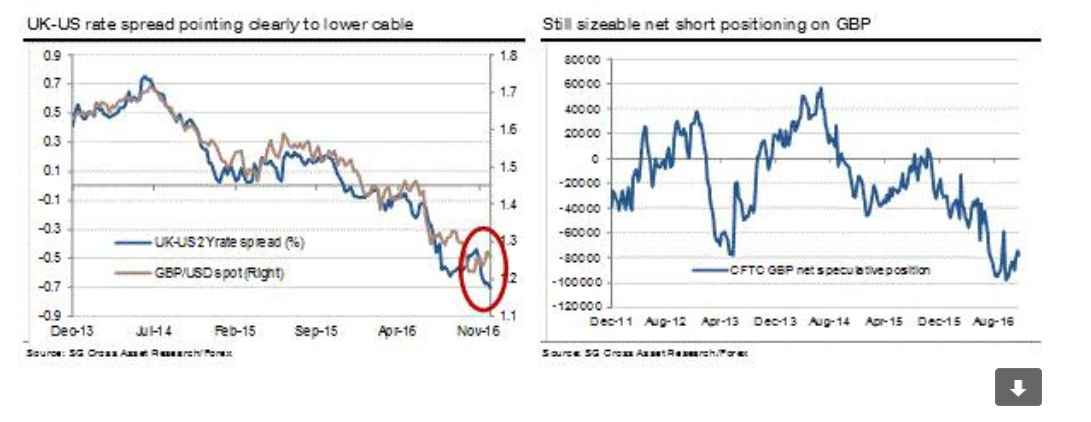
Diverging yield spreads and GBP/USD warn of GBP/USD weakness to come. Net Shorts still very high.
Technical Signs of Weakness Accumulating
There are signs on the chart of GBP/USD that it is vulnerable to weakness.
Two bearish candlestick patterns have developed over the last four days signaling that the trend is probably changing.
The first was a Doji Star at the highs and the second a Three Black Crows pattern after the chart showed three down days in a row following its peak.
When two patterns occur in close proximity there is a higher probability that they will successfully forecast the market’s next move.
Lloyds See Momentum Turning
More compelling signs of a reversal lower come from Lloyds Commercial Banking who note how momentum is moving down and how on each previous occasion it turned lower, GBP/USD followed.
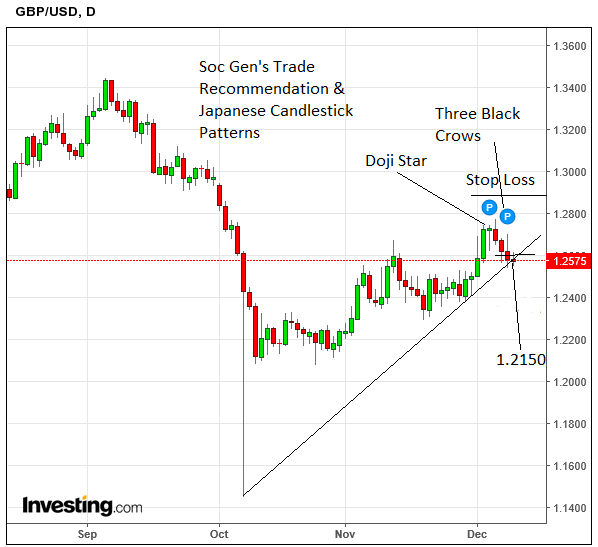
Soc Gen's trade and bearish Japanese candlestick cluster
J P Morgan’s Upside Forecasts Met
As far back as October J P Morgan said the market was going to correct in an Elliot Wave 4 higher to a zone between 1.2650 and 1.2800.
Since this target has now been met at the recent 1.27 highs, the pair is at risk of falling in the next wave lower – a wave 5, which should bring the pair down to at least the level of the flash crash lows.