
Strong economic data and rising dairy prices could lead to a higher-than-expected Q2 growth rate say BNZ which reaffirms the solid underpinning for the NZ Dollar.
- Pound to New Zealand Dollar exchange rate struggles to convince us it is in full flight to recovery
- Rebound in dairy prices offers substantive upside to New Zealand's terms of trade say BNZ who issue economic growth forecast upgrade
The Pound continues to slowly grind higher against the New Zealand Dollar with the pair rising from mid-August lows at 1.77 to the current 1.8214.
The move has been slow and while it does solidify the support level at 1.77, it doesn't exactly convince us of a major recovery move.
If we look at the chart below it is actually showing a marked lack of strength in the Pound’s rebound from its early August lows:
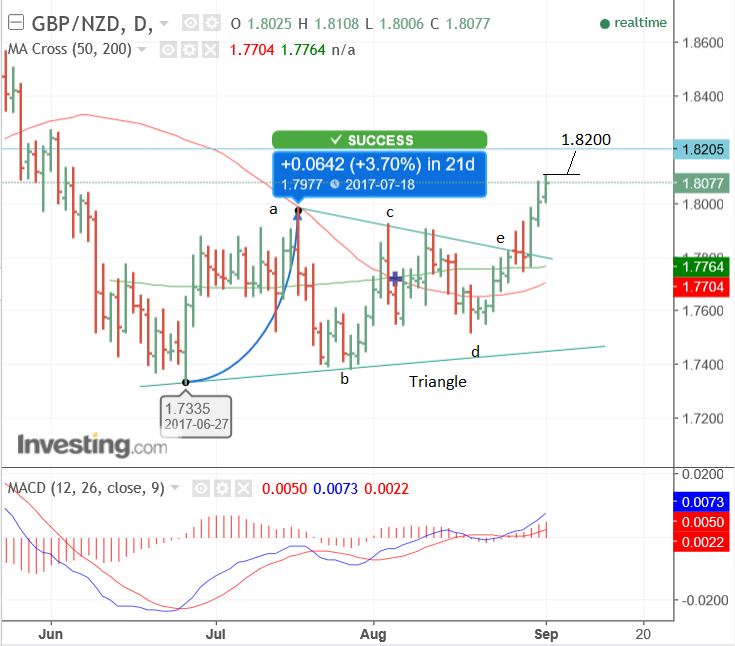
Despite positive manufacturing data out on Thursday pushing the pair higher, it has hit tough resistance at the 50-day moving average at 1.8275.
The lack of upside momentum in the move and the fact that the trend in the longer-term is down, leads to expectations that the pair will probably continue lower eventually.
As such, a break below the 1.7691 lows, would lead to a move down to a probable target at 1.7500.
Latest Pound / New Zealand Dollar Exchange Rates
  | Live: 2.3468▼ -0.47%12 Month Best:2.4815 |
*Your Bank's Retail Rate
| 2.267 - 2.2763 |
**Independent Specialist | 2.3139 - 2.3233 Find out why this is a better rate |
* Bank rates according to latest IMTI data.
** RationalFX dealing desk quotation.
New Zealand Dollar Continues to Enjoy the Support of a Solid NZ Economy
It's hard to argue against a currency like the NZD when we observe the solid fundamental underpinnings provided by the economy.
In fact, we can report that BNZ bank have upgraded their Q2 growth forecasts for the New Zealand economy to 0.9 from 0.6%.
The revision is partly based on BNZ’s prediction that Business Confidence would remain upbeat in August, a prediction which seems to have been proven true, after survey results released on Wednesday showed a positive balance of 15.5, only a half a basis point lower than the 16.0 of July.
Although admitting this has not yet, “translated into inflation”, the report sees it as a key indicator of growth, the data for which in Q2 will be released on September 14.
The sudden spike in dairy prices of 12.7%, recorded at auction in mid-August, are a further reason for businesses to feel more confident and for an increase in growth, as whole milk powder is the country’s largest export.
Other recent data further support’s BNZ optimism, after the Activity Outlook in August increased by 33.7 from 31.4 previously.
Terms of Trade came out at -2.1% rather than the forecast for -2.4%, showing an improvement.
Despite the negative Terms of Trade – which measure the aggregate value of exports minus imports – BNZ is positive about the overall outlook:
“The more recent recovery in dairy prices offers substantive upside to the terms of trade ahead. And our Q2 terms of trade view means for a decent expansion in real net exports – given what we know about export and import values in the quarter. We expect goods exports to expand even better than (core) import volumes do in Q2, to be precise.”
BNZ expect annual growth to rise by 3.2% versus the last reading of 2.8% (which itself was a gain from the previous 2.3%).
Construction still a major positive for the economy, providing much of the heavy lifting for the last GDP yoy reading:
“The other Q2 GDP indicator this week comes in the form of Friday’s (10:45am) Building Work Put in Place (BWPIP) report. To be sure, New Zealand’s construction indicators are looking increasingly positive.
"However, we are being cautious about this BWPIP result for Q2, with an anticipated increase of 1.0%, simply because of the 5.2% jump it posted in Q1.”
The BNZ note and economic growth upgrade paints a picture of a more supportive New Zealand economy going forward which should translate into continued support for the domestic currency.
“There is still much to be liked about the NZD,” says BNZ’s Jason Wong, “The strong surge in dairy prices and risk appetite up to its highest level this year are contributing factors.”