Our technical studies suggest the New Zealand Dollar's impressive strength against Pound Sterling could be about to stall.

The GBP/NZD is quoted at 1.7759 on the mid markets, two thirds of a percent lower than where it started the day.
The pair is teetering just above the 2016 lows set at 1.7704, achieved in the great GBP sell-off that followed the Brexit vote.
Are those looking to buy GBP with their NZD about to witness their best exchange rate of 2016?
The answer to this question is not as straight-forward as many would hope.
Momentum certainly favours the NZ Dollar at present with the currency continuing to counterintuitively strengthen in the wake of last week's rate cut at the Reserve Bank of New Zealand (RBNZ).
I say the move is counterintuitive as typically a currency would fall after a rate cut.
However, the New Zealand Dollar’s unexpected strengthening after the RBNZ rate cut last week was symbolic of the growing disconnect between central bankers’ intentions and their diminishing capacity to fulfil them.
The RBNZ is desperate to propogate a weaker currency, and typically cuts to the interest rate would achieve this goal.
However, that a rate cut of 0.25% actually led to a rally in the kiwi was odd, but that it happened despite the RBNZ also making it clear they were probably going to make further cuts in the future, was very strange.
A string of analysts had said the kiwi would fall were the accompanying statement hint of further easing.
Although this made perfect sense, markets thought otherwise.
The explanation is probably that New Zealand still boasts the highest interest rate in the G10 at 2.00%, and this combined with current investor appetite for higher yielding stable commodity currencies meant, even after the 0.25% cut, the kiwi was still head and shoulders a more attractive investment than its G10 partners.
Latest Pound / New Zealand Dollar Exchange Rates
  | Live: 2.3468▼ -0.47%12 Month Best:2.4815 |
*Your Bank's Retail Rate
| 2.267 - 2.2763 |
**Independent Specialist | 2.3139 - 2.3233 Find out why this is a better rate |
* Bank rates according to latest IMTI data.
** RationalFX dealing desk quotation.
The Charts: NZD's Dominance Could Start to Wane
From a technical point of view, however, there are signs the kiwi’s dominance may we waning.
The gap down on Thursday was probably an exhaustion gap since it ended the day as a bullish-looking hammer candlestick:
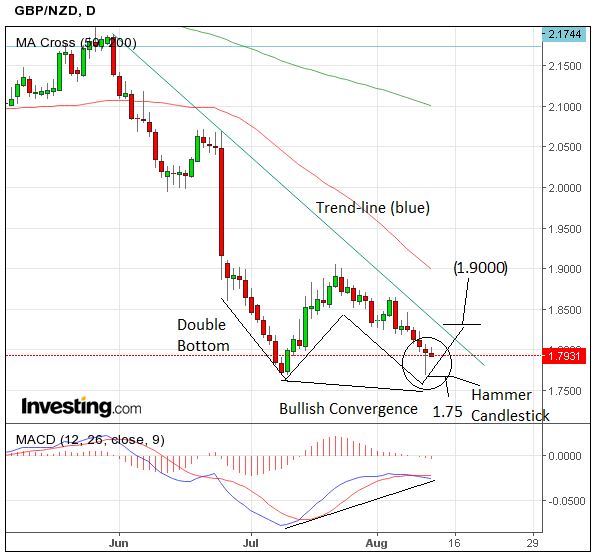
The fact this candlestick came after a five wave move down, which looks very much like an almost complete Elliot Wave was further evidence the trend could be ‘long in the tooth’.
The sharp convergence between the exchange rate and the MACD indicator which is not confirming the lower low, is also a sign of a bullish period in the near future.
The possibility (although its early days) that a double bottom chart formation may be developing on the pair, is further sign the down-trend may have its days numbered.
Basically although the down-trend remains intact there are signs popping up everywhere that it could be about to end so it needs monitoring carefully.
Nevertheless, as long as the down-trend remains intact there is a risk of more downside, with a break below the hammer lows of 1.7691 leading to a move down to 1.7500.
A bullish break above the blue trend-line, however, would provide confirmation of more upside and the beginnings of a possible reversal, with a move above 1.8450 probably signalling an extension to 1.9000.
New Zealand Data to Watch
It is Tuesday when the big data comes in for the Kiwi, with the publication of the latest prices gained at auction for dairy products, also known as Global Dairy Prices.
Dairy prices are closely monitored by the RBNZ as Whole Milk Powder (WMP) is the country’s largest single export; all eyes therefore will be on whether prices can rise with the same kind of strong momentum as they did at the previous auction two weeks ago, where they revealed a 6.6% rise in the index and 9.9% for whole milk powder alone.
If a country wants to increase its exports, then devaluing its currency is one way of doing that as it makes those exports relatively more affordable to foreign buyers.
Falling dairy prices and volumes have caused a lot of hardship amongst New Zealand dairy farmers and this was probably a factor in the RBNZ’s decision to lower interest rates, even though it did not have the desired effect of weakening the kiwi.
Unemployment data for the second quarter is out on Friday evening and is likely to show a fall from 5.7% to 5.2% in Q2.
Employment Change is forecast to show a 0.7% rise in the second quarter from 1.2% previously and a 2.5% yoy from 2.0% previously.
Finally, Friday sees the release of Credit Card Spending data in July.
A Big Data Week for Sterling
With the Bank of England pumping money into the economy, and devaluing Sterling in the process, analysts will be watching for evidence in the economy that would suggest even more easing will be announced before the end of 2016.
One of the key numbers to watch will be inflation.
With Sterling falling following the EU referendum the Bank has recently had to ramp up their inflation forecasts, owing to the rising cost of imports.
The Bank notes the 2% level they are tasked with targeting could be hit a lot sooner than originally envisaged.
A faster-than-forecast rise in inflation could well prompt the Bank to consider holding back on that stimulus, which in turn is a positive for the Pound.
Analysts are forecasting a 0.5% rise compared to July last year.
On a monthly basis inflation is expected to rise 0.2%.
On Wednesday the UK will release important employment and earnings data, however, due to it covering only June which is mostly before the EU vote its significance this time will be lessened.
Average Earnings is expected to rise a basis point to 2.4% from 2.3% previously. The Unemployment rate stands at 4.9% and 3month/3month change was 194k in May
Retail Sales data on Thursday rounds off the week.
This data will be important because it is also for July, and so will provide an idea for how well certain parts of the economy are bearing up.
Recent data from the British Retail Consortium (BRC) showed an unexpected 1.1% rise in retail sales in July when investors had been forecasting a Brexit-inspired contraction.
The higher than expected result was explained as a ‘life goes on’ shrug of the shoulders response from consumers and due to households not yet feeling a material impact from the referendum result. Especially hot weather which increased barbeque, charcoal, food and drink sales, as well as fashion sales was also a factor.
The 0.2% rise from -0.9% previously and steady 4.2% gain y-o-y forecast by analysts reflect BRC data’s increased optimism about July.