The NZ Dollar looks set to end the week on a high note after the Reserve Bank of New Zealand's interest rate cut prompted a bout of strength.

- Pound to New Zealand Dollar exchange rate = 1.7990, week's open = 1.8280
- New Zealand to US Dollar exchange rate = 0.7198, week's open = 0.7173
- GBP/NZD techs suggest 'exhaustion gap' - what does this mean for the outlook?
- More RBNZ cuts likely say analysts
The New Zealand Dollar strengthened versus the pound and the dollar on Thursday following the Reserve Bank of New Zealand's (RBNZ) decision to cut interest rates to 2%.
The rate cut was expected by markets, but what was not expected is just how strong the subsequent gians in the NZD would be.
Normally, currencies weaken after central banks reduce their base interest rates as lower rates tend to attract less inflows of foreign capital seeking higher not lower returns.
However, the kiwi actually gapped higher versus the Pound on Thursday after the announcement, as investors reflected that the move was too ‘tame’ and should have been a half a percent cut instead.
"Rightly or wrongly, financial markets were looking for the Reserve Bank Governor to deliver a relatively aggressive Monetary Policy Statement today. As far as the market was concerned, they didn’t get it. Consequently, the NZD headed forever higher and the markets started to question how low rates might go and how quickly," notes Stephen Toplis, an analyst with BNZ.
The declines take the GBP/NZD close to the 2016 lows registered following the hefty sell-off in the wake of the EU referendum result.
Notably, neither quantitative easing at the Bank of England, nor the RBNZ-inspired relief rally, could push GBP/NZD to, or below, these lows.
The move higher in the kiwi will come as a disappointment to the Reserve Bank whose primary purpose for cutting the rate was to weaken the currency.
In the accompanying monetary policy statement the RBNZ said the high exchange rate was stifling inflation by reducing the price of imports, and had to be lowered:
“Weak global conditions and low interest rates relative to New Zealand are placing upward pressure on the New Zealand dollar exchange rate. The trade-weighted exchange rate is significantly higher than assumed in the June Statement. The high exchange rate is adding further pressure to the export and import-competing sectors and, together with low global inflation, is causing negative inflation in the tradables sector. This makes it difficult for the Bank to meet its inflation objective. A decline in the exchange rate is needed.”
The end of the statement also pointed at more cuts in the pipeline, saying, “Monetary policy will continue to be accommodative. Our current projections and assumptions indicate that further policy easing will be required to ensure that future inflation settles near the middle of the target range.”
As mentioned, the 0.25% cut was already priced into the exchange rate and so the reaction of the kiwi was always going to be determined by whether the wording of the accompanying statement hinted at further cuts or not.
Given that the statement did hint at further cuts the kiwi’s response was all the more surprising.
Latest Pound / New Zealand Dollar Exchange Rates
  | Live: 2.3468▼ -0.47%12 Month Best:2.4815 |
*Your Bank's Retail Rate
| 2.267 - 2.2763 |
**Independent Specialist | 2.3139 - 2.3233 Find out why this is a better rate |
* Bank rates according to latest IMTI data.
** RationalFX dealing desk quotation.
Analysts have often pointed to the large disparity between the New Zealand rate at 2.0% and the UK rate of 0.25% as reason enough to expect further appreciation in the kiwi, and the counter-intuitive reaction of the currency on Thursday is a visible sign of this effect in play.
"The reaction of the currency was similar to the August RBA meeting, where an RBA rate cut saw the AUD rise," says a note from ANZ Research following the event. "In the current environment where carry is king, central banks with high yielding currencies need to over-deliver on market expectations to get any reaction from their currency."
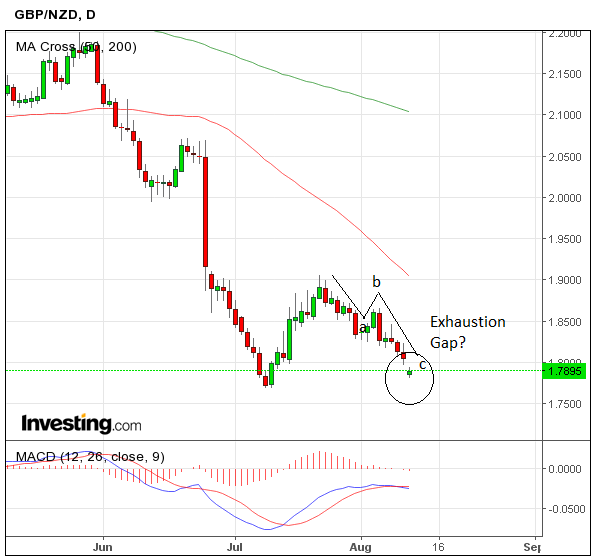
From a technical point of view the gap down could be an exhaustion gap, coming as it does after a three-wave move down from the July 21 highs.
It is worth monitoring carefully as it could mark a reversal from down to up in the rate.
Much may depend on activity on Friday, which if bullish for the pair will likely signal the gap was an exhaustion type and strengthen the call for a reversal in the short-term trend at least.
More Cuts Coming say Analysts
So with the RBNZ having seamingly having to cut deeper to achieve a desired weakening in the NZD, how many more attempts will be made?
"Given the dovish guidance from this meeting, we now expect another two 25bp rate cuts, which would take the OCR to 1.50%. We expect the next cut to be in November 2016, followed by another in Q2 2017," say Barclays.
Nomura's Charls St-Arnaud agrees:
"Overall, today’s decision suggests that another rate cut is very likely. However, given the central bank's concerns regarding the housing market and its impact on financial stability risks, it seems that the next rate cut is not imminent."
We get the sense though that the RBNZ can cut until it is blue in the face and not achieve a weaker NZD.
Only when the economy takes a real dip would we expect the multi-year NZD appreaciation to end.