Despite an impressive bout of strength witnessed on the 2nd August, Pound Sterling remains locked in a descending channel against the NZ Dollar which should ultimately extend over coming days.

The British Pound has risen against the New Zealand Dollar every day in August.
The strength comes as FX traders are seen to be intent on exiting their long-held negative bets against the UK currency ahead of the all-important Bank of England event due on Thursday the 4th of August.
With markets uncertain as to just how agressive the Bank will be, they smell risk.
Therefore, cutting exposure to GBP is the best option available to them. However, closing out of negative GBP bets necessarily requires the buying of GBP to cover the trade. Hence, the bid in GBP.
However, it is worth pointing out that this strength is therefore technical in nature, and ultimately the fundamentally driven GBP/NZD downtrend will likely restart.
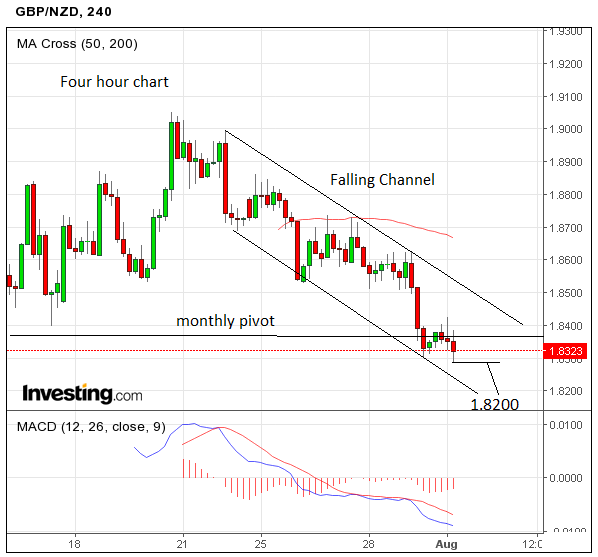
At the time of writing the Pound to New Zealand Dollar exchange rate is trading at 1.8493 with charts showing a down-trending channel on the four-hour time-frame, which is likely to extend lower over coming days.
The pair was capped by the monthly pivot at 1.8360, but the recent break above here does diminish some of the downside pressure.
Nevertheless, we would expect a move below the 1.8290 lows to ultimately transpire as the pair remains well within the downward sliping channel, and this would probably lead to a continuation down to the next target at 1.8200.
As mentioned, the week ahead will be dominated by Thursday’s Bank of England (BoE) Monetary Policy Committee Meeting decision and the release of the Quarterly Inflation Report.
Four times a year the Bank of England releases its Quarterly Report, where inflation and growth forecasts are updated. This report is also often used to telegraph or explain major changes in monetary policy.
"The Bank of England will provide its assessment of what life looks like after Brexit and given Carney's grim outlook, we think the forecasts will be grim," warns Kathy Lien, an analyst with BK Asset Management.
Money markets expect the BoE to cut interest rates by at least 0.25% with the OIS market pricing a near-100% probability.
Most anlysts expect the Bank’s quantitative easing (QE) programme to be expanded - this is the process by which the central bank provides liquidity to banks in the real economy by buying government bonds from them.
Stimulus measures generally weaken a currency as they increase the supply of money in the economy, and therefore dilute the value of each individual unit.
Thus we could be in for another bout of notale Sterling weakness this week.
Broker TD Securities sees a 0.25% interest rate cut (from 0.50% currently to 0.25%) as already absorbed into the value of the pound, but that a deeper cut or increase in QE will lead to a devaluation in sterling.
Latest Pound / New Zealand Dollar Exchange Rates
  | Live: 2.3474▲ + 0.03%12 Month Best:2.4815 |
*Your Bank's Retail Rate
| 2.2676 - 2.277 |
**Independent Specialist | 2.3145 - 2.3239 Find out why this is a better rate |
* Bank rates according to latest IMTI data.
** RationalFX dealing desk quotation.
The OIS markets are pricing in a rate cut with 100% certainty; however if the BoE should fail to announce any stimulus at all, Sterling will almost certainly rise from the surprise factor.
Indeed, even a 0.25% rate cut on its own could deliver some GBP gains on the basis that the markets are positioned for agressive easing.
Usually upbeat Capital Economics forecast an increase of 75bn in QE, which is higher than most analyst’s expectations of 50bn and a 0.25% cut in interest rates (down to 0.25%).
Interestingly, Nordea Bank’s Johnny Bo Jakobsen has said in a recent note that he also sees a strong possibility the quarterly inflation report released on the same day as the BOE rate meeting will show a rise in inflation in line with the bank’s 2.0% long-term target, however, that the BOE will “look through” this and “focus instead on stabilising output.”
Jakobsen expects the bank to cut interest rates by 0.25%, increase QE by 100bn and enhance the Funding for Lending scheme to help house buyers.
However, for forecasters, the bottom line amidst all these opinions about what the BoE may or may not do, is that the risks for the Pound remained skewed to the downside in the week ahead.
New Zealand Dollar Could See Carry Demand Taper Off
In its pairing versus the New Zealand dollar (kiwi), this is doubly true as the kiwi has very little market moving data in the week ahead except employment data on Tuesday.
The kiwi also gains continuous support due to demand for the carry trade which describes the preference of international investors for placing their capital in counties with relatively high interest rates such as New Zealand, which boasts a 2.25% return compared to the UK’s 0.50%.
This has been especially marked in the weeks following Brexit as many instruments considered ‘safe’ – such as German bunds, Japanese JGB’s and US Treasuries saw their yields fall below zero, which led investors to diversify into new higher yield securities such as Canadian and New Zealand bonds.
J P Morgan’s chief of research John Normand, however, says that this period of increased demand for commodity currency’s due to ‘carry’ is falling, and forecasts a period of weakness for commodity currencies, although AUD and CAD will be the primary victims as the weakening will also be as a result of lower oil and industrial metal prices.
“The outlook for the complex is sector and horizon-specific (negative on oil this summer then positive in Q4; positive on gold currently and into 2017; negative on base metals and iron ore into 2017), and so are the views on commodity currencies (positive on RUB; neutral on CAD and NOK; negative on AUD, NZD and MXN).”
Normand specifically singles out for discussion the high interest carry trade currencies NZD and AUD:
“After a Q2 that delivered the strongest returns on higher-yield assets since the post-Lehman rebound, the carry trade has been losing momentum.”
Could this dynamic soften the upside pressures being exerted on NZD going forward?
The NZ Dollar is Going Higher, Regardless
While global yield-hunting dynamics can take some blame for the stronger NZD, it must be noted that the reasons for NZD strength are broader than yield or global forces alone.
Domestic currency strength is strongly connected to the growth side of the equation argue ANZ.
"Solid pointers on the economic front are simply not providing ‘sell’ signals for the NZD," says a research note from the New Zealand bank, released at the start of the week beginning August 1st.
Last week’s combo of business confidence, credit growth, building consents and exports outside of dairying were all respectable.
And “respectable” is now “great” in an era of tepid, disappointing growth around the globe.
Therefore - in this environment expecting RBNZ rate cuts to lower the value of the NZD appear futile.
The NZ economy must start slowing down before the mighty kiwi rally starts to fade.
Tuesday August 2 is a key day for New Zealand data as it sees the release Global Dairy Trade prices, which show the average price dairy products achieve at auction, and the dairy sector is New Zealand’s largest export sector. If prices rise then it will support the kiwi.
As far as employment data is concerned, the unemployment rate was 5.7% in Q1, which was quite a sharp increase from the 5.3% in Q4 and if the rate keeps rising it will probably weaken the kiwi, as it will see rate cut expectations rise.