
The pound to New Zealand dollar exchange rate trades with a firm bias as broad-based bounce in the GBP exchange rate complex extends.
Don't get me wrong - this recovery is a pittance of the declines witnessed over the week gone by and in my opinion, we are merely witnessing a stabilisation.
GBP/NZD is quoted at 1.8973 at the time of writing, above the 1.8628 seen on Monday 27th but far below the pre-referendum 2.0746.
Those watching the payments market would see bank transfers offered between 1.8448 - 1.8315 and payment specialists offering rates between 1.8808 - 1.8675.
The strong print of New Zealand’s business confidence gauge in June failed to provide support to the local currency with the Kiwi losing almost 0.40% against the USD in overnight trading.
Separately, building permits contracted 0.9%m/m in May.
Nevertheless, currnet conditions continue to work in NZD's favour.
A measure of volatility on the world's headline S&P 500 index has fallen below the 20 marker - a reading above 20 suggests fear is running through the global investor community.
The soothing in sentiment has corresponded with a pick up in global stocks and commodities and a higher New Zealand dollar which has historically benefited from such conditions.
However, the British pound is also seen recovering in these conditions, ensuring the sharp drop in GBP/NZD gives way to more stable conditions.
The GBP/NZD Outlook: Conflicting Signals
There is a possible bullish set-up favouring GBP strength on the charts, contrasting with the much more favourable NZD fundamental outlook.
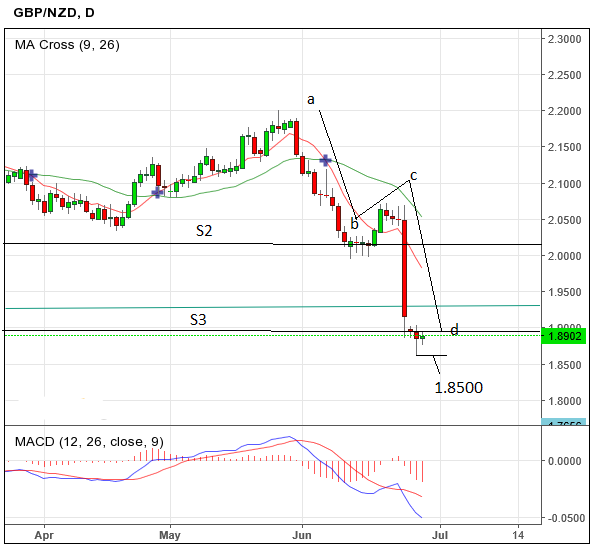
The GBP/NZD pair looks like it has completed a zig-zag, measured move or ABCD pattern lower, from the May 2.20 highs.
The final leg to the current lows (C-D) is now slightly longer than the first leg (A-B) suggesting the pattern is complete, however, there is as yet no indication from price action that the exchange rate is about to rotate higher.
Therefore, whilst the technical picture suggests the potential for a reversal on the horizon actual price action has not changed sufficiently to confirm that.
As such, the bearish down-trend remains intact, and favours more downside, with a break below the June 27 (hammer candlestick) lows confirming more downside, to an initial target at 1.8500, although given the bullish patterning, the recommendation is not high conviction.
New Zealand likely to escape Brexit shock waves
The longer-term picture is one that favours the New Zealand dollar which appears to be performing well in both risk-off and risk-on conditions.
Indeed, we noted here that the currency is gaining a reputation for being a safe-haven in times of turmoil.
This creates a currency that wins when times are both tough and easy.
ANZ Research have meanwhile written to their clients noting that the New Zealand dollar will likely escape the negative ripple effects of Brexit:
“We are not expecting the current bout of uncertainty over Brexit to materially impact negatively on the NZD.”
Further, analysts believe the country’s higher-than-average interest rates promise investors a relatively decent rate of return if they park their money there, compared to the comparatively low rates of most other country’s which will see their rates fall:
“NZ yields will remain alluring as the world pushes deeper into negative territory. This means a higher bias despite unsupportive valuation metrics.”
As long as emerging markets remain buoyant ANZ see the New Zealand economy and the kiwi as untouchable:
“We’ll change our view if we start to see pressures manifest in emerging markets on the back of a material reassessment of global and EM growth prospects, an increase in EM capital outflows, or pressure on EM currencies. This is a key risk over the coming months.”
Latest Pound / New Zealand Dollar Exchange Rates
  | Live: 2.3468▼ -0.47%12 Month Best:2.4815 |
*Your Bank's Retail Rate
| 2.267 - 2.2763 |
**Independent Specialist | 2.3139 - 2.3233 Find out why this is a better rate |
* Bank rates according to latest IMTI data.
** RationalFX dealing desk quotation.
Interest rate difference might play to Kiwi’s advantage
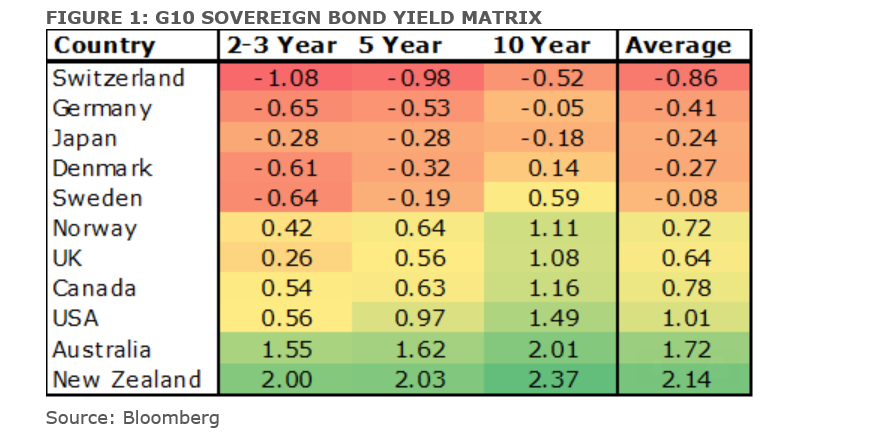
With every chance that the Bank of England (BOE) could make an interest rate cut (from 0.50% to 0.25%) by the end of the year and interest rates in New Zealand still the highest in the G10 at 1.75%, there is every chance this will result in more downside being placed on the GBP/NZD exchange rate.
This is due to the fact that New Zealand will attract more foreign capital since it offers relatively high interest rates - or yields for investors in the bond market. (Yields are the return invetsors get from investing their money in bonds).
“While rising uncertainty typically spells lower for the NZD, the allure of New Zealand’s yield will only be enhanced the more global policymakers test negative yields. German 10-year bunds yields – a key benchmark across Europe – are negative again. Despite increased risk aversion and stronger headwinds for global growth, one outcome could be a higher NZD – and that won’t be welcome.”
Reserve Bank of New Zealand not likely to cut interest rates soon
Further ANZ see a string or rate cuts in New Zealand as highly unlikely, given the country is so far from the Brexit epicentre and has under 3.0% exposure directly to the UK. This also obviously contrasts with the increased possibility that the UK will have to cut interest rates or use QE in the ‘rubble’ left by Brexit.
The very strong Auckland housing markets which is currently going through a boom, with some arguing prices are overstretched, puts a further brake on any decisions by the central bank to cut new Zealand growth:
“We believe the domestic growth impact (of Brexit) will be minor, although it is certainly a moving feast. Nevertheless, it does of course increase the odds of an August OCR cut, at a time when we were wavering on whether a further cut was even required.”
The main concern for New Zealand would be from Brexit contaminating the whole of the euro-zone and leading to a sharp down-turn in the region, as this would more fundamentally impact on the New Zealand economy.