The GBP is mixed on Friday with the bouyant trading that took us into the EU summit fading against the likes of the euro and US dollar.

The pound is sold aggressively against the euro and dollar but remains constructive against the commodity dollars in Friday trade as the Brexit summit extended to a second day.
"Even the solid retail sales data couldn’t give the pound a smile this morning," says Ipek Ozkardeskaya at London Capital Group, "the political risks are hard to price in at the moment, yet there is clearly little appetite in building fresh long and/or short positions before more clarity on the issue."
After a late night, talks resumed at 9 CET and there were clearly issues to be ironed out. That said, the morning session was always going to be the session in which issues concerning the UK's wish-list were to be ironed out.
Initital exchange rate action surrounding the summit was positive for the GBP with strong gains being seen on Thursday.
However, on Friday we get confirmation that these gains may have been merely short-covering in an agressively oversold market.
There is the outside risk of a better deal being announced, e.g. limitations on benefits for 13 rather than 4 years. Of course a better deal would be pro-sterling as it would allow the UK Prime Minister to set the referendum at his preferred time of mid-June.
There is the feeling amongst analysts though that any bounces in sterling will likely be short-lived.
"Any dips in EUR/GBP to the 0.7650/7700 area tentatively look a buy ahead of a difficult 4 months of campaigning," says Chris Turner at ING in London.
Latest Pound/Euro Exchange Rates
  | Live: 1.1943▼ -0.04%12 Month Best:1.195 |
*Your Bank's Retail Rate
| 1.1537 - 1.1585 |
**Independent Specialist | 1.1776 - 1.1824 Find out why this is a better rate |
* Bank rates according to latest IMTI data.
** RationalFX dealing desk quotation.
On the flip side, if there is no suitable deal, the impact on the pound is more obvious.
"If an agreement is not approved by all 28 EU Member States at this summit, sterling would correct sharply against both the dollar and the euro," says Asmara Jamaleh at Intesa Sanpaolo in Milan.
The pound to dollar exchange rate trades at 1.4319 on the open markets having recorded a close at 1.4331 overnight.
The pound to euro exchange rate trades at 1.2864 having closed at 1.2912 on Thursday. The pair is holding above the crunch 1.28 support zone - an area that appears a hard not to crack and could therefore be seen as an area from which the pair will bounce on any positive news flow from the summit.
That said, as we have warned here, any break below this point could potentially open the door to 1.25 and then the 1.20 target held at HSBC in their latest set of forecasts.
But, for now support holds at 1.28 in GBP/EUR and 1.46 against the US dollar.
"If an agreement is reached, Cameron will immediately announce the date of the referendum, which in this case would be held in June (probably on 23 June). This outcome would allow sterling a breather, although it would stay under pressure during the referendum campaign," says Jamaleh.
Better Days Ahead for the Pound?
There remains the chance that sterling ends the week higher against the majors.
According to foreign exchange market positioning, although bearish GBP positions have not increased further, the GBP remains the largest short.
"This leaves the GBP susceptible to a rally on positive news, especially related to the UK’s referendum on EU membership," says James Hellawell at BNP Paribas.
Suggesting sterling faces better days ahead is Joel Kruger at LMAX Exchange who suggests the GBP is heavily oversold:
"The Pound has been hit with a confluence of negative drivers over the past couple of months, some of which include oil weakness, Brexit fear and Fed policy normalization.
"But with much of this downside priced in and these negative drivers now showing signs of diffusion, the currency could finally be in a position to benefit in the days ahead. Technically, while the Cable market holds above 1.4200, scope exists for a more significant correction into the 1.4600-1.4800 area."
Pound Suffers on Market Sell-Off
There is also the issue of another bout of stock market declines.
The pound does not like it when global equities sell-off, which is presently the case. To see the winners and losers of such a scenario observe how various currencies have reacted to the latest selling pressures:
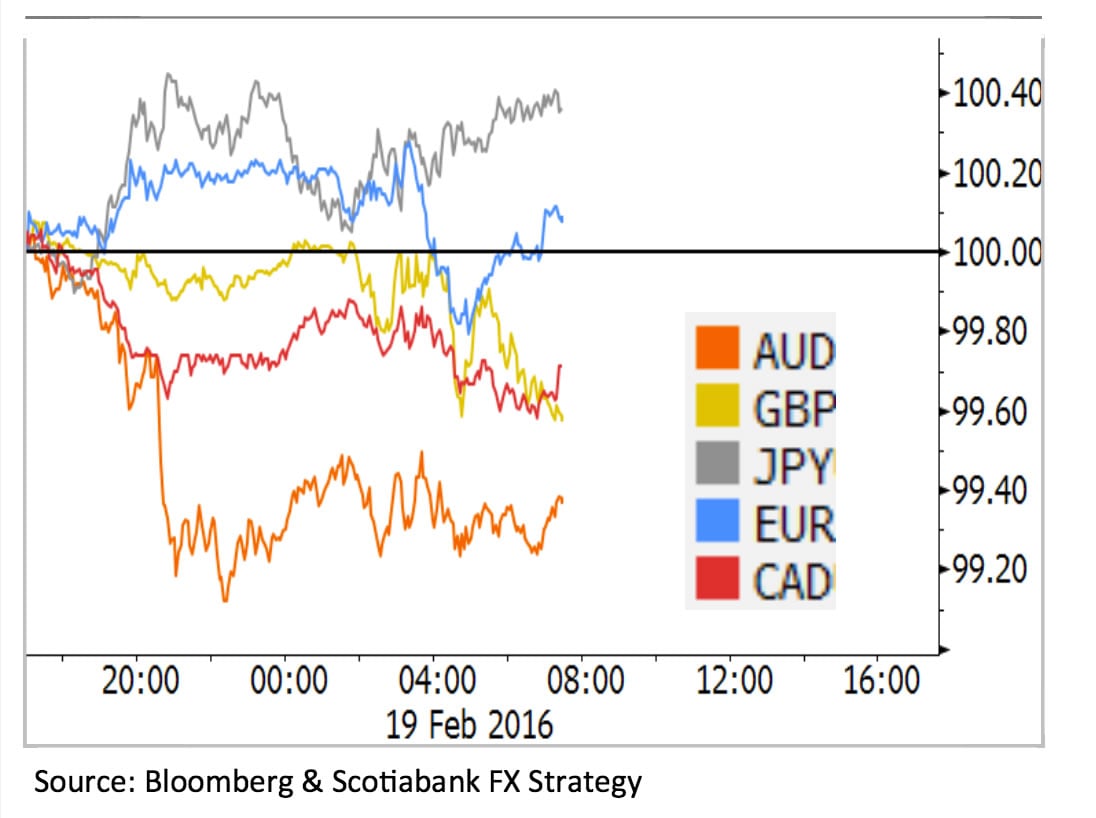
While the uncertainty presented by discussions in Brussels is a concern to markets we reckon the biggest driver of Friday's market losses lies with the inability of oil to catch a bid.
"Oil remains close to $30 as traders have been unconvinced by developments from the major oil-producing nations. An agreement that didn’t include Iran in the first place, and peppered with caveats and loopholes, has prevented spot prices from falling but done nothing to address the longer term issue of oversupply," says Alastair McCaig at IG.
Considering the high levels of global oil inventories too, it would take weeks before any agreement would start to take effect.
Brexit + the Pound: FDI is the Big Issue
The big downside risk to the British pound of an exit rests largely with the impact the move would have on Foreign Direct Investment - i.e will it impact that money flowing into the country which keeps sterling propped up in the face of the UK’s structural trade deficit.
So far there are indications that Brexit has not impacted confidence in the UK as a FDI destination. The worry is that this could change.
“The main fear here seems to be that, if the United Kingdom voted to leave, foreign direct investment inflows would dry up and parent companies may even close-up shop and move production or offices elsewhere,” says a report on the matter released by Woodford Funds.
These FDI Fears are Overblown: Woodford
Nevertheless Woodford Investment Management think that these concerns surrounding FDI flows are overblown.
“They are predicated on the assumption that, on leaving the European Union, Britain would be hit with a swathe of harsh tariffs which would make it costly to export to member countries. But, as we have already determined, tariffs on exports to the European Union remain generally low for non-member countries,” says the report.
Moreover, Woodford argue these fears don’t take into account the fact that firms choose to invest in Britain for a myriad of reasons, not just for its access to the single market, and that they do not just invest in projects for the production of physical goods.
Nevertheless, a recent poll of 700 UK based business by the Bertelsmann Foundation found that 80% of companies are pro-staying in the Union with a further 30% saying a Brexit would see a reduction of jobs.
The economics of supporting a Brexit should these job losses be realised are simply unjustifiable.
Of course these predictions of job cuts are made without knowing what the situation on the ground will be following an out vote and we will continue to hear noise from the business community ahead of the vote.
We will update this article on developments.