The GBP to EUR conversion is defending support at 1.3000 as UK employment figures stem the pound's haemorrhaging.

The pound fought back in mid-week trade after a welter of key employment data showed the Unemployment Rate unexpectedly falling to 5.1% from 5.2% previously, a fall in the number of Jobless Claimants and a less-than-expected decline in the growth rate of wages (Ex Bonus).
Not all the data was rosy, however, as the rise in Wages Including Bonuses, which is the gauge most commonly quoted, declined a basis point to 2.0%, as some analysts had feared, and whilst Ex Bonuses did not fall as much as expected it was still lower than the previous 2.0% level.
Given Assistant Governor of the BOE, Minouche Shafik's comments last month that she wanted to see more sustainable growth in take-home pay before putting her hand up for an increase in interest rates, the impact of today's data may be transitory, and the trend lower in GBP/EUR could soon resume.
Carney Punishes Pound
Hopes for a 2016 interest rate rise were held up by Bank of England Governor Mark Carney after he gave a speech on Tuesday, in London, in which he listed a number of reasons as to why markets should not expect an imminent rise.
The pound desperately needed some bullish talk from Carney to relight expectations for a 2016 interest rate rise.
Higher interest rartes are desperately needed to shore up demand for GBP.
Throw into the mix expectations for a mid-year EU referendum, the uncertainty of which is proving to be like a millstone around the neck of sterling sentiment, and we can understand why markets are shedding exposure to the British pound and leading analysts are slashing their forecasts.
Latest Pound/Euro Exchange Rates
  | Live: 1.1661▲ + 0.01%12 Month Best:1.1828 |
*Your Bank's Retail Rate
| 1.1265 - 1.1311 |
**Independent Specialist | 1.1498 - 1.1544 Find out why this is a better rate |
* Bank rates according to latest IMTI data.
** RationalFX dealing desk quotation.
Chart View
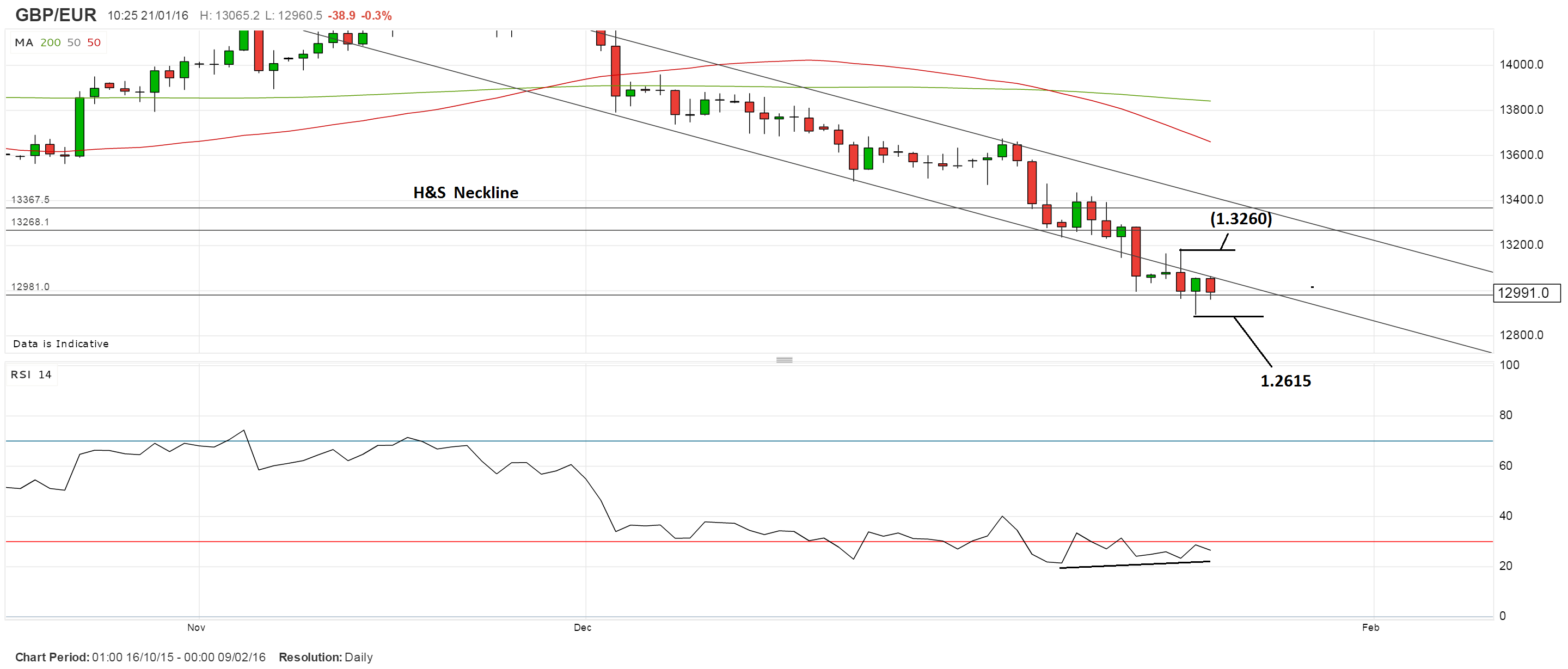
From a technical perspective GBP/EUR is in a strong down-trend, but the 1.3000 level appears to now be offering tentative support.
It has broken below the lower border of a descending channel, but it could yet bounce back further.
There is a possibility this could represent an exhaustion move and the pair could form a temporary bottom.
A bullish hammer candlestick has formed after the break-out lower.
RSI has formed what might be a possible double-bottom, which also converges bullishly with price, and could point to further gains.
If so then we could see a more sustained short-term recovery back up, with a break above 1.3200 potentially leading to a move up to resistance at 1.3260.
Longer-Term Still Bearish
The longer-term technical outlook remains beairsh, however, and its too early to dismiss the dominant down-trend.
The pair has broken below a large head-and-shoulders reversal pattern clearly visible on the weekly chart at 1.3300.
The initial target for the H&S was at the 1.3000 level.
If the pair breaks clearly below the hammer lows at 1.2893 it will probably move all the way down to the next target at support at 1.2615 – which is the level of the 200-week MA.
Inflation Data Provides Brief Glimmer of Hope
The Bank of England will likely only act on interest rates once they believe inflationary pressures are headed towards their goal line of 2.0%.
It was reported earlier that inflation rose by 0.1% in December, which was above the 0.0% consensus expectation and 0.0% in the previous month. Sterling rose.
On a year-on-year basis, it came out at 0.2% in line with forecasts, core Inflation rose by 1.4% - beating forecasts of 1.2%.
Sterling’s recvored against the euro climbing to 1.3188 highs following the release of the data.
Although the inflation data was viewed positively by market commentators, such as Daniel Vernazza, the Chief U.K Economist at UniCredit, he saw no reason to revise his November BOE rate hike expectations, because he saw the rise in Core Inflation as probably temporary since it was due entirely to a rise in transport inflation:
“The ONS said the rise in inflation came entirely from transport prices, principally air fares (pushing up core inflation) and to a lesser extent motor fuels as the large fall in oil prices at the end of last year largely neutralized the positive base effect from the big oil price fall at the end of 2014.
“We would caution that air fares are volatile and, hence, the rise in core inflation could prove temporary.”
Vernazza pointed out that low oil prices continue to weigh on ‘pipeline’ inflation:
“Indeed, pipeline inflationary pressure remains subdued, largely because of the further fall in oil prices and other global commodity prices.
“Therefore, today’s inflation release is unlikely to change the wait-and-see position of most MPC members and we continue to expect the first BoE hike in November this year.”
This is Why the Euro is in Demand
The euro was little changed after its own data showed inflation meeting expectations in December.
However, market experts are split over the outlook for the currency, with those who are embracing the eurozone green shoots theme expecting a rise, and those who believe the ECB will end up having to use their bazooka again to realign inflation with expectations.
Representing the former camp, is Alex Lydall, Senior Sales Trader at Foenix partners, who said, in response to today’s eurozone inflation data that:
“Mario Draghi saw a solid start to 2016 as eurozone inflation posted an annualised figure of 0.2%, as forecast by analysts and likely to be viewed in a positive light exemplifying the effect of recent policy measures to stabilise the bloc state.”
Lydall pointed out that the data was all the more significant because it was from the month in which the ECB increased its easing measures, which would not have had time to trickle through and influence the data yet.
“The cuts in deposit rate and extension of Quantitative Easing last month was largely a reaction to inflationary pressures, with hope that monetary policy changes will lead to a gradual uplift through 2016.
"As long as a reduction in inflation numbers doesn’t occur inearly 2016, ECB officials will feel significant comfort that levels are on the relevant trajectory.”
Lydall also highlighted the euro’s new ‘role’ as a safe-haven could see it swimming with the current higher over following months assuming jitters over the global and Chinese economy persist:
“With risk aversion rife in the market, the euro itself is holding up specifically well with many citing the single currency as taking on ‘safe haven’ status, more traditionally seen in the greenback and Japanese Yen.”
Those who expect the ECB to use more QE during 2016, (a move which would weigh on the euro), include SEB Bank.
In a recent note, analysts at SEB said they expected Drgahi to underline the fact that the ECB’s accommodative approach is working at the next meeting, and that therefore it should be increased.
“At next week’s meeting we expect no additional action, but instead believe Mario Draghi will highlight that the ECB’s expansionary policy and that more will and can be done if necessary.”
The SEB note further suggested a relatively high probability of a rate cut at the ECB March meeting:
“At present market prices imply an almost 40% probability of a 10 bps rate reduction by Q3 2016.”
SEB highlights continued low medium term inflation expectations as the main reason for their view:
“The triggers for additional policy measures are to be found primarily in continued falling medium term inflation expectations and downward revisions to inflation forecast by the ECB.”